
Whether to single-source or multi-source a promotional product should be decided by two factors: how critical the item is to the program, and how long it would take to recover if the primary vendor failed to deliver. Low-criticality items with fast recovery options are generally safe to single-source for the cost and administrative efficiency it provides. High-criticality items with slow recovery options warrant multi-sourcing, or at minimum an actively qualified backup vendor.
This guide is written for procurement managers sourcing branded merchandise for mid-market and enterprise programs in US and UK markets, deciding a sourcing strategy for a specific product or program rather than an entire vendor roster. It assumes the buyer can reasonably estimate both criticality and recovery time for the product in question.
Single source vs. multi source promotional products is rarely a single company-wide policy decision — it is a product-by-product and program-by-program call. Treating every item the same way either overspends on redundancy for low-stakes giveaways or leaves a launch-critical program dangerously exposed to one vendor’s failure. The sections below provide a decision table comparing both strategies, the criticality-by-recovery-time model itself, a repeatable framework for applying it, and an illustrative example of two programs classified differently.
Figures, timeframes, and program examples used in this article are illustrative only. Estimate actual recovery times and criticality ratings directly against your own products, vendors, and program requirements.
Why Product Criticality Should Drive the Sourcing Strategy
Procurement teams often default to whichever sourcing strategy is administratively easiest, rather than one matched to the actual risk of each product. A single vendor is simpler to manage for every program, until the one program where a delay would be genuinely costly is the one running through that same, unbacked-up vendor.
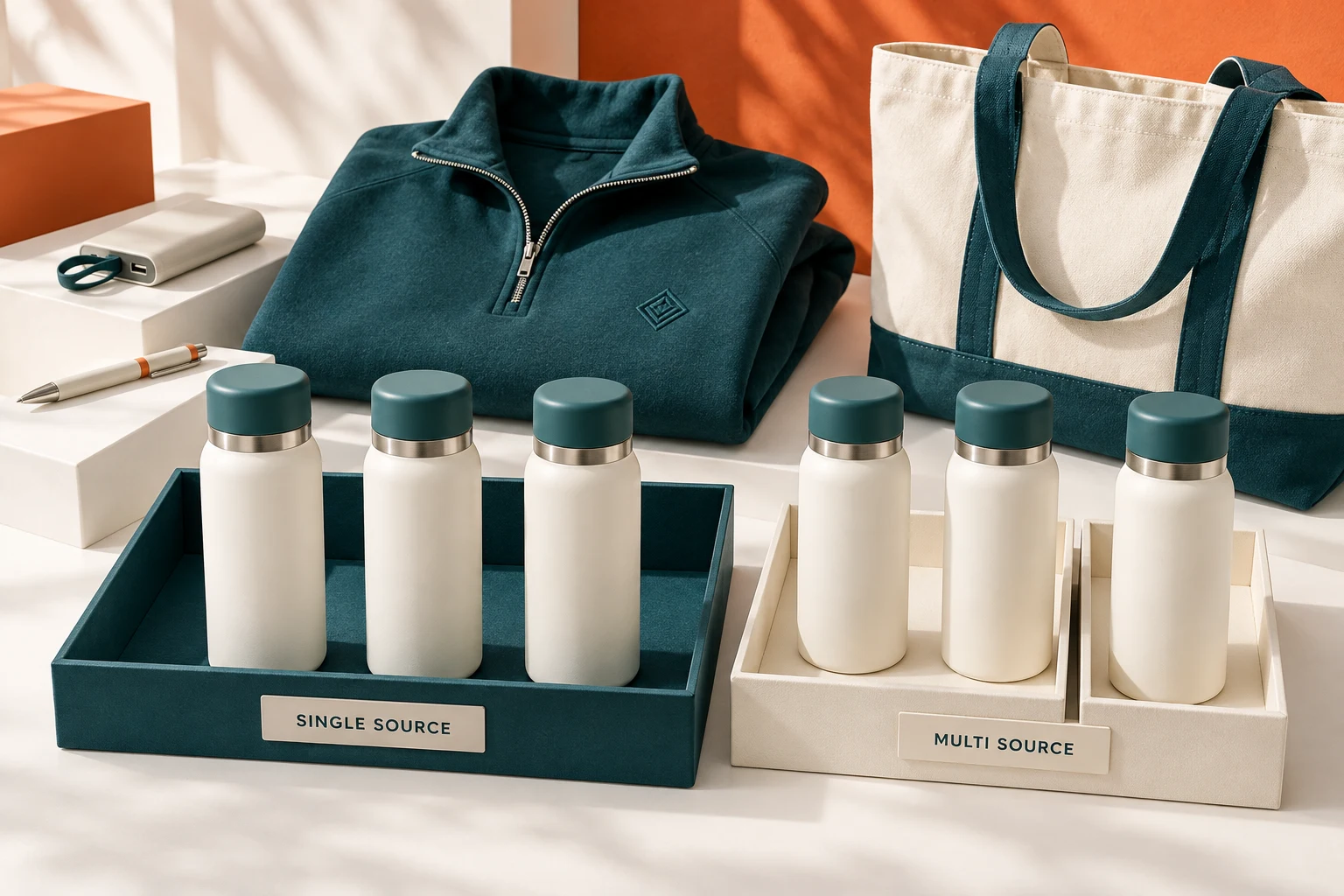
A risk-based approach to single source vs. multi source promotional products starts from the product’s criticality and its recovery time, not from a blanket preference for simplicity or redundancy. That distinction is what lets a low-stakes item stay efficiently single-sourced while a launch-critical item gets the backup coverage it actually needs.
Decision Table: Single-Sourcing vs. Multi-Sourcing
Compare both strategies against the criteria below using evidence you can verify, rather than a general preference for one approach.
| Criterion | Single-sourcing | Multi-sourcing | What to verify |
| Cost leverage | Strongest volume-based pricing on fully committed spend | Split spend limits leverage with any one vendor | Confirm actual volume pricing tiers in writing |
| Quality consistency | Easier to hold one standard and one golden sample | Requires aligning standards and samples across multiple vendors | Confirm how the approved reference is shared with each vendor |
| Lead time resilience | No redundancy if the vendor is delayed | A second vendor can absorb volume during a delay | Confirm each vendor’s demonstrated, not just stated, capacity |
| Administrative overhead | Lower — one relationship to manage | Higher — multiple contracts and relationships | Estimate internal hours currently spent per vendor relationship |
| MOQ efficiency | Combined volume clears MOQ thresholds more easily | Split volume may fall below favorable MOQ tiers with either vendor | Confirm MOQ tiers and where your split volume actually lands |
| Recovery speed if a vendor fails | Slower — no qualified backup already in place | Faster — a second qualified vendor can step in | Confirm whether the alternate vendor has already approved a golden sample |
| Risk concentration | Higher — one disruption affects the entire program | Lower — a disruption is contained to a portion of volume | Confirm what share of program volume sits with each vendor |
The Risk-Based Decision Model: Criticality × Recovery Time
The core of this framework is a simple model built on two factors: how critical the product is to the program, and how long recovery would take if the primary vendor failed to deliver. Plotting a product against both factors points to a recommended strategy.
| Product criticality | Recovery time if the vendor fails | Recommended strategy | Why |
| Low — replaceable, limited brand visibility | Fast — a comparable item can be resourced quickly | Single-source is generally acceptable | The cost of being wrong is low; efficiency gains outweigh the limited risk |
| Low — replaceable, limited brand visibility | Slow — specialized decoration or material, few alternate vendors | Single-source, with active monitoring | Low criticality limits impact, but slow recovery still warrants a documented contingency plan |
| High — core to the brand experience, launch-critical, or regulated | Fast — comparable, pre-qualified vendors readily available | Single-source with a pre-qualified backup vendor identified | High criticality justifies keeping a fallback ready, even if recovery would be fast |
| High — core to the brand experience, launch-critical, or regulated | Slow — specialized capability, long onboarding, few alternate vendors | Multi-source, or maintain an actively qualified second vendor | High impact combined with slow recovery creates the highest exposure; redundancy is warranted |
Buyer Framework: How to Apply the Decision Model
The steps below turn the model into a repeatable process, with a clear decision owner — typically the category procurement manager, working with the brand or program stakeholder to rate criticality.
- List each product or program you are sourcing and rate its criticality as low or high, based on brand visibility, launch importance, or regulatory sensitivity.
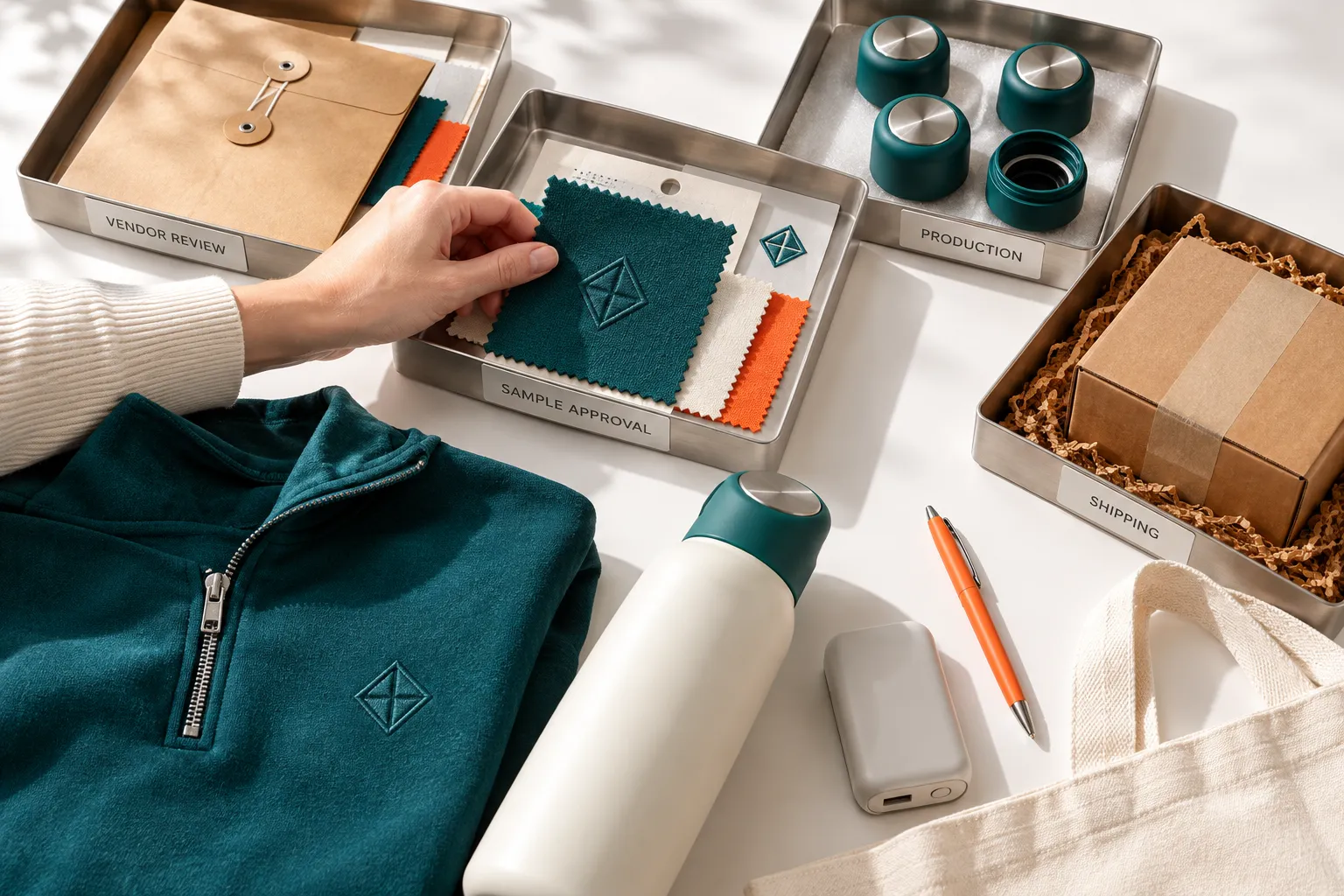
- Estimate recovery time for each product using the recovery time checklist below, summing vendor identification, sample approval, production, and shipping time.
- Plot each product on the criticality-by-recovery-time matrix to get a recommended strategy.
- For any product landing in the high-criticality, slow-recovery quadrant, qualify a second vendor before finalizing a single-source decision, not after a disruption occurs.
- Document the sourcing strategy and the reasoning behind it for each product, so the decision can be revisited if criticality or recovery time changes.
- Review the matrix placement at least annually, or whenever a product becomes more central to a program or a vendor’s capacity changes.
Our team can help estimate realistic recovery times and evaluate backup vendor options — see promotional product sourcing for how we support procurement teams applying this model.
Recovery Time Checklist: What to Estimate
Recovery time is the sum of several components, not a single guess. Use the checklist below to build a realistic estimate for each product.
| Recovery time component | What to estimate | Typical driver |
| Time to identify and vet an alternate vendor | How long it would take to find and evaluate a qualified backup | Category specialization and market availability |
| Time to approve a new golden sample | How long proofing and sample approval would take with a new vendor | Product complexity and decoration method |
| Time to reach committed volume | How long the new vendor would need to schedule and produce your required quantity | The vendor’s current capacity and production queue |
| Time to ship and clear customs | How long delivery would take from the new vendor’s location to your destination market | Shipping method and destination market |
| Total estimated recovery time | Sum of the components above | Used to classify the product on the decision model matrix |
Evidence From the Field: Illustrative Model Application
The example below is an illustrative application of the decision model created to show how two different programs land in different quadrants. Replace the sample details with your own verified assessment before presenting this as a real case.
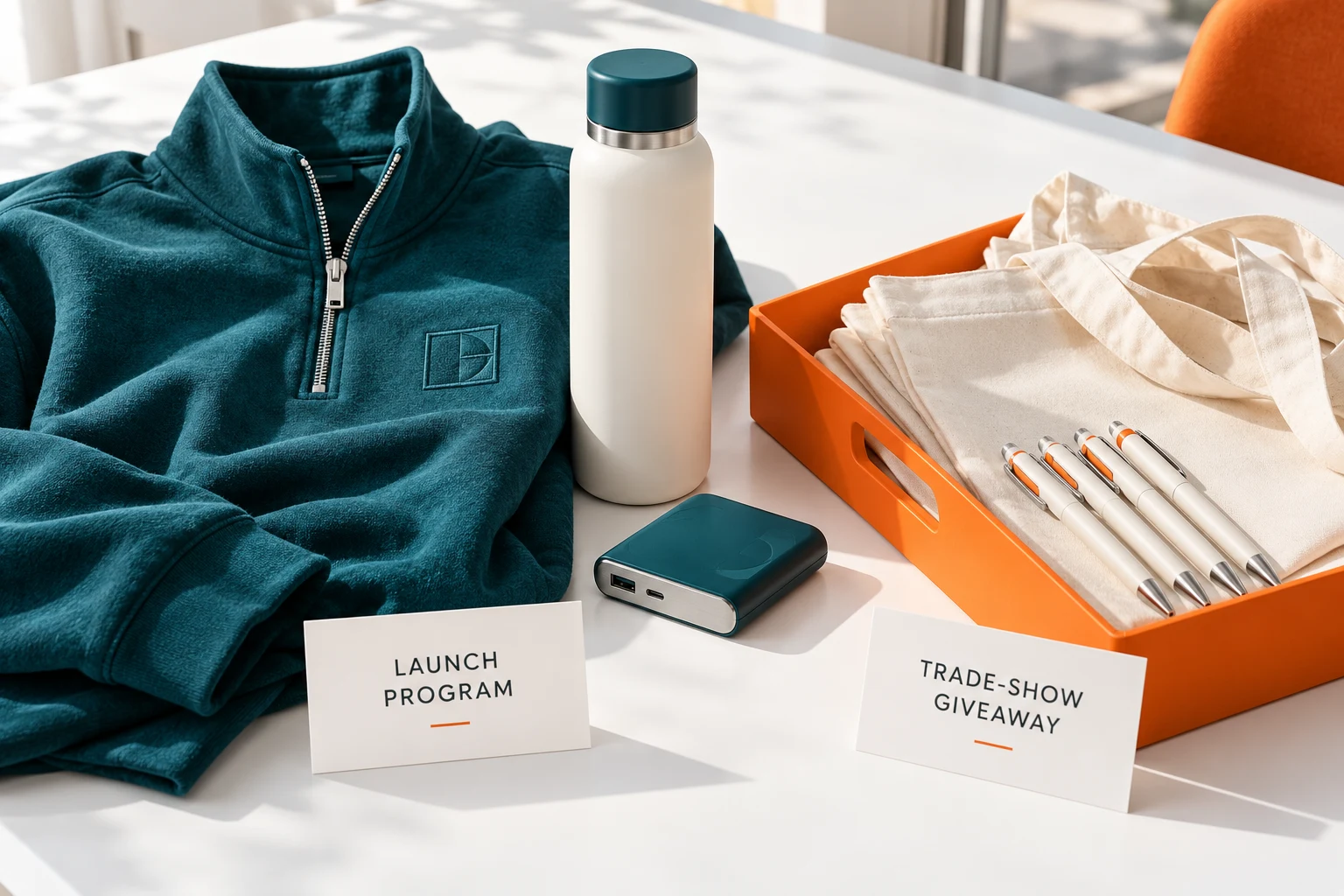
A procurement team classifies two active programs using the model: a national launch apparel program and a regional trade-show giveaway.
| Program | Criticality | Estimated recovery time | Quadrant | Strategy applied |
| Program A: national launch apparel | High — core to the brand launch | Slow — specialized decoration, few alternate vendors | High criticality, slow recovery | Multi-sourced across two qualified vendors |
| Program B: regional trade-show giveaway | Low — limited brand visibility, easily substituted | Fast — common product, many alternate vendors | Low criticality, fast recovery | Single-sourced with one vendor |
In this illustrative example, the same procurement team applied two different strategies to two different programs, using the same model. The national launch program’s combination of high criticality and slow recovery justified the added cost and overhead of a second vendor, while the trade-show giveaway did not.
Mitigations for Single-Sourced Critical Items
Sometimes a genuinely qualified second vendor does not exist for a specialized product, even when criticality is high. The table below covers mitigations to put in place when single-sourcing is the only realistic option for a critical item.
| Mitigation | What to put in writing | Why it matters |
| Pre-qualified backup vendor | Confirm a second vendor has reviewed the spec and could produce a comparable item if activated | Reduces the time to switch if the primary vendor fails |
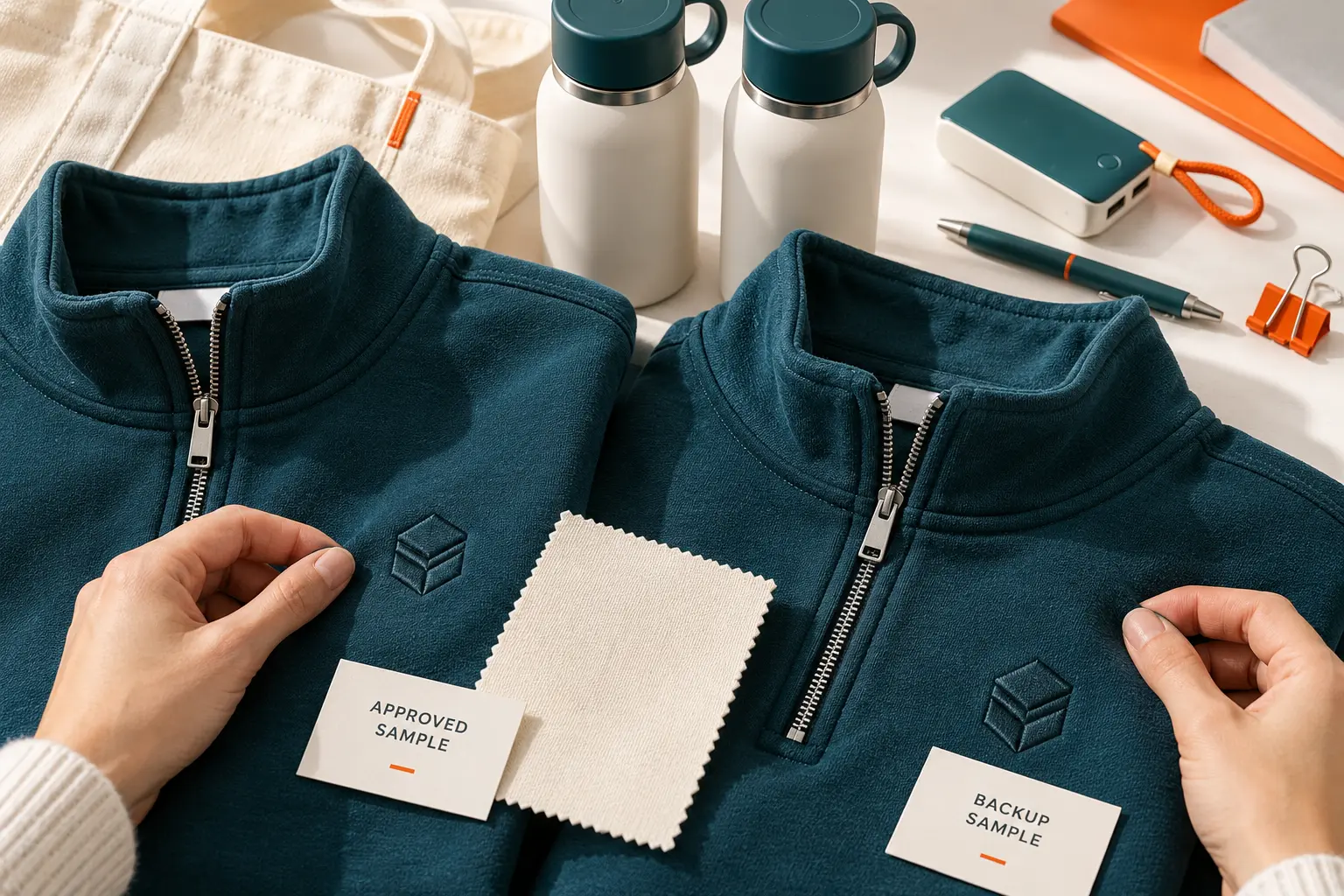
| Golden sample shared with a backup | Keep the approved reference available to a backup vendor, not only the primary | Prevents starting the approval process from zero during a disruption |
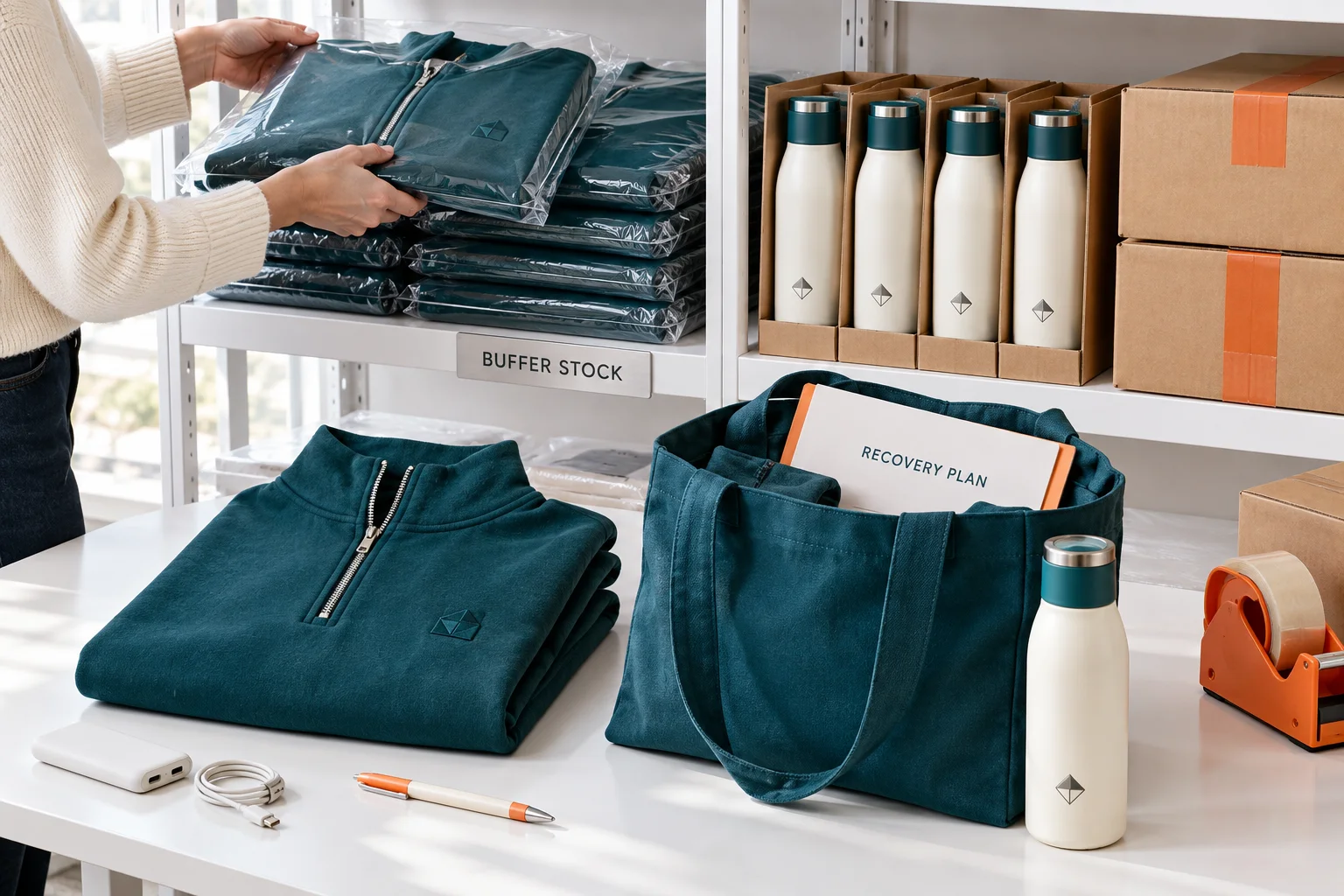
| Safety stock or buffer inventory | Confirm a minimum stock buffer for the most critical SKUs | Buys time to activate a backup vendor without missing a delivery date |
| Written recovery clause with the primary vendor | Confirm a documented remedy and timeline for a primary-vendor failure | Creates accountability even without a second vendor in place |
| Scheduled capacity check-ins | Confirm the vendor proactively reports capacity constraints before they become disruptions | Provides early warning before a single point of failure becomes an active failure |
Risks and Limitations of This Decision Model
- Criticality and recovery time ratings are judgment calls; involve both procurement and the brand or program stakeholder to avoid a one-sided assessment.
- Recovery time estimates can be overly optimistic if based on a vendor’s stated capacity rather than demonstrated, verified capacity.
- Multi-sourcing reduces concentration risk but does not eliminate it; both vendors can still share upstream risk, such as the same raw material supplier.
- This model assumes a buyer can identify a genuinely qualified backup vendor; in highly specialized categories, the absence of a true backup is itself a risk finding worth escalating.
- The matrix is a decision aid, not a guarantee; a product correctly classified as low-risk can still experience an unexpected disruption.
- The program examples in this guide are illustrative; actual criticality and recovery time will vary by product, category, and market.
Request a Scoped Quote
If you are deciding a sourcing strategy for an upcoming program, share your product specifications, program criticality, and current vendor relationships. Our team can help assess recovery time and backup vendor options.
Prefer a lighter first step? Send us your current single-sourced critical items for a quick recovery-time risk review.
Frequently Asked Questions
How do we rate criticality objectively, rather than by gut feeling?
Base the rating on defined factors — brand visibility, whether the item is tied to a launch date, and whether it falls under a regulated category — rather than a general impression. As part of vendor evaluation, involving the brand or program stakeholder alongside procurement helps prevent the rating from reflecting only one team’s perspective.
Does multi-sourcing always double our costs?
Not necessarily. When comparing single source vs multi source promotional products, multi-sourcing typically reduces volume-based pricing leverage rather than doubling total cost, since spend is split rather than duplicated. The decision table above compares this trade-off directly against the value of reduced risk concentration for the specific product in question.
What if no qualified backup vendor exists for a specialized product?
Treat the absence of a true backup as a documented risk finding, not something to quietly accept. Supplier due diligence should identify this gap and document appropriate mitigations, such as safety stock and a written recovery clause, when single-sourcing is genuinely the only realistic option.
Should recovery time include internal approval delays, or just vendor lead time?
Include both. A recovery time estimate based only on a new vendor’s production lead time will understate real exposure if your own internal sample approval or purchase order process adds meaningful time. Including these steps in the procurement process provides a more realistic recovery estimate.
How does this model relate to vendor consolidation?
The two decisions interact directly: consolidating multiple programs toward one vendor increases that vendor’s criticality across your portfolio, even if no single product changed. This makes single source vs multi source promotional products an important consideration when evaluating whether to consolidate further. See our vendor consolidation framework for how to weigh that trade-off.
Sources and Further Guidance
US Consumer Product Safety Commission — Children’s Product Certificate
California OEHHA — Proposition 65 Frequently Asked Questions for Businesses
UK Government — Placing Manufactured Products on the Market in Great Britain
Google Search Central — Creating Helpful, Reliable, People-First Content
Author & Reviewer
Written by Claire Morgan, Senior Content Writer, with professional experience advising procurement teams on sourcing strategy and supply risk for branded merchandise programs.
Freshness & Update Log
- Published: September 23, 2026
- Last Reviewed: September 23, 2026
- Next scheduled review: within 12 months, or sooner if referenced regulatory guidance changes.
Related Resources
- /questions-to-ask-a-promotional-product-supplier/ — 18 evidence-based questions to ask once quotes are in hand.
- /promotional-product-supplier-audit-checklist/ — the 25-point checklist for auditing a supplier before you award the order.
- /promotional-merchandise-vendor-consolidation/ — how vendor consolidation interacts with ongoing performance scoring.