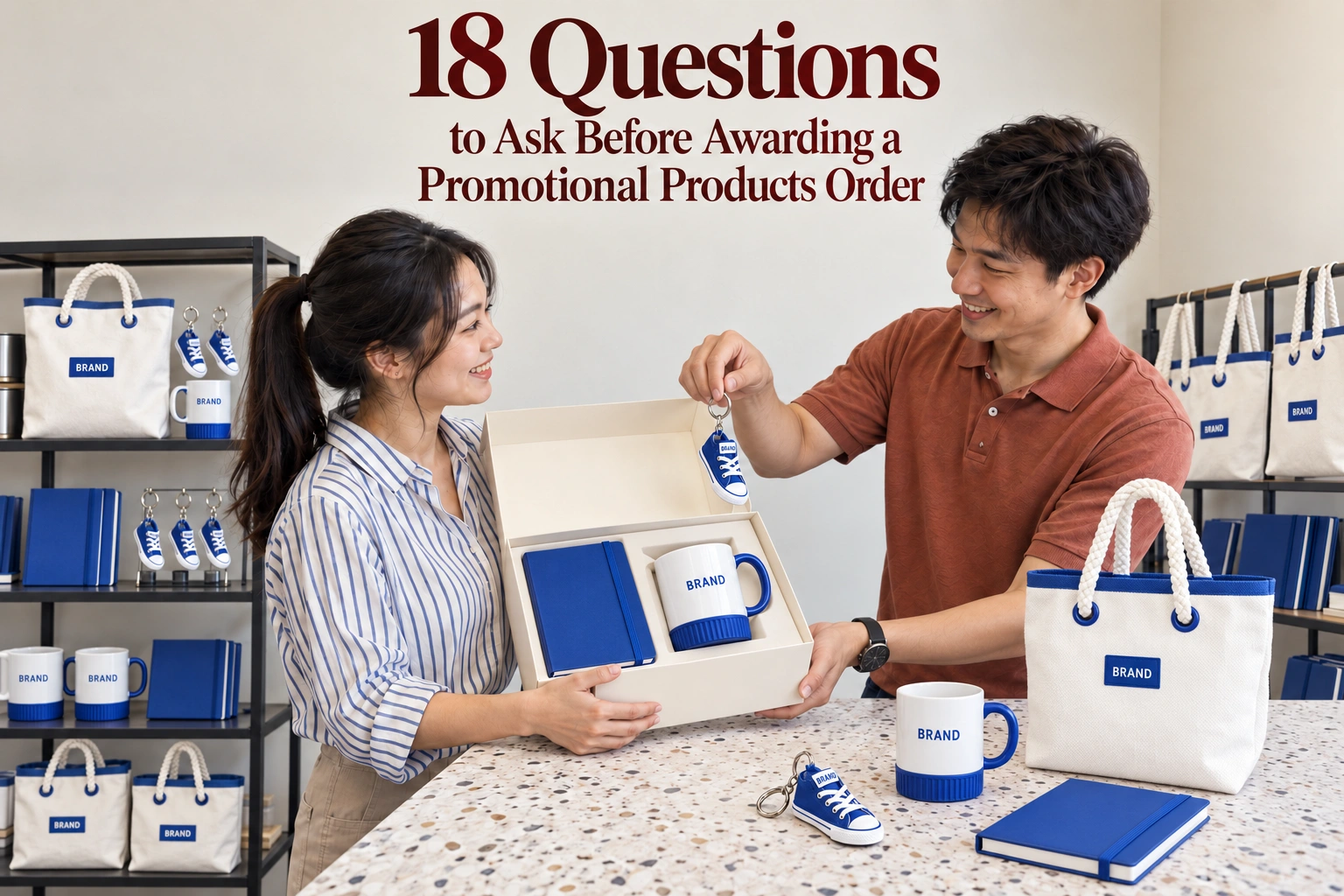
Before awarding a promotional products order, a buyer should consider questions to ask a promotional product supplier across six areas: company accountability, product and compliance evidence, proofing and sample accuracy, production capacity and timeline, cost and commercial terms, and risk and recovery. This guide is written for procurement managers sourcing branded merchandise for mid-market and enterprise programs in US and UK markets, comparing a shortlist of two to four suppliers before a purchase order is issued. It assumes the buyer already has product specifications, a target quantity, and a required delivery date. The questions below are built to request evidence, not to collect a supplier’s own summary of its capabilities.
Asking the right questions is a current priority for procurement teams because a verbal answer during a sales call rarely holds up once an order is in production. The sections below provide a decision table for prioritizing question categories, the full 18-question checklist, a repeatable framework for using it during the award process, and an illustrative example of how the questions surfaced a gap before an order was placed.
Figures, tiers, and thresholds used as examples in this article are illustrative only. Confirm actual MOQ, lead time, and compliance requirements directly with each supplier and, where relevant, with legal or compliance counsel.
Why Evidence-Based Questions Matter Before Awarding an Order
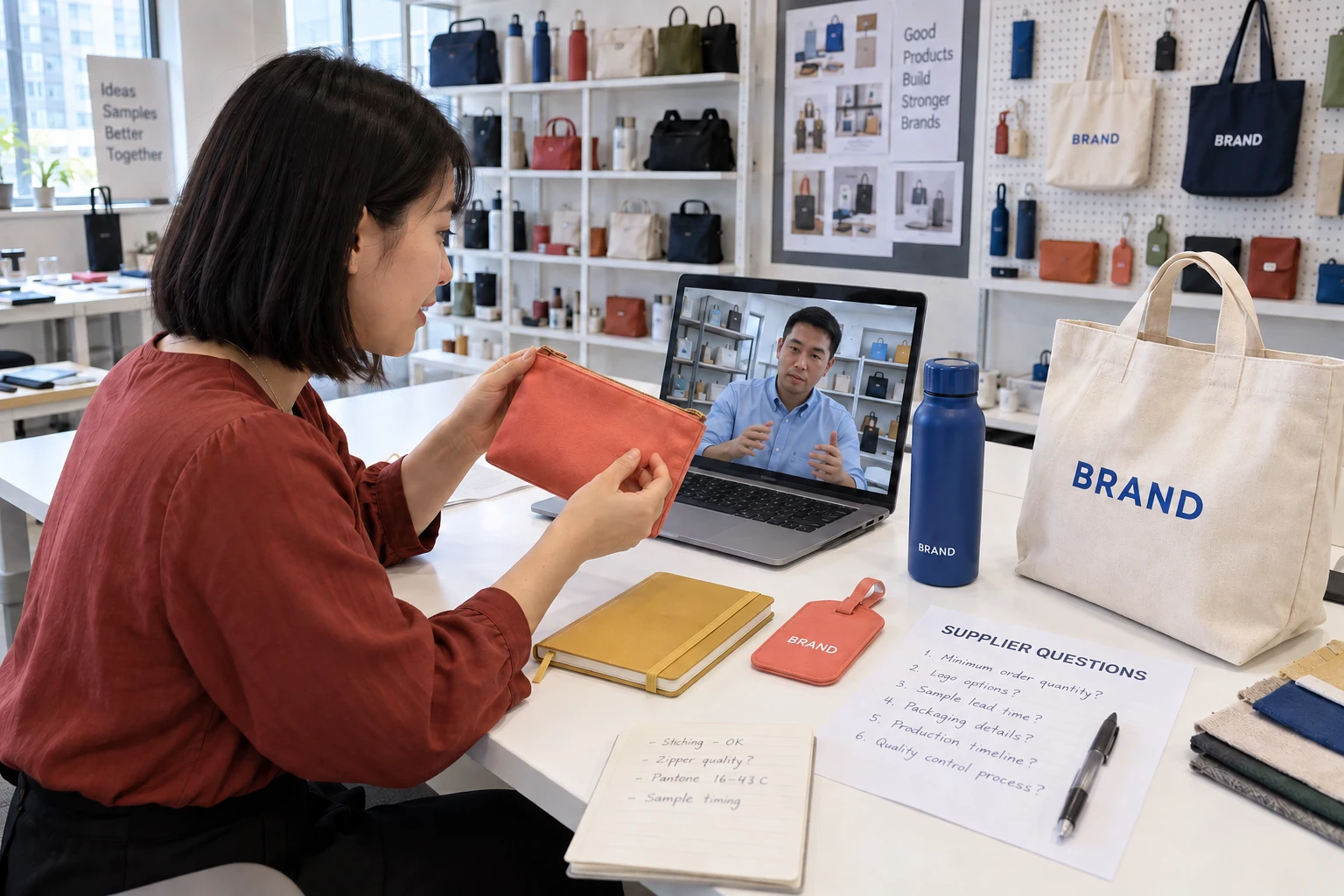
A sales conversation is designed to reassure a buyer, not to produce evidence. Questions like “can you handle this order” or “is this compliant” tend to get a confident verbal yes regardless of whether the supplier can actually back it up in writing. That gap only becomes visible once a shipment is late or a compliance document does not match the product shipped.
The questions to ask a promotional product supplier before awarding an order should each request a specific, checkable piece of evidence — a written policy, a document, a dated report — rather than an opinion. That shift is what turns a sales call into a real due diligence step.
Decision Table: Which Question Categories Matter Most
Use the table below to prioritize which categories of questions need the most scrutiny for a given order, based on evidence a buyer can actually verify.
| Question category | Why it matters | Evidence to request | Risk if skipped |
| Company accountability | Confirms who is responsible when something goes wrong | Named account and escalation contacts, insurance or liability coverage | No clear owner when a problem needs resolving |
| Product & compliance evidence | Confirms the product is documented for your exact SKU and market | Test reports, certificates, and labeling matched to the SKU | Non-compliant product reaching a regulated destination market |
| Proofing & sample accuracy | Confirms what you approve is what gets produced | Digital mockup, physical sample, or pre-production proof | Production run that does not match the approved artwork |
| Production capacity & timeline | Confirms the supplier can deliver your volume by your date | Written capacity statement and production schedule | Missed delivery date from an overcommitted factory |
| Cost & commercial terms | Confirms the total cost and MOQ for your exact specification | Itemized quote with MOQ tiers and pricing breaks in writing | Hidden costs or price jumps discovered after order placement |
| Risk & recovery | Confirms what happens if something fails after the order is placed | Written remedy clauses for delay, failed QC, and force majeure | No documented recourse when an issue occurs |
The 18 Questions to Ask a Promotional Product Supplier
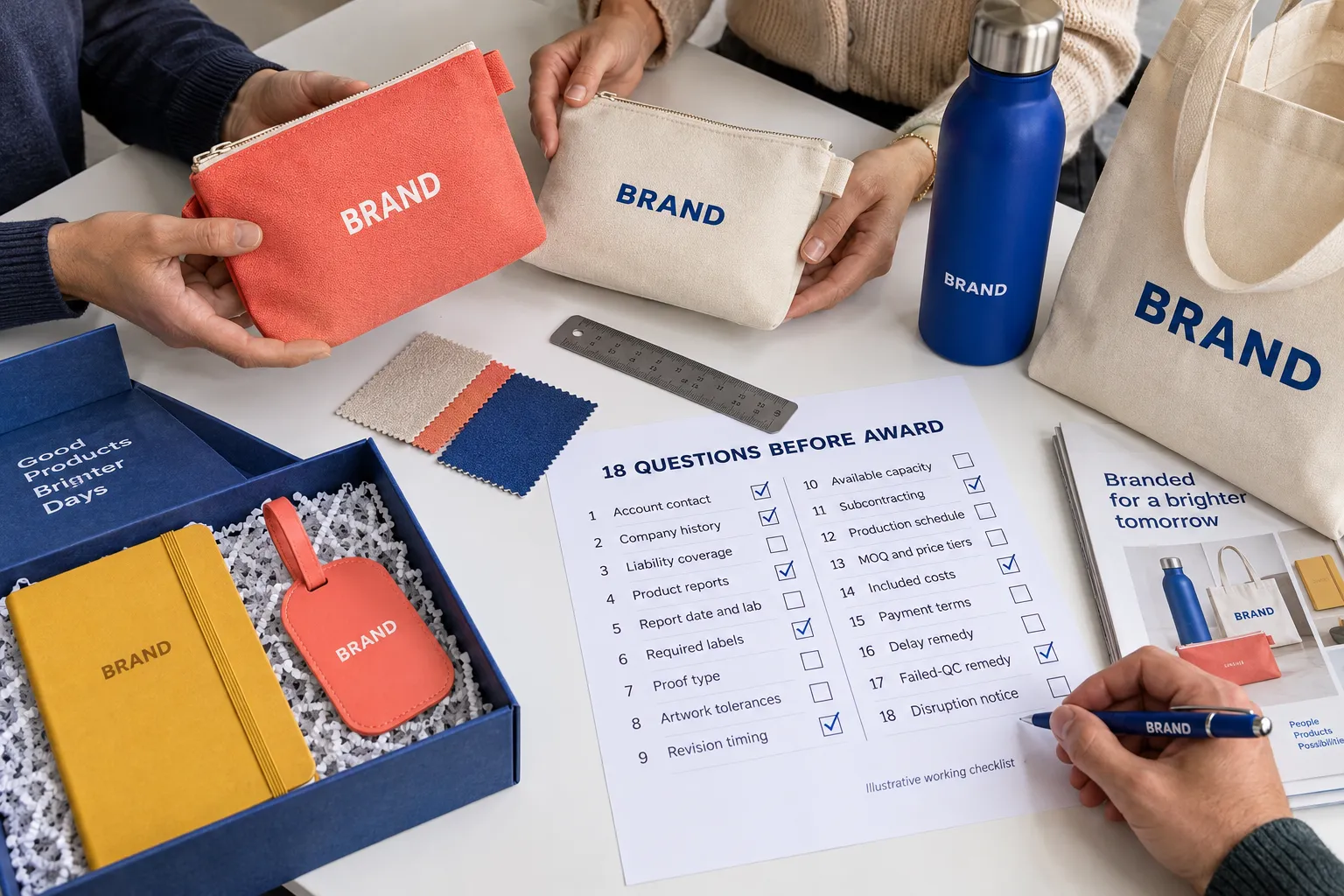
The 18 questions below are grouped into six categories. Send them in writing ahead of a supplier call so responses can be compared against documentation, not just a verbal answer.
Company & Accountability
- Who is our named account contact, and who is the separate escalation contact if they are unavailable?
- How long has the company operated under its current ownership and name?
- What insurance or liability coverage applies to an order of our size?
Product & Compliance Evidence
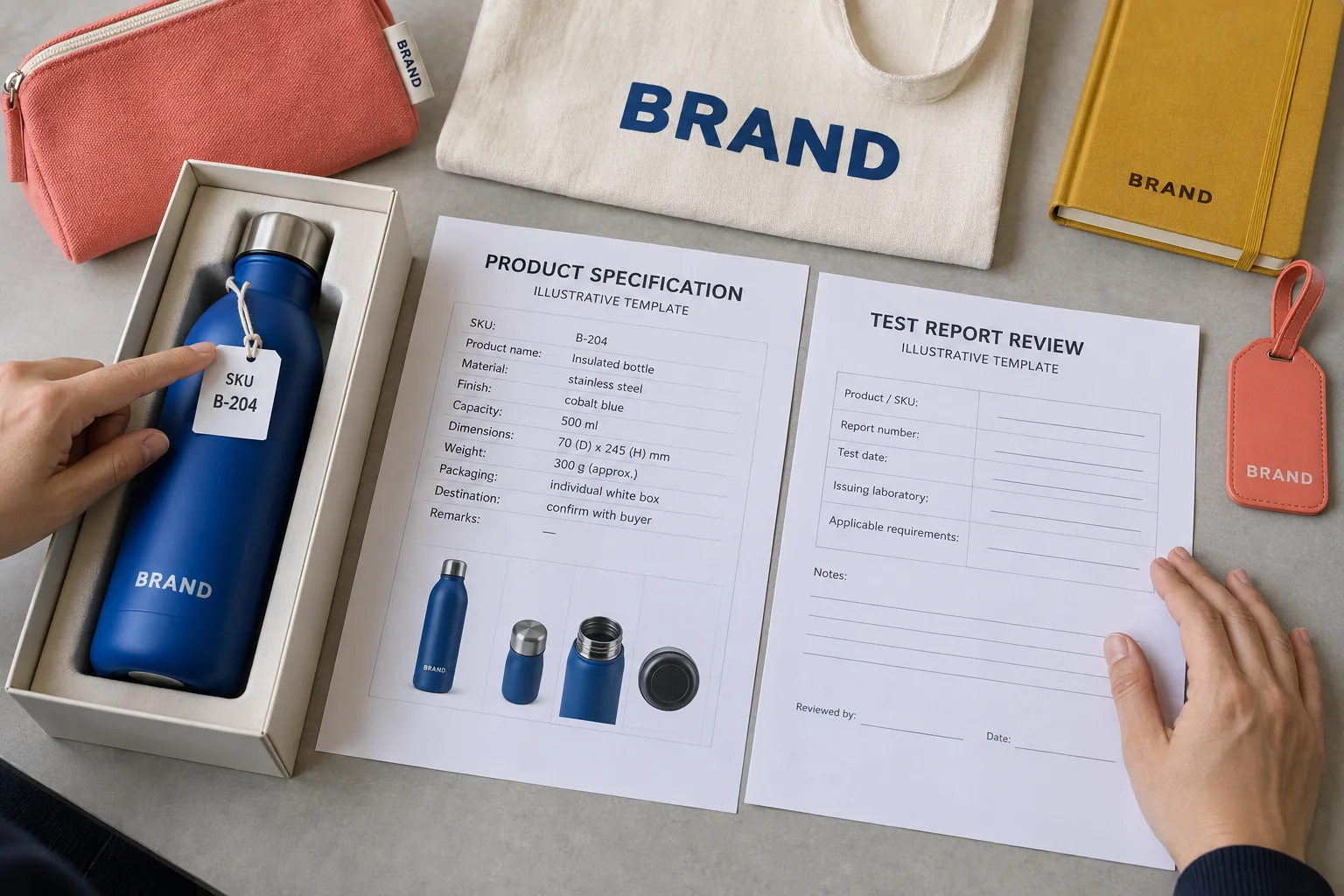
- What test reports or certificates apply to this exact product, material, and destination market?
- Can you provide the test date, report number, and issuing laboratory for the compliance documents?
- What labeling or warning requirements apply to this product in our destination market?
Proofing & Sample Accuracy
- What type of evidence will we receive before production: digital mockup, stock sample, custom sample, or pre-production proof?
- What are the color, placement, and dimension tolerances for this order?
- What is the turnaround time for a revised proof if the first submission is rejected?
Production Capacity & Timeline
- What is your current production capacity relative to our order volume and timing?
- Are any parts of this order subcontracted, and to which facility?
- What production schedule and buffer do you have against our required delivery date?
Cost & Commercial Terms
- What is the MOQ for this exact specification, and how does pricing change at different volumes?
- What is included in the quoted price, and what is billed separately, such as tooling, freight, duties, or rework?
- What are the payment terms and any deposit requirements?
Risk & Recovery
- What is the written remedy if the shipment is late?
- What is the written remedy if a proof or production run fails QC?
- What are the force majeure terms, and what notice do we receive if they are invoked?
Evidence to Request by Question Category
The table below maps each question category to the specific type of document or written evidence a supplier should be able to provide on request.
| Question category | Evidence type to request | Format |
| Company & accountability | Named contacts and proof of insurance or liability coverage | Written statement or certificate |
| Product & compliance evidence | Test reports, certificates, and labeling matched to the SKU | Dated document with report number and laboratory |
| Proofing & sample accuracy | Digital mockup, physical sample, or pre-production proof | Physical item or digital file matched to approved artwork |
| Production capacity & timeline | Capacity statement and production schedule | Written schedule or facility audit note |
| Cost & commercial terms | Itemized quote with MOQ tiers and payment terms | Written quotation |
| Risk & recovery | Remedy clauses for delay, failed QC, and force majeure | Contract clause or quality agreement |
Buyer Framework: Using These Questions in the Award Process
The steps below turn the 18 questions into a repeatable part of the award process, with a clear decision owner — typically the category procurement manager running the sourcing decision.
- Send the 18 questions to each shortlisted supplier in writing, alongside the RFQ, with a stated response deadline.
- Request documentation for each answer, not just a written summary — a certificate, a schedule, or a contract clause.
- Score responses against the decision table categories above, weighting compliance and recovery items as pass-or-fail.
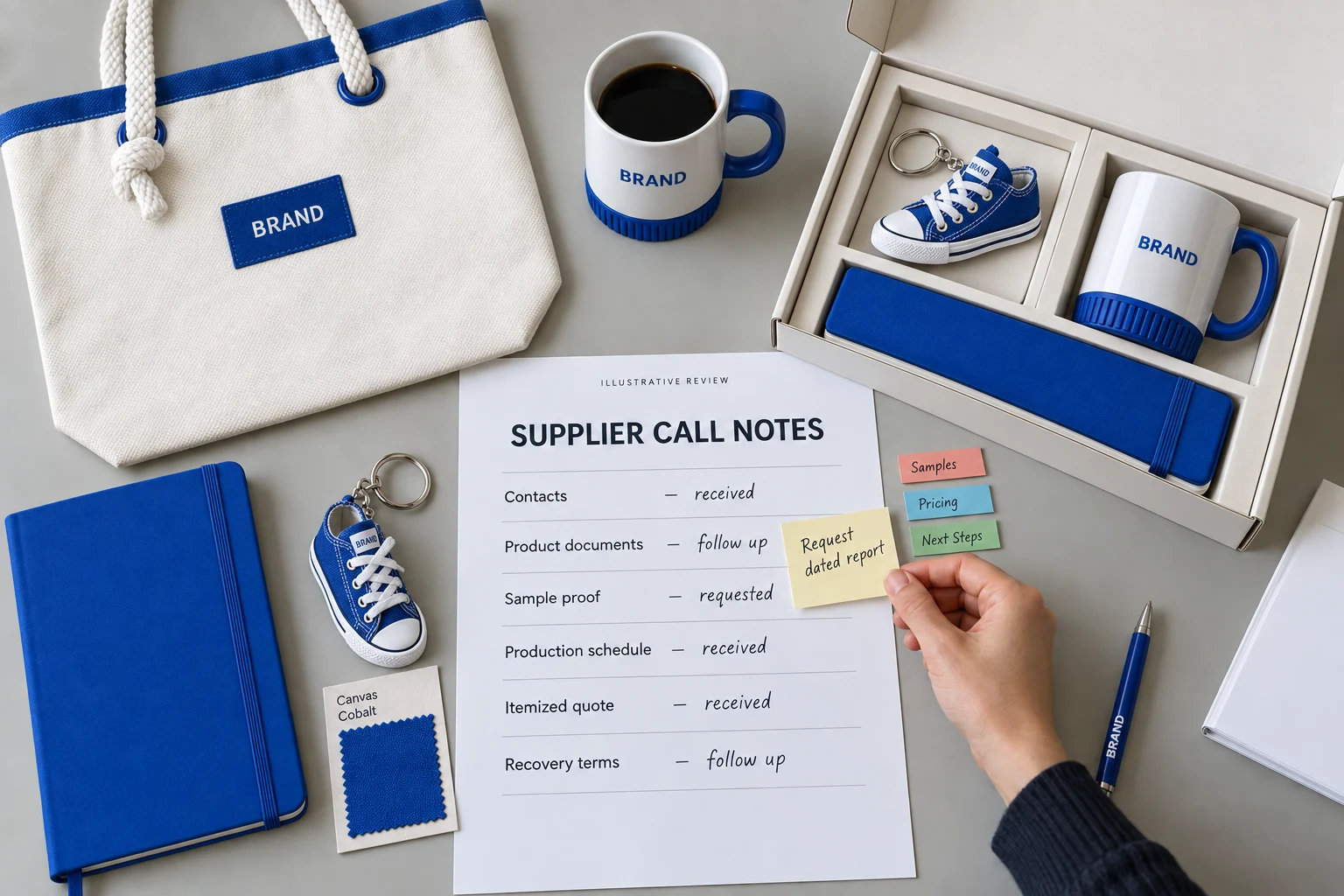
- Flag any question that receives a verbal answer only, with no supporting document, for follow-up before award.
- Route unresolved compliance, capacity, or recovery gaps to the relevant specialist — quality, legal, or compliance — before the order is awarded.
- Record the completed question set against the purchase order file for future reference.
- Reuse the same 18 questions at reorder, or whenever specifications, factory, or destination market change.
Our team can help run this question set against your own supplier shortlist — see promotional product sourcing for how we support procurement teams through the award process.
Evidence From the Field: Illustrative Example
The example below is an illustrative supplier-question scenario created to show how the 18 questions surface gaps in practice. Replace the sample results with verified records before presenting this as a real case study.
A procurement team sends the 18 questions to two shortlisted suppliers ahead of a branded merchandise order. Supplier A answers all 18 in writing with supporting documents. Supplier B answers most questions but responds to two compliance questions verbally, without a supporting document.
| Question category | Supplier A | Supplier B |
| Company & accountability | Named contacts and insurance certificate provided | Named contact provided; no insurance detail given |
| Product & compliance evidence | Test report and certificate matched to the SKU | Verbal assurance only; no dated report provided |
| Proofing & sample accuracy | Pre-production proof provided and approved | Digital mockup only; no physical proof offered |
| Risk & recovery | Written remedy clause included in the quotation | No written remedy; verbal reassurance only |
In this illustrative scenario, the gaps in Supplier B’s compliance and recovery answers were the deciding factor, even though its quoted unit price was competitive. Supplier A’s ability to produce documentation on request, rather than a verbal assurance, reduced the buyer’s risk going into production.
Risks and Limitations of This Question Set
- A supplier’s written answer confirms documentation at a point in time — it does not guarantee ongoing performance on future orders.
- Some smaller suppliers may not have every document formatted for buyer review; a missing format is not the same as a missing capability, and should be followed up rather than treated as an automatic disqualifier.
- Applicable compliance requirements vary by product, material, age grade, destination market, and sales channel, and may require questions beyond this general 18-question set.
- This checklist supports a purchasing decision; it does not replace contract or legal review of the final agreement.
- Regulated categories such as children’s products, food-contact items, or electronics typically require additional category-specific questions.
- The supplier comparison in this guide is illustrative; actual results will vary by supplier, product, and market.
Request a Scoped Quote
If you are preparing to award a promotional products order, share your product specifications, quantity, branding, destination market, and required delivery date. Our team can help apply these 18 questions to your shortlist as part of a scoped quote and sourcing review.
Prefer a lighter first step? Send us a supplier’s written answers to these 18 questions for a documentation review before you award the order.
Frequently Asked Questions
Should these questions be sent before or after requesting a quote
Send them alongside the RFQ, not after a quote is already in hand. Suppliers who know in advance that documentation will be requested tend to prepare more complete answers, and it avoids reopening commercial terms later to accommodate a compliance gap found afterward.
What if a supplier cannot answer a question in writing
Treat an inability or refusal to document a standard answer, such as a compliance certificate or a written remedy clause, as a relevant data point in the award decision. A supplier that cannot produce documentation on request during evaluation is unlikely to produce it later when a problem occurs.
Do all 18 questions apply to every order
Not with equal weight. A low-risk reorder from an already-approved supplier may only need the risk and recovery questions revisited, while a new supplier or a regulated product category should go through the full set, as shown in the decision table above.
How is this different from a supplier audit checklist
This question set is designed for the award-decision conversation itself, before a purchase order is issued. For a more complete pre-order and ongoing review process, see our 25-point supplier audit checklist, which expands on these categories in more depth.
Who inside procurement should own asking these questions
Typically the category procurement manager running the sourcing decision, with compliance, quality, or legal brought in to review flagged answers rather than every response. Naming one accountable owner keeps the question set applied consistently across suppliers.
Sources and Further Guidance
US Consumer Product Safety Commission — Children’s Product Certificate
California OEHHA — Proposition 65 Frequently Asked Questions for Businesses
UK Government — Placing Manufactured Products on the Market in Great Britain
Google Search Central — Creating Helpful, Reliable, People-First Content
Author & Reviewer
Written by Claire Morgan, Senior Content Writer, with professional experience running supplier due diligence for branded merchandise programs.
Freshness & Update Log
- Published: September 18, 2026
- Last Reviewed: September 18, 2026
- Next scheduled compliance check: within 12 months, or sooner if referenced regulatory guidance changes.
Related Resources
- /promotional-product-sourcing/ — primary commercial page: request a scoped quote and sourcing review.
- /promotional-product-supplier-audit-checklist/ — the 25-point checklist for a deeper pre-order and ongoing supplier audit.
- /direct-manufacturer-vs-promotional-products-distributor/ — how to choose between a direct manufacturer and a distributor before running this question set.
- /promotional-product-compliance/ — category-specific compliance requirements and documentation.