A promotional product supplier audit checklist should confirm 25 verifiable points across five areas: company and commercial basics, product and compliance documentation, proofing and sample accuracy, production capacity and logistics, and recovery and continuity terms. This guide is written for procurement managers sourcing branded merchandise for mid-market and enterprise programs in US and UK markets, comparing a shortlist of two to four suppliers before a purchase order is issued. It assumes the buyer already has product specifications and a target delivery date. The checklist below turns supplier due diligence into a repeatable pre-order workflow rather than a one-off review.
Procurement teams currently treat supplier audits as a rising priority, since a single undocumented gap in compliance, capacity, or recovery terms can turn a low unit price into a costly delay. The sections below provide a decision table for scoring suppliers, the full 25-point checklist grouped by audit area, a repeatable workflow with a named decision owner, and an illustrative example of how the checklist surfaces gaps before an order is placed.
Figures, tiers, and thresholds used as examples in this article are illustrative only. Confirm actual MOQ, lead time, and compliance requirements directly with each supplier and, where relevant, with legal or compliance counsel.

Why a Repeatable Audit Process Matters
A one-off supplier review answers questions for a single order. A repeatable audit checklist answers the same questions every time, for every supplier, regardless of who on the team is running the sourcing decision. That consistency matters most when a category manager changes, a new supplier joins the shortlist, or an existing supplier changes factories.
Without a standard checklist, buyers tend to ask different questions of different suppliers, which makes comparison unreliable and lets gaps slip through when a deadline is tight. A written promotional product supplier audit checklist closes that gap by making the evidence requirements explicit before outreach begins.
The Supplier Audit Decision Table
Use the table below to compare shortlisted suppliers on criteria a buyer can actually verify, rather than on a sales pitch. Each row links to a related item in the full 25-point checklist that follows.
| Criterion | What to verify | Evidence to request | Risk if unverified |
| MOQ flexibility | Whether MOQ can flex for pilot runs or reorders without a steep price penalty | Written MOQ tiers and associated pricing breaks | Buyer locked into oversized orders or undisclosed price jumps |
| Lead time commitment | Standard versus rush lead time, and what drives the difference | Written production schedule or lead-time policy tied to order complexity | Missed launch date from an undocumented lead-time assumption |
| Material specification | Exact material, grade, and any substitution policy | Material spec sheet matched line-by-line to the purchase order | Undisclosed substitution affecting durability, compliance, or brand fit |
| Compliance documentation | Test and compliance documents matched to the exact SKU, market, and use | Current certificates, test reports, and labeling matched to that SKU | Non-compliant product reaching a regulated destination market |
| Production capacity | Stated capacity against your order volume and required timing | Written capacity statement or facility audit note | Overcommitted factory delaying your order behind another client’s |
| Recovery evidence | Whether a written remedy exists for delay or failed QC | Contract clause or quality agreement covering recovery terms | No documented recourse when something goes wrong |

The 25-Point Supplier Audit Checklist
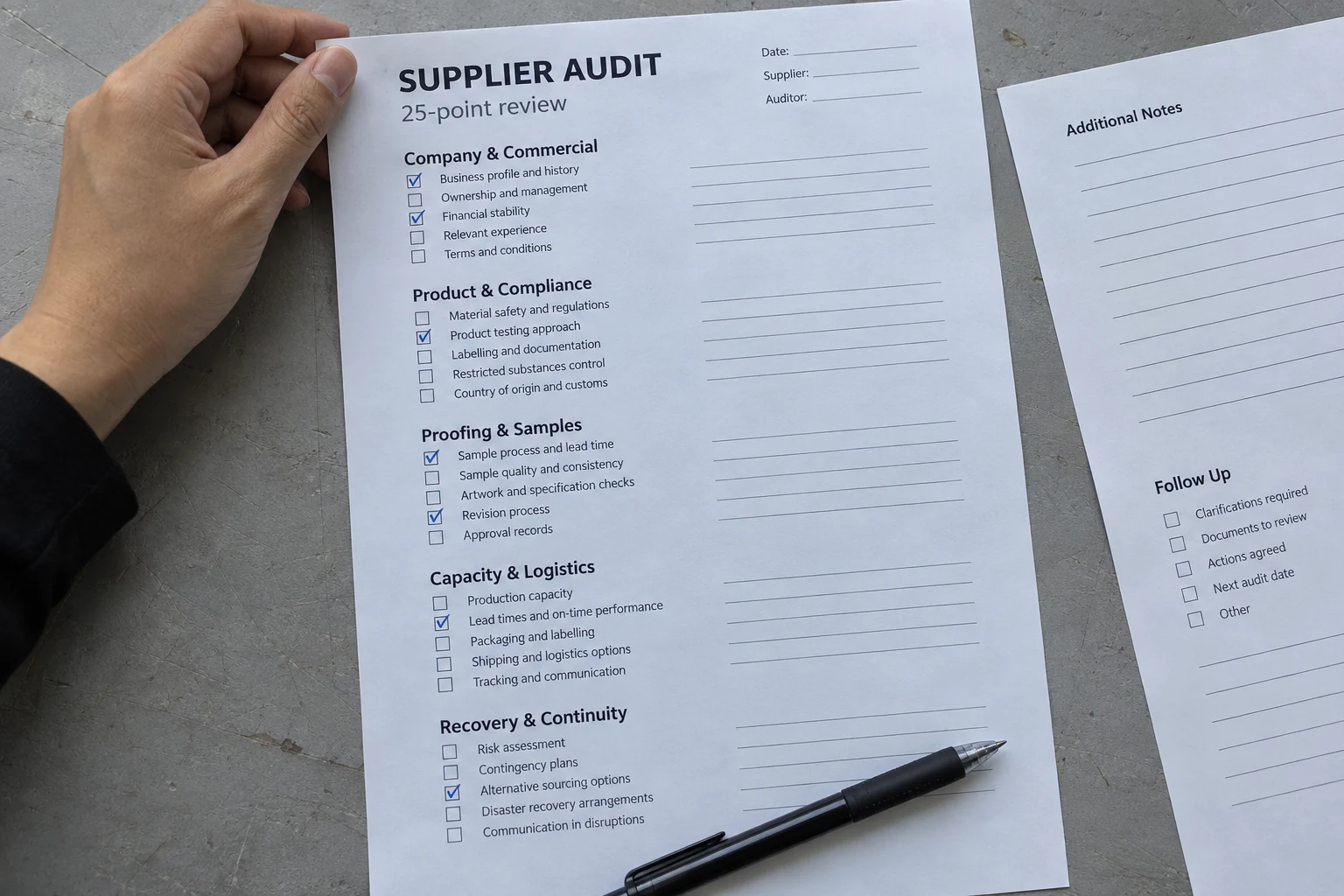
The checklist below groups 25 verifiable points into five audit areas. Send it to each shortlisted supplier alongside your RFQ, and score responses using the decision table criteria above rather than the supplier’s own summary.
Company & Commercial Basics
- Confirm legal company name, registration, and years operating under current ownership.
- Confirm a named account contact and a separate escalation contact, not a shared inbox.
- Confirm MOQ tiers and pricing breaks in writing.
- Confirm standard payment terms and any deposit requirements.
- Confirm insurance or liability coverage relevant to your order value.
Product, Material & Compliance
- Confirm the exact material specification matches the purchase order.
- Confirm any substitution policy and the required notice to the buyer.
- Confirm compliance documents match the exact SKU, destination market, and intended use.
- Confirm test report dates, report numbers, and the issuing laboratory.
- Confirm labeling and warning requirements for the destination market.
Proofing & Sample Accuracy
- Confirm which evidence type will be provided: digital mockup, stock sample, custom sample, or pre-production proof.
- Confirm the proof approval process and the internal sign-off owner.
- Confirm color, placement, and dimension tolerances in writing.
- Confirm the timeline for proof revisions if the first submission is rejected.
- Confirm that the approved proof, not a verbal description, becomes the production reference.
Production Capacity & Logistics
- Confirm stated production capacity against your order volume and timing.
- Confirm whether any processes are subcontracted, and to whom.
- Confirm the production schedule and buffer against your required delivery date.
- Confirm shipping method, incoterms, and customs responsibility.
- Confirm the supplier’s contingency plan for peak-season or multi-client capacity conflicts.
Risk, Recovery & Continuity
- Confirm the supplier’s own business continuity plan, including backup facilities and key-person risk.
- Confirm a written remedy for late shipment.
- Confirm a written remedy for failed QC or a misprint.
- Confirm force majeure terms: covered events, notice duties, and mitigation steps.
- Confirm how the supplier handles data and IP for provided artwork and brand assets.
Documentation to Request by Compliance Area
Compliance documentation requirements vary by product, intended use, age grade, destination market, and sales channel. The table below shows the type of document to request by area — confirm the specific standard that applies to your product before relying on any single document.
| Compliance area | Document type to request | What it should confirm |
| Product safety testing | Current laboratory test report matched to the exact SKU and material | Test date, report number, laboratory, and standard tested against |
| Children’s products (where applicable) | Children’s Product Certificate (CPC) or equivalent | Certificate matches the product, age grade, and destination market |
| General conformity | General Certificate of Conformity (GCC) or equivalent, where applicable | Certificate matches product configuration and destination market |
| California exposure warnings | Proposition 65 exposure assessment or warning review, where applicable | Whether a warning is required for the specific product and use |
| UK / GB market placement | UKCA or CE marking documentation, where applicable | Marking matches the product category and market of sale |
Buyer Framework: Running the Audit as a Repeatable Workflow
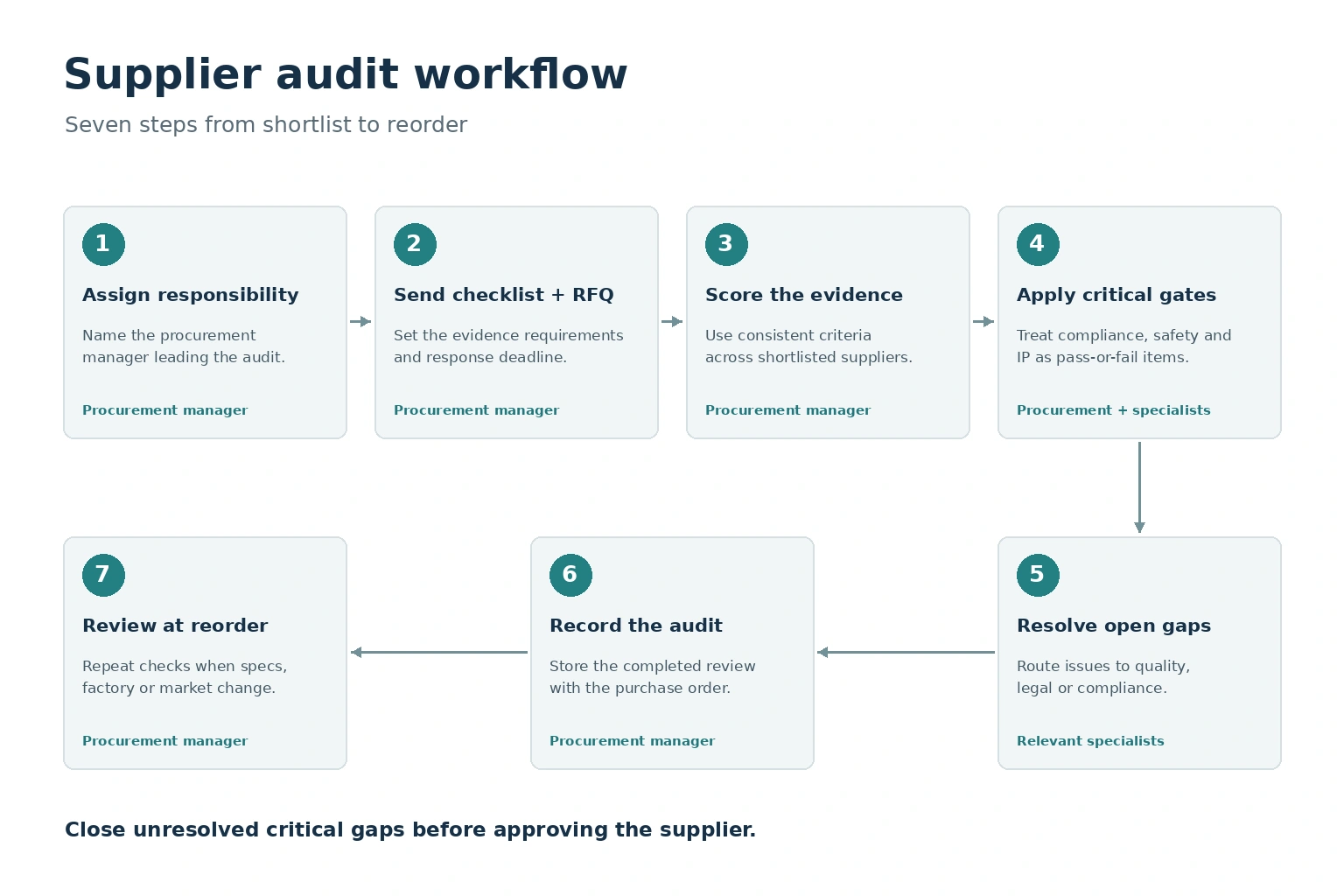
The steps below turn the checklist into a workflow with a clear decision owner, typically the category procurement manager running the sourcing decision.
- Assign an audit owner before the supplier shortlist is finalized.
- Send the 25-point checklist to each shortlisted supplier alongside the RFQ, with a stated response deadline.
- Score returned evidence against the decision table criteria, not the supplier’s own claims.
- Escalate compliance, safety, and IP items to pass-or-fail status; do not average these into a general score.
- Route unresolved gaps to the relevant specialist — quality, legal, or compliance — before the audit is closed.
- Record the completed audit against the purchase order file for future reference.
- Re-run a lightweight version of the audit at reorder, or whenever specifications, factory, or destination market change.
Our team can run this same audit as part of a scoped sourcing engagement — see promotional product sourcing for how we support procurement teams through this process.
Evidence From the Field: Illustrative Audit Example
The example below is an illustrative supplier-audit scenario created to show how the 25-point checklist surfaces gaps in practice. Replace the sample results with verified audit records before presenting this as a real case study.
A procurement team runs the checklist against a shortlisted supplier ahead of a branded merchandise order. Four of the five audit areas pass cleanly on first review; two areas return flagged items that are resolved before the purchase order is issued.
| Audit area | Items passed | Items flagged | Outcome |
| Company & Commercial Basics | 5 of 5 | None | Cleared on first review |
| Product, Material & Compliance | 4 of 5 | Lab report did not match the exact SKU | Flagged; cleared after supplier issued a corrected report |
| Proofing & Sample Accuracy | 5 of 5 | None | Cleared on first review |
| Production Capacity & Logistics | 4 of 5 | No written peak-season contingency | Flagged; resolved with a written contingency note before award |
| Risk, Recovery & Continuity | 3 of 5 | No force majeure clause; no written IP handling terms | Flagged; added via contract addendum before order confirmation |
Audit Depth by Order Risk
Not every order justifies running all 25 points in full depth. The table below is a starting guide for scaling audit depth to order risk — adjust the tiers to your own company’s purchasing policy and risk appetite.
| Order risk tier | Example triggers | Suggested audit depth | Typical decision owner |
| Low risk | Small reorder from an already-audited, approved supplier; no spec changes | Lightweight review: confirm no material, factory, or spec changes since last audit | Buyer or category coordinator |
| Medium risk | New product from an approved supplier, or a new supplier for a non-regulated category | Full 25-point checklist, standard evidence review | Procurement manager |
| High risk | New supplier, regulated product category, new destination market, or high order value | Full 25-point checklist plus specialist review (quality, legal, compliance) | Procurement manager with specialist sign-off |
Risks and Limitations of This Checklist
- A completed audit confirms documentation and stated commitments at a point in time — it does not guarantee ongoing supplier performance.
- Self-reported production capacity, testing, and continuity information should be independently checked where the order’s risk justifies it.
- Applicable compliance requirements can change when the product, material, age grade, use, destination market, or sales channel changes.
- This 25-point checklist is a general-purpose baseline; regulated categories such as children’s products, food-contact items, or electronics may require additional category-specific review.
- The checklist supports a purchasing decision; it does not replace contract or legal review of the final agreement.
- The audit example in this guide is illustrative; actual results will vary by supplier, product, and market.
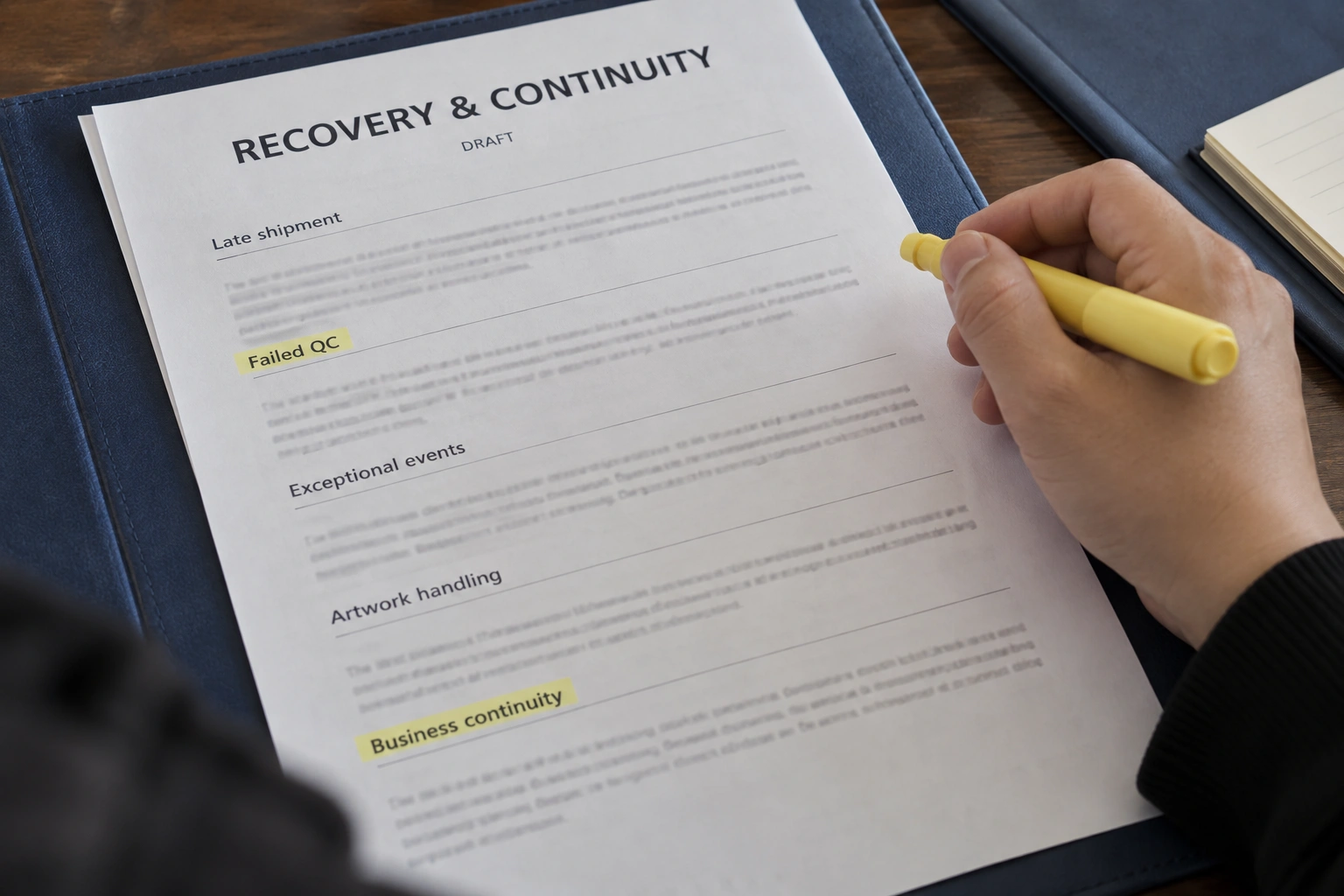
Recovery & Continuity Checklist for the Contract
Once the audit is complete, use this checklist to identify recovery and continuity points that should be documented in the quotation, purchase order, quality agreement, or contract. Final terms should be reviewed according to your company’s purchasing policy and applicable law.
| Recovery item | Ask for in writing | Why it matters |
| Late shipment remedy | Defined credit or freight-upgrade trigger point | Removes ambiguity on when a delay becomes a breach |
| Failed QC or misprint | Reproduction timeline and process | Sets a measurable recovery expectation |
| Force majeure and exceptional events | Covered events, notice duties, mitigation steps, and revised schedule | Clarifies how both parties respond when an exceptional event affects production |
| IP and artwork handling | Written terms for storage, use, and deletion of provided brand assets | Protects brand assets shared during proofing and production |
| Business continuity | Backup facility or key-person contingency, where relevant to order size | Reduces exposure if the primary facility or contact is unavailable |
Frequently Asked Questions
How is a supplier audit checklist different from a supplier scorecard
A checklist confirms whether specific evidence exists and matches the order — a yes/no or pass/fail review. A scorecard then weighs and scores that evidence to compare suppliers against each other. Most procurement teams use the checklist first, then feed the results into a scorecard for the final decision.
Should every supplier go through all 25 points
Not necessarily. Audit depth can be scaled to order risk, as shown in the audit-depth table above. A low-risk reorder from an already-approved supplier may only need a lightweight review, while a new supplier in a regulated category should go through the full checklist plus specialist review.
Who should own the audit process inside a procurement team
Typically the category procurement manager running the sourcing decision, with compliance, quality, or legal brought in for flagged items rather than for every audit. Naming one accountable owner before outreach begins keeps the process consistent across suppliers.
What happens if a supplier refuses to provide requested evidence
Treat a refusal or an unexplained delay in providing standard evidence, such as a compliance certificate or written capacity statement, as a red flag in its own right. A supplier that cannot produce documentation on request is unlikely to produce it later when a problem occurs.
How does this checklist apply to regulated product categories
Regulated categories such as children’s products or food-contact items typically need additional, category-specific documentation beyond the 25 general points — see our promotional product compliance resource for category-specific guidance.
Sources and Further Guidance
US Consumer Product Safety Commission — Children’s Product Certificate
California OEHHA — Proposition 65 Frequently Asked Questions for Businesses
UK Government — Placing Manufactured Products on the Market in Great Britain
Google Search Central — Creating Helpful, Reliable, People-First Content
Author & Reviewer
Written by Claire Morgan, Senior Content Writer, with professional experience running supplier due diligence for branded merchandise programs.
Freshness & Update Log
- Published: September 16, 2026
- Last Reviewed: September 16, 2026
- Next scheduled compliance check: within 12 months, or sooner if referenced regulatory guidance changes.
Request a Scoped Quote
If you are preparing to audit a supplier shortlist for an upcoming order, share your product specifications, quantity, branding, destination market, and required delivery date. Our team can apply this checklist to your shortlist as part of a scoped quote and sourcing review.
Prefer a lighter first step? Send us your current supplier’s compliance documents for a documentation review before you commit to a full audit.
Related Resources
- /promotional-product-sourcing/ — primary commercial page: request a scoped quote and sourcing review.
- /promotional-product-compliance/ — category-specific compliance requirements and documentation.
- /supplier-onboarding-guide/ — how new suppliers are onboarded and audited after selection.
- /quality-control-process/ — how proofing and QC are run once a supplier is approved.