When a fixed event or campaign date is coming, ready stock vs custom production comes down to one rule: choose the most customized option whose latest safe order date has not yet passed, after adding a delivery contingency buffer. Ready stock suits short deadlines and low sourcing risk, while custom production suits longer windows where branding, packaging or specification must be exact. This guide covers promotional gift and branded merchandise orders shipped cross-border to overseas B2B buyers, with assumptions dated 11 November 2026. Lead times and costs vary by factory, product and season, so confirm every figure in a written quote.
Operations Managers rarely lose a deadline because they picked the wrong product. They lose it because the route was chosen before anyone checked how much time remained. The ready stock vs custom production decision is really a turnaround planning decision: every extra layer of customization adds approvals, samples and production steps, and each one adds sourcing risk. Below you will find a decision table, a six-step framework, a backward-planning formula, a risk register and a buyer checklist, all built to help you match customization ambition to the time you actually have. If you want to see how orders are scheduled across partner factories, our factory and supply network page explains the commercial side.
Scope, Market and Assumptions Behind This Ready Stock vs Custom Production Guide
In this guide, ready stock means existing finished blanks that only need decoration such as printing, engraving or simple packing changes. Custom production means new or modified tooling, materials, colors, structures or packaging made to your specification. A hybrid route, where a ready stock blank receives custom decoration or packaging, sits between the two and is often the practical answer when the calendar is tight.
| Assumption | Value used in this guide | How to verify |
| Review date | 11 November 2026 | Re-check freight, tariff and factory capacity before any commitment |
| Product scope | Promotional gifts and branded merchandise | Confirm product category and decoration method in the quote |
| Buyer market | Overseas B2B buyers ordering from an Asian supply network for a fixed delivery date | State the destination country and Incoterm in your request |
| Order pattern | Single production run, no reorder | Ask whether reorder slots are available if demand exceeds forecast |
| Lead times and prices | No universal figures are given; examples are hypothetical | Use only written supplier quotes with a validity date |
| Out of scope | Product compliance testing, customs classification, current tariff rates | Consult your compliance team and official customs sources |
Keeping these assumptions visible matters because a framework is only as reliable as the inputs behind it. If your destination, quantity or product category differs, treat the framework as a structure to fill with your own figures rather than a set of answers.
Ready Stock vs Custom Production: The Decision Table
The table below compares the two routes using criteria a buyer can verify with a supplier before committing. It deliberately avoids universal prices or lead times, because those depend on the factory, the season and the specification.
| Criterion | Ready stock | Custom production | What to verify |
| MOQ | Often lower, tied to available inventory | Often higher, tied to tooling and material runs | MOQ per color and per SKU, in writing |
| Lead time driver | Decoration, packing and transit | Approvals, sampling, production, QC and transit | Stage-by-stage schedule with dates |
| Customization depth | Logo, color of decoration, simple packaging | Shape, material, color matching, structure, packaging | Which elements are fixed and which can change |
| Material and spec control | Limited to what the blank already is | Specified by you and checked at sample stage | Material declaration and sample approval record |
| Sourcing risk | Stock may be sold or differ by batch | Delay, rework or color drift during production | Stock confirmation date; QC criteria and tolerance |
| Cost pattern | Lower setup, unit cost set by the blank | Setup or tooling cost spread over the run | Itemized quote: unit, setup, packing, freight |
| Best fit | Short deadlines and low-risk campaigns | Longer windows and brand-critical items | Your latest safe order date from Table 4 |
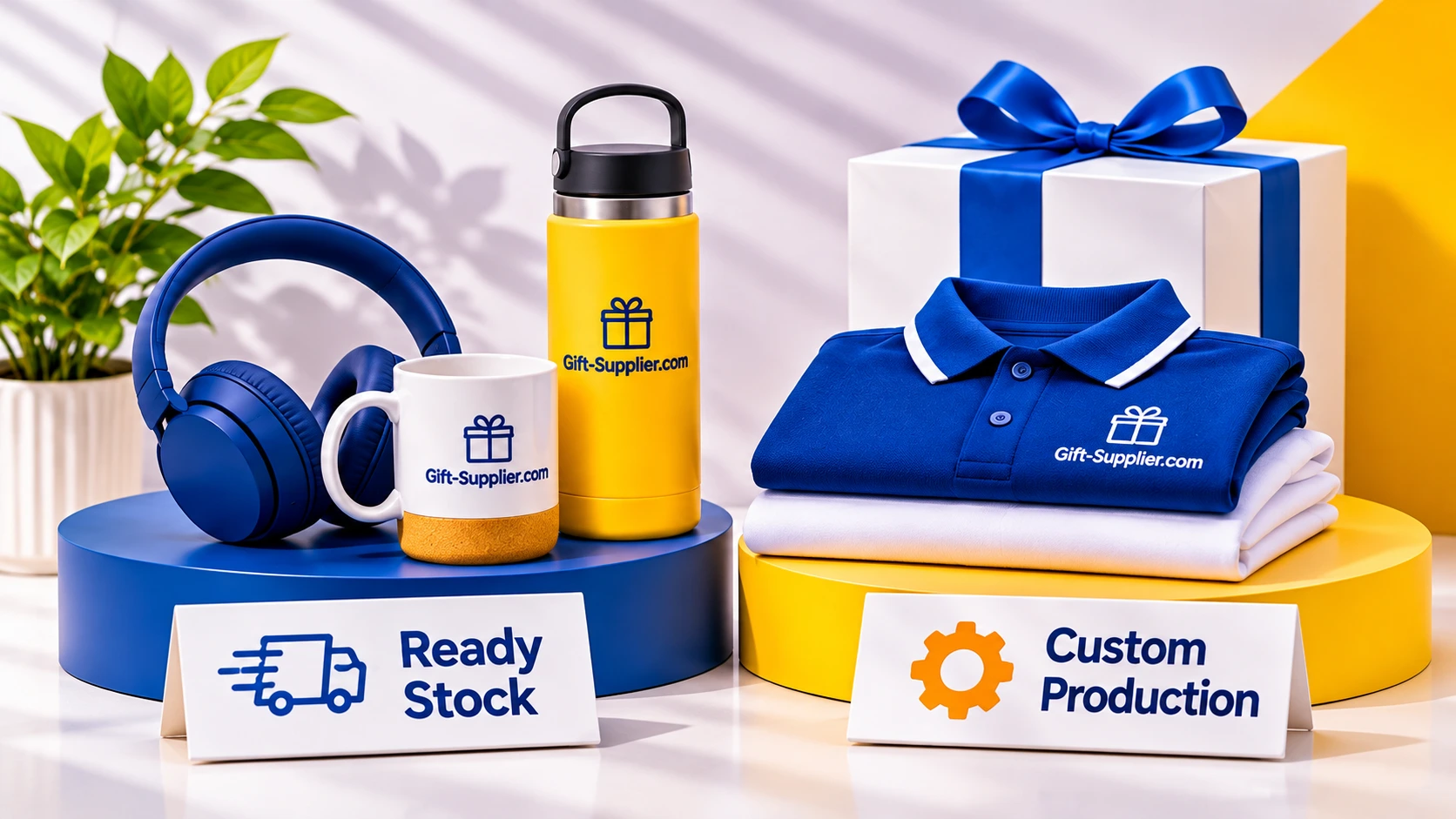
Customization ambition and sourcing risk rise together, so the table works best as a screening tool. If the criteria you care about most sit in the custom column, move on to Step 3 below to test whether your calendar can support that route. Capability details such as factory assessment and order management are summarized on our factory and supply network page.
A Six-Step Framework for Ready Stock vs Custom Production Decisions
Use these six steps in order. Each has a named decision owner so the choice between ready stock and custom production is made once, with evidence, rather than renegotiated every week.
- Step 1 – Fix the immovable date (owner: Operations Manager). Write down the date goods must be in hand, not the date they ship. Separate the event date from the warehouse receipt date.
- Step 2 – Rate your customization ambition (owner: Marketing or Brand Lead). Score each element as low (logo only), medium (new color or packaging) or high (new tooling or material).
- Step 3 – Calculate the time remaining (owner: Operations Manager). Subtract today from the delivery date, then compare the result to the ready stock path and the custom production path in Table 4.
- Step 4 – Score the acceptable sourcing risk (owner: Procurement Lead). Decide in advance how much delay the campaign can absorb and who approves spending on faster freight.
- Step 5 – Choose the route using Table 3 (owner: Operations Manager with Procurement). Match your ambition level and time remaining to the recommended route, including the hybrid option.
- Step 6 – Lock the contingency and request the quote (owner: Procurement Lead). Agree a fallback trigger date, then send a scoped request so the supplier can confirm stock, schedule and QC.
| Time remaining | Low ambition (logo only) | Medium ambition (color or packaging) | High ambition (tooling or material) |
| More than the custom path plus buffer | Ready stock or custom, based on cost | Custom production or hybrid | Custom production |
| Between the ready stock path and the custom path | Ready stock | Hybrid: ready stock blank with custom packaging | Reduce ambition or move the date |
| Less than the ready stock path plus buffer | Ready stock with air freight option priced | Ready stock, decoration only | Not recommended; renegotiate the deadline |
Turnaround Planning: Work Backward From the Deadline
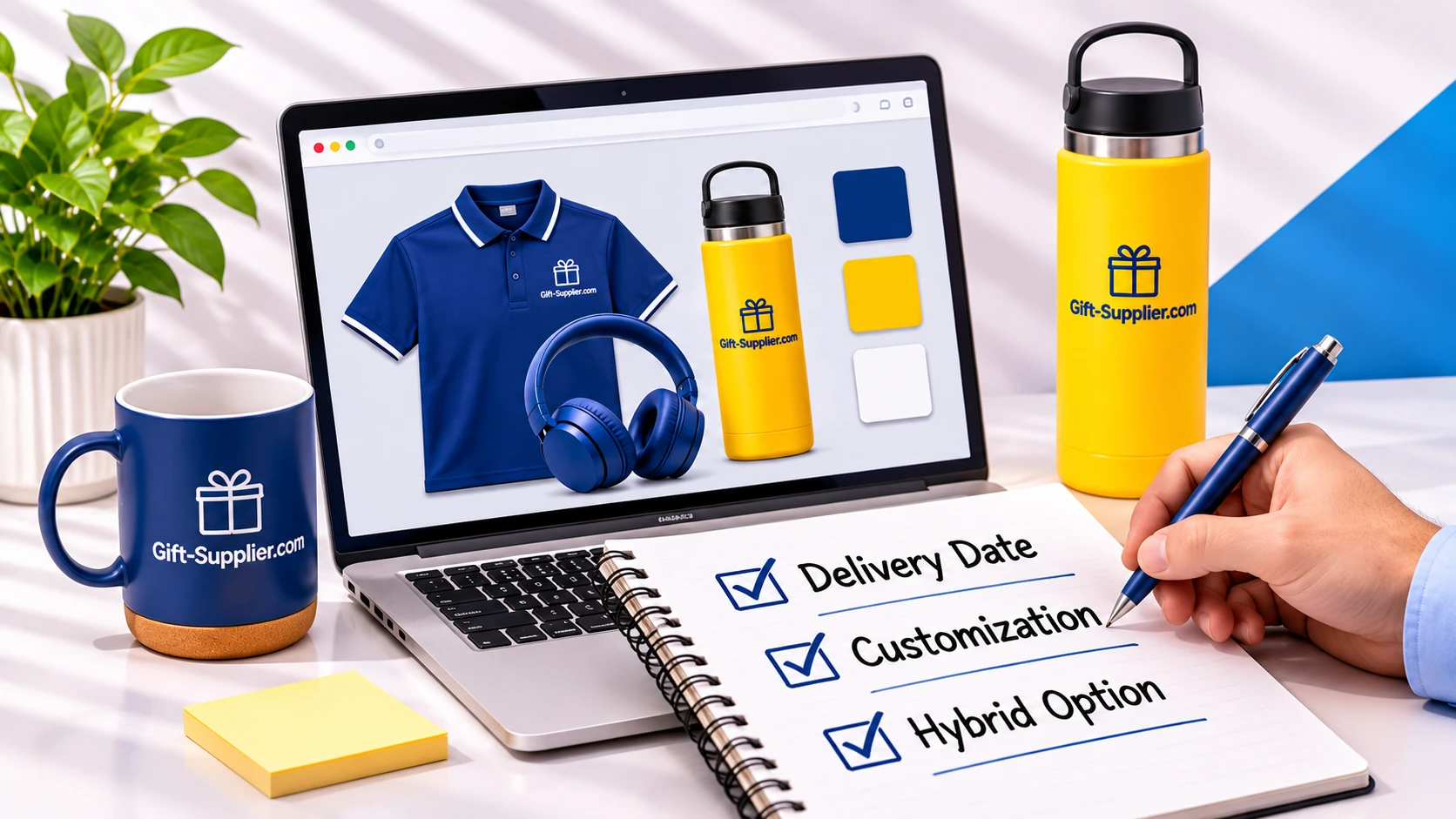
Good turnaround planning starts at the delivery date and moves backward, because the buyer controls the date while the supplier controls the stages. The formula below gives you the latest safe order date for each route.
Latest safe order date = Delivery deadline – (approval time + sampling time + production or decoration time + final QC and packing + transit + delivery contingency)
Run the formula twice, once for each route. If the custom production date has already passed, the ready stock vs custom production question is answered by the calendar, not by preference. If both dates are still open, use Table 3 to decide.
| Stage | Ready stock route | Custom production route | Decision owner |
| Artwork and spec approval | Artwork only | Artwork, specification and materials | Brand Lead |
| Sample or pre-production proof | Digital proof, sometimes a physical sample | Physical sample and approval record | Operations Manager |
| Production or decoration | Decoration on existing stock | New production run | Supplier, tracked by Procurement |
| Final QC and packing | Check decoration and count | Check spec, color tolerance, count and packing | QC lead or third-party inspector |
| Transit | Freight mode and Incoterm confirmed | Freight booked against the real ready date | Logistics lead |
| Delivery contingency buffer | Set as a fixed block of time | Larger block because more stages can slip | Operations Manager |

Sourcing Risk and Delivery Contingency by Route
Sourcing risk changes shape between routes. Ready stock risk is mostly about availability and batch consistency. Custom production risk is mostly about schedule slippage and approval loops. A delivery contingency plan should name the trigger, the action and the person who can approve it before the order is placed, not after the delay appears.
| Failure mode | Ready stock exposure | Custom production exposure | Contingency trigger and action |
| Stock or material not as confirmed | Stock sold or batch differs | Material substitution | Written stock hold; approve substitutes only after a sample |
| Color or finish mismatch | Blank differs slightly between batches | Color drift against the master sample | Agree tolerance and photo or color-reference proof before bulk |
| Production delay | Decoration queue | Capacity or rework | Fixed checkpoint dates; escalate if a checkpoint is missed |
| Artwork or spec rejected | Re-proof only | Resample and re-approval | Freeze artwork by a named date; limit approval rounds |
| Transit disruption | Same exposure | Same exposure, with less spare time | Pre-price a faster freight mode and set the decision date |
Notice that transit risk is identical for both routes, yet custom production leaves less room to absorb it. This is why the contingency buffer in the formula should grow as customization increases, and why the cheapest unit price can become the most expensive outcome if the date slips.

Worked Example: Ready Stock vs Custom Production Against a Fixed Date
The figures below are hypothetical and are provided only to show how the calculation works. They are not a quote, a benchmark or a promise of lead times. Replace them with the stage durations in your supplier’s written quote.
Suppose an Operations Manager must receive goods on 15 March 2027 and today is 15 January 2027, leaving 59 days. The table shows how the same deadline treats each route.
| Stage | Ready stock route | Custom production route |
| Approval | 3 | 5 |
| Sampling | 0 (digital proof) | 10 |
| Production or decoration | 7 | 20 |
| Final QC and packing | 2 | 3 |
| Transit | 10 | 10 |
| Delivery contingency buffer | 5 | 10 |
| Total | 27 days | 58 days |
| Float against 59 days | 32 days | 1 day |
The custom route technically fits, but one day of float leaves no space for a missed approval or a transit delay. In this example the sound decision in the ready stock vs custom production debate is a hybrid: use a ready stock blank and apply the custom decoration or packaging that matters most, which leaves far more float.

Buyer Checklist Before You Choose a Route
Work through this list before requesting a quote for either route. Each item removes a common cause of late or mismatched orders in a ready stock vs custom production decision.
- Delivery date and the receiving address, with the contact who accepts the goods, are written down.
- Customization ambition is scored low, medium or high for each element of the order.
- The latest safe order date has been calculated for both routes using the formula above.
- Acceptable delay and the person who can approve faster freight are agreed internally.
- Stock availability and a stock hold period are requested in writing for ready stock.
- A master sample, color reference or material specification is available for custom production.
- Approval rounds and freeze dates for artwork and specification are fixed.
- QC criteria, tolerance and inspection method are agreed before production starts.
- A contingency trigger date and fallback route are documented and shared with the supplier.
- The quote states unit price, setup cost, packing, freight terms and a validity date.
Risks and Limits of This Framework
No framework removes uncertainty, and overclaiming would defeat its purpose. Keep these limits in mind whenever you apply a ready stock vs custom production framework to a live order.
- The framework supports a scheduling decision; it does not predict a factory’s actual lead time, which only a written quote can confirm.
- Hypothetical figures in this guide are examples, not benchmarks, and should never be copied into a plan.
- Freight conditions, tariffs and capacity change, so any figure older than the quote validity date needs re-checking.
- Product compliance, labeling and customs requirements depend on the product and destination and are outside this guide.
- A hybrid route reduces schedule risk but may not deliver every brand requirement; confirm what you are giving up.
- Faster freight can recover some delay but cannot recover a missed approval or a failed sample.

Request a Scoped Quote
Primary action: Request a scoped quote with your delivery date, quantity range and customization level, so the ready stock vs custom production routes can be priced and scheduled against your real deadline.
Secondary action: Send your artwork or specification for a document review before you request pricing, so approval time is estimated realistically.
Frequently Asked Questions
How late can I decide between ready stock and custom production?
Decide before the latest safe order date of the custom route has passed. After that date, the choice is effectively ready stock or a hybrid, because the custom route no longer has contingency time.
Does ready stock always cost less than custom production?
Not always. Ready stock usually avoids setup or tooling cost, but the unit price depends on the blank, quantity and decoration. Compare itemized quotes rather than assuming.
What is a hybrid route and when does it make sense?
A hybrid route uses an existing blank and customizes only the most visible elements, such as decoration or packaging. It suits mid-ambition projects with limited time.
How much delivery contingency should I add?
There is no universal figure. Size the buffer to the number of approval and production stages, and make it larger for custom production. Ask the supplier which stages have slipped before.
What should I send to get a reliable quote?
Send the delivery date, destination, quantity range, customization level, artwork or specification files and your fallback preference. Our team can review these through the factory and supply network page at gift-supplier.com/factory-and-supply-network/.
Sources and Further Guidance
ISO — ISO 31000:2018 Risk management — Guidelines
US Consumer Product Safety Commission — Children’s Product Certificate
UK Government — Placing Manufactured Products on the Market in Great Britain
International Chamber of Commerce — Incoterms® Rules
Author & Reviewer
Written by Claire Morgan, Senior Content Writer, with professional experience managing supply chain risk for branded merchandise programs.
Freshness & Update Log
- Published: November 11, 2026
- Last Reviewed: November 11, 2026
- Next scheduled review: within 6 months, or sooner if cited standards or compliance guidance changes materially.
Related Resources
- /promotional-products-budget-allocation/ — how to decide which portfolio tier a price-break decision should apply to.
- /questions-to-ask-a-promotional-product-supplier/ — 18 evidence-based questions to ask once quotes are in hand.
- /promotional-product-supplier-audit-checklist/ — the 25-point checklist for auditing a supplier before you award the order.
- /promotional-merchandise-vendor-consolidation/ — how vendor consolidation interacts with ongoing performance scoring.