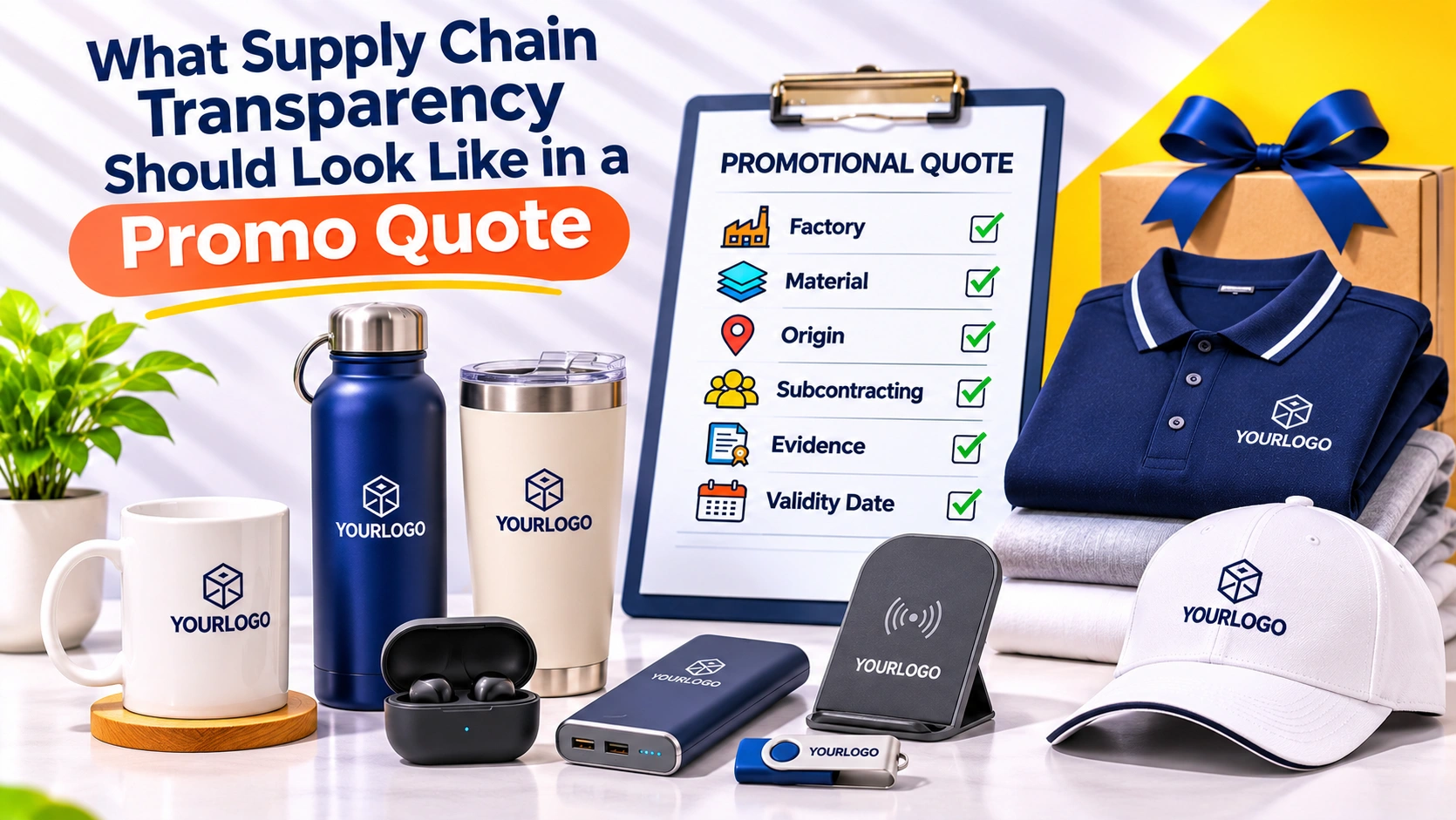
Promotional products supply chain transparency means a quote that names, in writing, who will make your product, from which material, in which country, which steps are subcontracted, and what evidence supports each statement. For an operations manager, a transparent quote carries five field groups: factory, material, origin, subcontracting and evidence. Each field should be specific, dated and attached to a named owner, so turnaround planning and delivery contingency can rest on facts. If a detail is not yet known, the quote should say so and state when it will be confirmed.
Most quotes show a unit price, a quantity break and one headline lead time. That is enough to compare price, but not enough to judge turnaround planning, sourcing risk or delivery contingency, because the quote hides who actually does the work and where the sourcing risk sits. Below you will find a decision table for comparing quote quality, field-by-field specifications, a seven-step review workflow, a buyer checklist and a worked example. The guidance does not replace legal or customs advice, which depends on your product and destination market.
Why Promotional Products Supply Chain Transparency Starts With the Quote
A quote is the earliest document in which a supplier commits to a version of your supply chain, and the first input to turnaround planning. After the purchase order is placed and the artwork is approved, changing a factory, a material or a decoration method costs time that a campaign rarely has. Promotional products supply chain transparency therefore has to be built into the quote itself, not requested after the deposit is paid.
Operations managers are accountable for three outcomes that transparency directly affects: whether the order lands on the date, whether production matches the approved sample, and whether the buyer can explain origin and materials to internal stakeholders. Gaps usually appear where the quote is silent, such as a second site for decoration, a substituted fabric or a packing location in another country. Each silence is a sourcing risk that someone must absorb later, usually through an unplanned delivery contingency.

Decision Table: Promotional Products Supply Chain Transparency in Opaque vs. Transparent Quotes
Use the table below to classify any incoming quote in a few minutes. Each criterion can be checked with a document, a call or a sample, so the comparison does not rely on trust alone. We deliberately show no universal prices or lead times, because both vary by product, decoration method and season.
| Criterion | Opaque quote | Transparent quote | How the buyer verifies |
| Factory identity | “Our factory” or a trading name only | Legal entity name, site address and the role of each site (assembly, decoration, packing) | Business licence, address check, audit summary or video walk-through |
| Material | “Premium polyester” or “high-grade metal” | Material grade, composition, colour reference and tolerance | Material data sheet, physical swatch, test report reference |
| Origin | “Made in Asia” or one country for everything | Origin stated by stage: material, manufacture, decoration, final packing | Written origin statement cross-checked against shipping documents |
| Subcontracting | Not mentioned | Subcontracted steps named, with site and accountable party | Subcontractor list and change-notification clause in the PO to limit sourcing risk |
| Lead time basis | One number of days | Stage-by-stage days with the start trigger for each stage | Dated milestone schedule for turnaround planning, agreed before deposit |
| MOQ and validity | MOQ only | MOQ per colour and decoration, quantity tolerance, quote validity date | Compare against the order tolerance and validity clauses |
| Evidence | “Quality assured” | Named documents attached, dated and tied to a batch or approved sample | Document index with dates; signed sample approval record |
The Five Field Groups a Promo Quote Should Specify
These fields reflect what a supplier with a documented factory and supply network can usually state in writing. If your supplier cannot complete a field, record it as a gap rather than assuming the answer.
Factory fields
The factory fields answer a simple question: who will physically make this order, and do they have room for it? A trading company is not a problem in itself, but the quote must say so and name the production site behind it. Capacity should be stated against your quantity and delivery window, not as a generic monthly output figure.
| Field | What to require | Why it matters for turnaround planning | Red flag |
| Legal entity and site | Registered name and production address | Confirms who is accountable for the schedule | Only a brand or trading name |
| Production role | Assembly, decoration, packing: which site does which | Shows hand-offs that complicate turnaround planning | One site claimed for every step |
| Capacity allocation | Lines or shifts reserved for your quantity and dates | Tests whether turnaround planning is realistic | Capacity quoted as a general yearly figure |
| Backup site | Named alternate site, or a statement that none exists | Defines the delivery contingency options early | Backup promised but not named |
| Supplier-side owner | One named contact who can approve changes | Shortens escalation and supports delivery contingency decisions | Several contacts, no decision owner |

Material fields
Material detail is where substitution happens most quietly. A quote that says “premium” gives the factory room to change grade between sample and bulk. Ask for the grade, composition and colour reference, plus a clear rule on what happens if a material runs short. Any statement about restricted substances should state its scope, such as which standard and which components, rather than claiming the product is simply compliant.
| Field | Acceptable level of detail | Evidence to request | Sourcing risk if missing |
| Base material and grade | Named grade, not a marketing adjective | Material data sheet | Silent downgrade, a hidden sourcing risk, between sample and bulk |
| Composition | Percentages where the material is a blend | Supplier declaration or lab report | Feel, durability or labelling mismatch |
| Color reference | Pantone or physical standard with a stated tolerance | Signed colour standard | Colour disputes that call for a delivery contingency |
| Substitution rule | Written approval needed before any change | PO clause | Unapproved swaps that raise sourcing risk when stock is short |
| Test or compliance scope | Standard, component and market named | Test report with date | Over-reading a narrow report as full coverage |
Origin fields
Origin is easy to blur in promotional products supply chain transparency because three different ideas share one word. Material origin is where the raw material was produced. Manufacturing origin is where the main production took place. Final-processing origin is where decoration, assembly or packing was completed. A quote should state all three where they differ. The legal country of origin used for customs is set by the rules of the importing market and can differ from a marketing claim, so confirm it with your customs broker before it appears on a buyer-facing document.
Subcontracting fields
Subcontracting is common and not automatically a problem. The risk lies in undisclosed subcontracting, because the schedule, quality control and accountability all move to a party you have never evaluated. Ask the supplier to list every step that may leave the main site, and to commit to notifying you before any change.
| Process step | Disclosure the quote should include | Question to ask | Impact if changed late |
| Decoration (print, embroidery, engraving) | Site name and method | Is this done in-house at the main site? | Colour variance and added sourcing risk |
| Plating, coating or finishing | Named finishing site | Who inspects before the next stage? | Added transit days that disrupt turnaround planning |
| Components and accessories | Source and approval status | Is the component part of the approved sample? | Fit mismatch and sourcing risk |
| Packing and kitting | Site and packing standard | Is final packing separate from production? | Carton or count errors that trigger delivery contingency |
| Freight consolidation | Who books and who is the contact | Who owns the cargo during consolidation? | Missed cut-off that triggers delivery contingency |
Evidence fields
Evidence is the field group that turns promotional products supply chain transparency from statements into something you can check. Not every claim needs the same proof. A useful habit is to match the level of evidence to the impact of the claim: a packing location may need only a statement, while a material or test claim needs a document tied to a date and a batch or sample.
| Level | Evidence type | Example | What it shows | Limit |
| 1 | Supplier statement | Written origin or subcontracting declaration | Supplier commits to a position | Not independently checked |
| 2 | Document | Business licence, material data sheet | The entity or material exists as described | May not match your batch |
| 3 | Sample or proof | Approved pre-production sample | The agreed standard for bulk | Does not prove bulk consistency |
| 4 | Independent test or inspection | Third-party report with a named method | Result for the tested scope | Valid only for scope and date |
| 5 | Buyer or third-party visit | Site audit or witnessed production check | Practices at the time of the visit | Snapshot, not continuous assurance |
A Seven-Step Buyer Framework for Reviewing a Quote
The framework below is a real workflow an operations team can run on every incoming quote to raise promotional products supply chain transparency. Each step has a decision owner, so gaps do not stay unassigned. It is procedural guidance for the buyer, and it works for any promotional product category.
- Send the field template with the request. Build promotional products supply chain transparency in from the start: ask suppliers to complete factory, material, origin, subcontracting and evidence fields. Owner: Operations Manager.
- Mark each field. Label every field as stated, partly stated or missing, so turnaround planning rests on facts. Owner: Operations Manager.
- Request evidence on high-impact fields first. Start with factory, material and subcontracting, where sourcing risk is highest. Owner: Operations Manager with the quality lead.
- Score the quote. Apply the scorecard below. Owner: Operations Manager.
- Turn gaps into sourcing risk entries. Record each gap with an owner and a due date. Owner: Operations and Procurement.
- Set delivery contingency triggers. Tie each trigger to a disclosed production stage, such as a missed material arrival date. Owner: Operations Manager with the supplier account manager.
- Lock disclosed fields into the purchase order. Add a change-notification clause so later changes need written approval. Owner: Procurement or Legal.
The promotional products supply chain transparency scorecard
Score each of the six field rows (factory, material, origin, subcontracting, lead time basis, evidence). Give 2 points for a field that is stated and backed by evidence, 1 point for stated without evidence, and 0 for missing. The formula is: Promotional products supply chain transparency score = (points earned ÷ (number of fields × 2)) × 100.
| Score | Interpretation | Suggested action |
| 75 to 100 | Most fields stated and evidenced | Proceed to sample approval; lock fields in the PO and confirm turnaround planning |
| 50 to 74 | Material gaps remain | Request evidence on sourcing risk fields before deposit |
| Below 50 | Quote cannot support planning | Ask for a revised quote or compare an alternative supplier |
Buyer checklist: confirm promotional products supply chain transparency before you approve a quote
☐ Legal name and production address of every site are stated.
☐ Each site has a stated role, and a backup site is named for delivery contingency, or confirmed as none.
☐ Material grade, composition and colour reference are written, with a tolerance.
☐ Origin is stated for material, manufacture and final processing.
☐ Every subcontracted step is listed as a sourcing risk, with a change-notification clause.
☐ Lead time is shown stage by stage for turnaround planning, with the start trigger for each stage.
☐ Evidence documents are attached, dated and tied to a batch or sample.
☐ Quote validity date and quantity tolerance are stated.
Worked Example: Reading a Quote Line by Line
The scenario below uses an anonymized structure to show the method: an operations manager at a conference organizer requests 3,000 branded insulated bottles. Quantities and wording are illustrative, and the example focuses on turnaround planning and sourcing risk. Before publication, replace or supplement this section with an anonymized real quote or sample record from your own files.
| Field | Quote as received | Question raised | Revised quote line |
| Factory | “Our factory in the south” | Which legal entity and site? | Legal entity and address named; role: assembly and packing |
| Material | “Premium stainless steel” | Which grade and finish? | Grade and finish stated; data sheet attached |
| Origin | Not stated | Where are material and final processing done? | Material, manufacture and decoration origins stated separately |
| Subcontracting | Not stated | Is decoration done in-house, or is it a sourcing risk? | Laser engraving at a named second site; notice required before any change |
| Lead time basis | “25 days” | Counted from which trigger? | Stage days for turnaround planning, counted from artwork and sample approval |
| Evidence | “Quality assured” | Which documents, dated when? | Licence, data sheet and pre-production sample record attached |
As received, three fields were stated without evidence (factory, material, lead time basis) and three were missing or unsupported (origin, subcontracting, evidence). That earns 3 points out of 12, a score of 25, which falls in the lowest band. After the revision, factory, material and evidence each earn 2 points, while origin, subcontracting and lead time basis each earn 1, for 9 of 12, a score of 75. Nothing about price changed; the buyer simply gained the information needed to plan.
Using Disclosed Fields for Turnaround Planning, Sourcing Risk and Delivery Contingency
Turnaround planning. Stage-by-stage lead times let you build a backward schedule from the event date and see which hand-off holds the least slack. A single headline number cannot be tested, but a stage schedule can be compared with the supplier’s dated milestones as the order progresses. Good turnaround planning starts with that comparison.
Sourcing risk. Once factory, material and subcontracting fields are filled, sourcing risk is easier to map, and single points of failure become visible: one finishing site, one material supplier, one packing line. Record each as a risk entry with an owner. A transparent quote does not remove sourcing risk; it makes the risk visible early enough to act. This is the practical value of promotional products supply chain transparency.
Delivery contingency. Delivery contingency options such as a backup site, split shipment or a ready-stock fallback only work when they are agreed before production starts. Tie each trigger to a disclosed stage, for example a missed material arrival date, and name who decides. A written delivery contingency saves days when something slips. For wider planning, read our related guides on timeline planning and on handling a late production order.

Risks and Limits of Promotional Products Supply Chain Transparency
- Disclosure is not assurance. A named factory and a data sheet show what the supplier says and documents. They do not prove that every batch matches.
- Documents age. Test reports and licences are valid for a scope and date. Check that the document covers the product version you are ordering, or you carry a sourcing risk.
- Origin rules differ by market. The legal country of origin depends on the importing country’s rules. Use a customs broker for decisions that affect duties or labelling, and keep a delivery contingency if clearance is uncertain.
- More fields can slow quoting. Asking for detail adds effort at the quote stage, so use the full template for turnaround planning on higher-value or deadline-critical orders and a shortened version on repeat orders.
- Small runs have limits. Suppliers may not be able to name every sub-tier source for low quantities, so record the gap as a sourcing risk with an owner rather than blocking the order.
- The score is a screening tool. The bands in this guide are a working aid and should be tuned to your own history.
Frequently Asked Questions
Can a supplier withhold the factory name for confidentiality?
Some suppliers prefer to disclose after a confidentiality agreement or a deposit. That can be reasonable, but the quote should still state the legal entity, the production role and a date by which the name will be shared. Without a date, turnaround planning and delivery contingency both stall.
How much subcontracting disclosure is reasonable on a small order?
Ask for every step that may leave the main site and a promise to notify you before any change. For small orders you may not need the name of every sub-tier source, but you should know about decoration, finishing and packing, since each is a sourcing risk.
Does a transparent quote cost more or take longer?
It can add effort at the quote stage, though it reduces sourcing risk later, because the supplier must confirm more details. Whether that changes price depends on the supplier and the product, so compare quotes on the same fields instead of assuming a cost. Promotional products supply chain transparency is easier to price once every supplier answers the same questions.
What if material origin and manufacturing origin differ?
State both separately in the quote. The legal origin for customs is determined under the importing market’s rules, so confirm with your customs broker before you use it in any buyer-facing claim.
Which evidence should I prioritize on an urgent order?
For delivery contingency, start with the claims that would cause the most damage if wrong: the production site, the material grade and any subcontracted decoration. A signed pre-production sample often gives the most useful proof when time is short.
Sources and Further Guidance
ISO — ISO 31000:2018 Risk management — Guidelines
US Consumer Product Safety Commission — Children’s Product Certificate
UK Government — Placing Manufactured Products on the Market in Great Britain
International Chamber of Commerce — Incoterms® Rules
Author & Reviewer
Written by Claire Morgan, Senior Content Writer, with professional experience managing supply chain risk for branded merchandise programs.
Freshness & Update Log
- Published: November 12, 2026
- Last Reviewed: November 12, 2026
- Next scheduled review: within 6 months, or sooner if cited standards or compliance guidance changes materially.
Related Resources
- /promotional-products-budget-allocation/ — how to decide which portfolio tier a price-break decision should apply to.
- /questions-to-ask-a-promotional-product-supplier/ — 18 evidence-based questions to ask once quotes are in hand.
- /promotional-product-supplier-audit-checklist/ — the 25-point checklist for auditing a supplier before you award the order.
- /promotional-merchandise-vendor-consolidation/ — how vendor consolidation interacts with ongoing performance scoring.