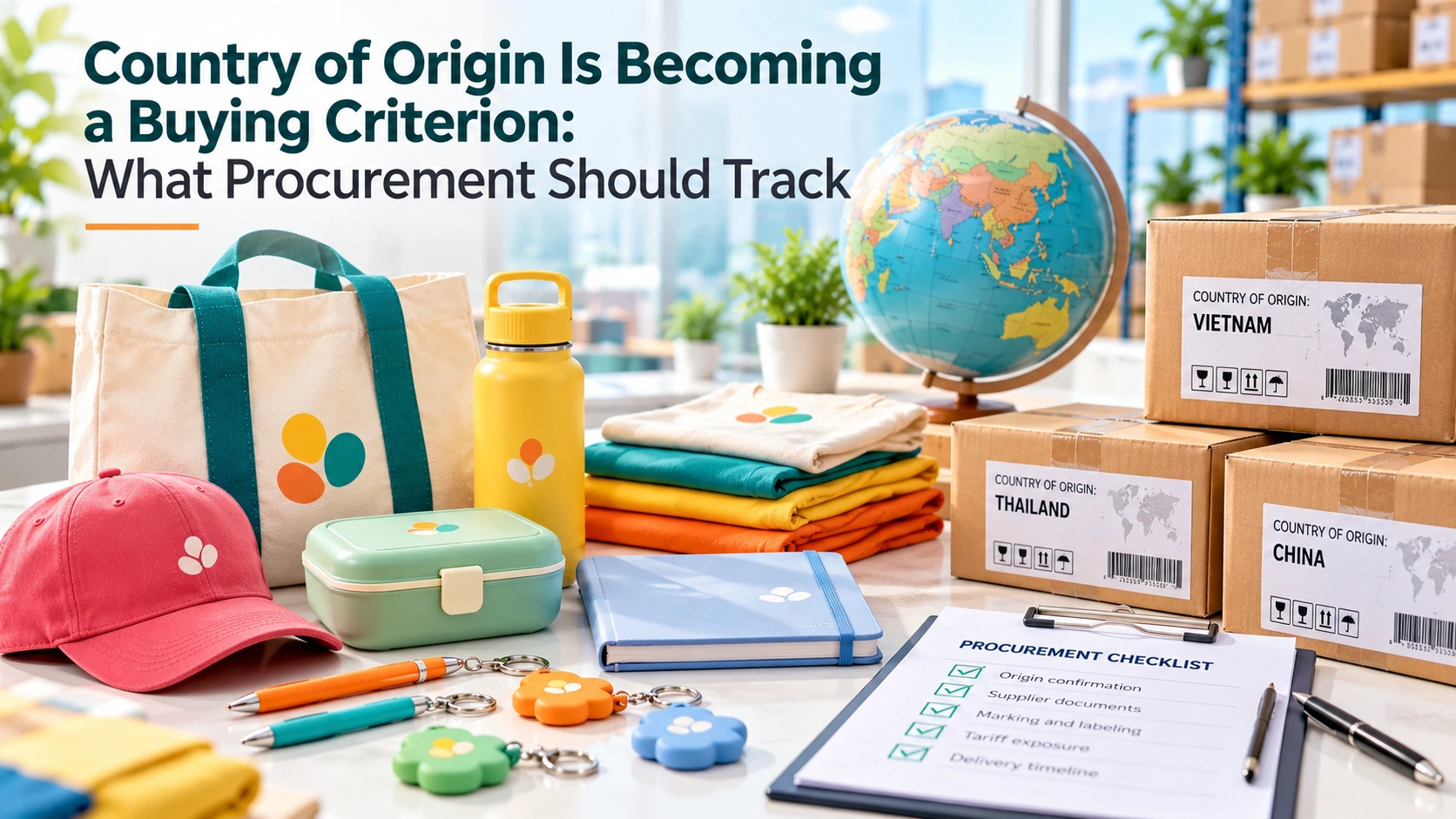
Procurement teams should track four things once country of origin enters a promotional product brief: the evidence that supports an origin claim, how the end audience perceives that origin, how tariff and customs exposure changes landed cost, and how well the plan holds up when a schedule slips. A sound promotional products country of origin strategy turns those four into scored, verifiable fields on every quote instead of a preference stated late in the project. Imported branded merchandise for corporate and B2B programs, with the United States as the reference market.
Origin used to be a line on a commercial invoice. For an Operations Manager running a merchandise program, it now touches four decisions at once: whether a quote is acceptable, what the order really costs on arrival, what the recipient will read on the product, and what happens to the delivery date if the plan has to change. This guide is written by the team at gift-supplier.com from the supplier side of quotes, samples and production schedules. It explains what to track, how to verify it, and how to score it before a purchase order is released. It does not replace advice from a licensed customs broker or trade counsel.
Why a promotional products country of origin strategy is now a buying criterion
Four pressures are converging on merchandise programs. Customs and tariff exposure can differ by origin and can change on a specific date. Clients and recipients increasingly ask where goods are made, and some procurement policies write the answer into contracts. Any origin claim printed on a product or carton must be accurate. And a single-origin plan has one route and one set of failure modes, which matters for turnaround planning when the in-hand date is fixed.
The practical problem is timing. The cost of changing origin rises with every approval gate: after the brief, after sample approval, after artwork sign-off, after purchase order release. Sourcing risk also grows when origin is chosen late, because fewer fallback options remain. Buyers who record origin requirements at the RFQ stage keep the most options open. The table below turns the pressures into fields procurement can actually track.
| Driver | What to track | Decision owner | Where it shows up |
| Customs and tariff exposure | Product classification, declared origin, measures in force on the date of entry, importer of record | Operations with customs broker | Landed-cost line; quote validity window |
| Marking and labeling | Required origin mark, location, legibility, carton-level marking, any voluntary claims | Operations with brand or compliance lead | Sample approval; artwork proof |
| Audience perception | Client policy, recipient expectations, claim wording | Account or marketing lead | Brief; RFQ criteria |
| Schedule resilience | Sample loop, production time, transit mode, fallback origin | Operations Manager | Backward timeline; contingency buffer |
| Evidence quality | Supplier declarations, production site, records that match the purchase order | Procurement | RFQ response; document review |
What origin means inside a promotional products country of origin strategy
Confusion often starts because “origin” answers three separate questions. For US customs marking, the regulations define country of origin as the country of manufacture, production or growth of a foreign article entering the United States, and imported articles or their containers generally must be marked unless an exception applies (19 CFR Part 134). For duty, origin works alongside classification and whichever trade measures are in force at entry. For marketing, a voluntary “Made in USA” claim is judged under the FTC standard, which looks for products that are “all or virtually all” made in the United States (16 CFR Part 323).
These can give different answers for the same item. Whether decoration, assembly or packing in a second country changes the origin of a product is a classification and legal question, not a supplier preference. Ask your broker before you build a claim into artwork. Rules outside the United States differ, so the framework below needs adapting if you import into another market.
| Question | What it governs | Reference to check | Common trap |
| Marking origin | What the item and packaging must say when imported | 19 CFR Part 134 (CBP) | Mark missing, illegible, or applied at the wrong container level |
| Duty origin | Which tariff measures may apply to the entry | Harmonized Tariff Schedule; CBP and USTR notices | Assuming marking origin and duty treatment always match |
| Marketing claim | Voluntary statements such as “Made in USA” | FTC Made in USA Labeling Rule, 16 CFR Part 323 | Claiming origin for an imported blank that is only decorated locally |

Origin evidence that strengthens a promotional products country of origin strategy
A quote is only comparable when the origin behind it is documented. Ask for the same evidence set from every supplier at the RFQ stage, then reconcile the documents against each other before the order is released. The most useful check is consistency: the factory named on the quote, the site on the production plan, the mark on the approved sample and the origin on the draft invoice should all tell the same story.
| Evidence | What it shows | Request at | Limit to remember |
| Supplier origin declaration per item | Where the product is made, and where relevant decorated and packed | RFQ | A statement, not an audit; compare with other records |
| Factory name and address for this order | The production site accountable for the PO | RFQ | Subcontracting can change the site; require notice of changes |
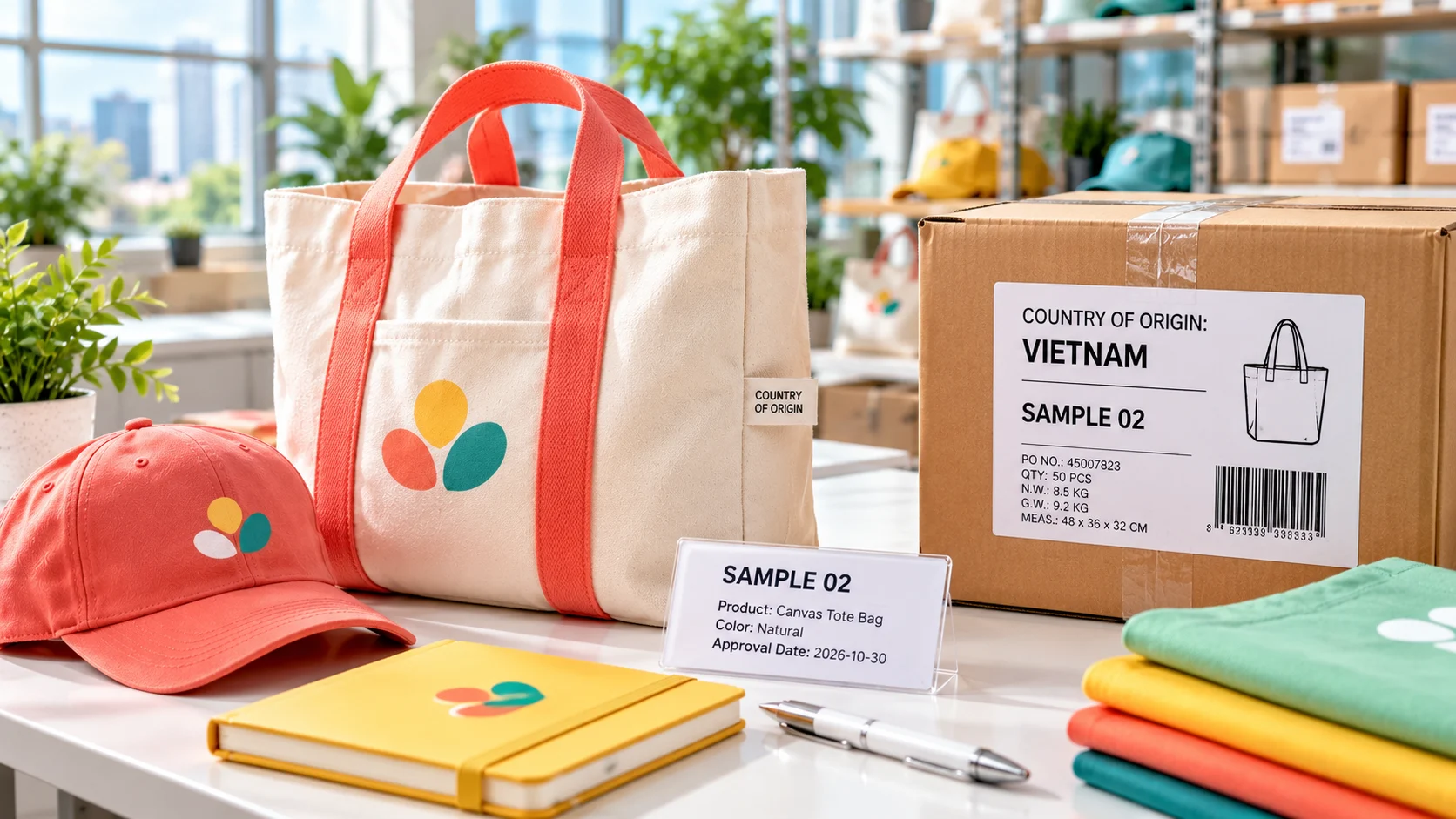
| Marking sample or artwork proof | How the origin mark appears on the item and packaging | Sample approval | Approve product-level and carton-level marking separately |
| Draft commercial invoice and packing list | Declared origin and values for customs entry | Before shipment | Must agree with marking and supplier declaration |
| Certificate of origin, where a program or buyer requires one | A formal origin statement under the applicable rules | Before shipment | Not needed on every shipment; does not replace marking |
| Material or component declarations, where a claim depends on them | Origin of key inputs | RFQ | Harder to document than finished-goods origin |
How audiences read origin: the perception layer
In any promotional products country of origin strategy, perception is audience-specific, and this guide does not offer survey data. Treat it as a question to put to the client, not an assumption to make on their behalf. A corporate client with a supplier code of conduct may restrict origins in writing. A public-sector contract may include domestic-content terms. A trade-show giveaway may attract little attention to origin at all. The shared rule is accuracy: whatever claim appears should match the evidence file.
| Audience context | Question to ask | Evidence to prepare | Risk if ignored |
| Enterprise client with a sourcing policy | Does a policy or supplier code restrict origins? | Written policy; origin declaration | Rejection at delivery or audit |
| Public-sector or regulated buyer | Are origin or domestic-content terms in the contract? | Contract clause; certificate where applicable | Non-compliance with contract terms |
| Event or trade-show giveaway | Will origin on the item be noticed or questioned? | Marking sample | Low consequence, but inaccurate claims still create exposure |
| Premium employee or customer gift | Does origin affect the brand story or perceived quality? | Sample comparison; claim wording | Mismatch between brand message and label |
Tariff considerations: track the date, not just the rate
Tariffs and trade measures are volatile, so this guide deliberately quotes no current rates. What procurement can control is the set of assumptions behind each quote: the classification used, the origin declared, the measure in force on the date of entry, who acts as importer of record, the Incoterms, and how long the price stays valid. A quote that does not state these assumptions cannot be compared fairly with one that does. Confirm all of them with your customs broker, and re-check them if the entry date moves. In practice, a promotional products country of origin strategy should track the date a measure applies as carefully as the rate itself.
To see why the assumptions matter, take a purely hypothetical item: a unit value of 2.00 USD, an order of 5,000 units, and duty applied to a customs value equal to that unit value (real customs valuation rules are more detailed). The rates below are scenarios for illustration, not current or expected rates.
| Scenario duty rate | Duty per unit (USD) | Duty on 5,000 units (USD) | Change versus 0% scenario (USD) |
| 0% | 0.00 | 0 | 0 |
| 5% | 0.10 | 500 | +500 |
| 10% | 0.20 | 1,000 | +1,000 |
| 25% | 0.50 | 2,500 | +2,500 |

Turnaround planning, sourcing risk and delivery contingency by origin
Origin changes the shape of a schedule, not only the price. It affects how quickly samples can be iterated, how long goods spend in transit, which holiday calendars apply, and which fallback options exist. Good turnaround planning starts from the in-hand date and works backward through transit, production, artwork approval and sampling. Sourcing risk is the concentration of dependency: one factory, one decoration site, one port. Delivery contingency is what you can do when something slips: a buffer, a split shipment, an air upgrade, or a pre-qualified second origin.
Nearshore or domestic production may shorten sample loops and transit, but it can also change unit price, MOQ and assortment. A split across two origins adds a fallback and adds management overhead, so a promotional products country of origin strategy should decide early whether that trade is worth making. Sourcing risk and delivery contingency planning belong in the same conversation. The table below compares options on criteria a buyer can verify. It contains no universal prices or lead times; fill each cell from real quotes.
| Criterion | Single offshore origin | Nearshore or domestic origin | Split across two origins |
| Unit price basis | Obtain FOB or EXW quote plus a landed estimate | Obtain delivered quote; compare on a landed basis | Two quotes; calculate a blended price at the split ratio |
| MOQ | Confirm per item, colour and decoration method | Confirm; may differ from the offshore MOQ | Check both; a split can push each lot below its MOQ |
| Sample lead time | Confirm sample build plus shipping time | Confirm; compare the full sample loop | Sample from both, or from the primary only |
| Production lead time | Confirm from artwork approval | Confirm from artwork approval | Longest lot sets the plan unless staged |
| Transit and handoffs | Ocean or air options; port and customs steps | Shorter transit; confirm handoffs and carrier | Two flows to track |
| Origin evidence | Declaration, marking sample, invoice | Same set; confirm component origin if a claim is made | Separate evidence file per lot |
| Tariff exposure | Classification and measure in force at entry | Confirm per route and origin | Exposure differs by lot; track both |
| Delivery contingency | Buffer, split shipment, air upgrade | Local re-run or expedite if capacity exists | Built-in fallback if both are pre-qualified |

A six-step buyer framework for your promotional products country of origin strategy
Use the steps below as a repeatable workflow. Each step has a named decision owner, so turnaround planning and sourcing risk reviews do not stall between departments. To see how production sites and handoffs are organized before you issue an RFQ, review our factory and supply network.
- Define why origin matters for this program.* Capture client policy, any claim you intend to make, and the in-hand date. Owner: Operations Manager with the account lead
- Put origin evidence into the RFQ. Ask every supplier for the Table 3 set so quotes are comparable. Owner: Procurement.
- Classify and check tariff exposure. Have the broker confirm classification, the measure in force at entry, and quote validity. Owner: Customs broker, confirmed by Operations.
- Score perception risk with the client. Confirm policy, wording of any claim, and the audience context from Table 4. Owner: Account or marketing lead.
- Stress-test the schedule backward from the in-hand date. Include sample loop, production, transit, and a delivery contingency buffer for each candidate origin. Owner: Operations Manager.
- Decide and record. Score the options, select an origin plan, and file the assumptions with the date and a re-review trigger. Owner: Operations Manager, with approval per internal policy.
| Criterion | Score 1 looks like | Score 5 looks like | Starting weight |
| Evidence quality | Declaration only, documents do not agree | Full Table 3 set, documents reconcile | 25% |
| Tariff exposure clarity | Classification and entry-date measure unconfirmed | Broker-confirmed, validity window stated | 20% |
| Schedule resilience | Single route, no buffer or fallback | Backward timeline with buffer and a pre-qualified fallback | 25% |
| Perception fit | Client policy unknown or in conflict | Policy confirmed; claim wording approved | 15% |
| Landed cost | Only unit price compared | Full landed estimate under stated assumptions | 15% |

Evidence block: what an origin check looks like on a quote
The most practical way to keep a promotional products country of origin strategy honest is a one-row-per-SKU evidence file that travels with the quote. The structure below is the working template. Each field can be filled only from documents and confirmations, never from memory or assumption.
| Field | What to record | Source of truth | Example entry |
| Item and quote reference | SKU, quantity, quote number | Quote | quote ref |
| Declared origin | Country of manufacture and of decoration | Supplier declaration | from declaration |
| Production site | Factory name and address for this PO | Supplier confirmation | from confirmation |
| Marking approved | Product and carton marking sample approved, with date | Approved sample | date and sample ID |
| Classification and tariff check | Broker confirmation and the date the entry-date measure was checked | Customs broker | broker, date |
| Quoted lead time and contingency | Sample loop, production, transit, buffer, fallback | Supplier quote | from quote |
SME input required before publishing: Insert one anonymized real quote, sample or process example from gift-supplier.com here (for example: quote reference, the origin options quoted, which evidence was requested, what the document review changed, and the lead-time outcome). Do not publish with invented figures, cases or certifications.

Risks and limits of a promotional products country of origin strategy
- Scope. This guide uses the United States as the reference market. Marking, duty and claim rules in other markets differ and need separate checks.
- Documents are statements. Declarations and certificates support an origin position but do not by themselves verify where production took place. For high-stakes programs, consider an independent check.
- Tariffs move. Any figure here is illustrative. Confirm the measure in force at entry with a broker, and revisit the assumptions if the entry date changes.
- Origin options are not available for every item. Decoration, assembly or packing in a second country raises classification and claim questions that need broker or counsel input.
- A closer origin is not automatically a more resilient one. Capacity, MOQ, assortment and quality trade-offs can outweigh transit gains, and sourcing risk can simply move rather than shrink. Verify them with a real quote.
- Perception is audience-specific. The audience table is a set of questions, not research findings.
Date-stamped assumptions and update log
| Assumption | Status at last review | Review trigger |
| Reference market is US imports | Applied throughout | Adding another destination market |
| No current tariff rates are quoted | Table 5 is hypothetical arithmetic | Any change in measures, or replacement with a real quote example |
| Regulations cited: 19 CFR Part 134; 16 CFR Part 323 | Reviewed 30 October 2026 | Amendment to either part or relevant agency guidance |
| Scorecard weights are starting values | Not benchmarked | After review of several real programs |
Frequently asked questions
Why is country of origin important when sourcing promotional products?
Country of origin plays an important role in promotional products country of origin strategy because it can affect import duties, customs requirements, shipping costs, and delivery schedules. Buyers should confirm where products will be manufactured and shipped from before placing an order.
How does country of origin affect turnaround planning?
Country of origin can influence production and shipping timelines. Buyers should consider manufacturing lead times, customs clearance, and transportation when developing their turnaround planning. Confirming these details early helps set realistic delivery expectations and avoid delays.
How can buyers reduce sourcing risk when choosing a manufacturing country?
Buyers can reduce sourcing risk by evaluating supplier reliability, production capacity, quality control procedures, shipping options, and applicable import requirements. Comparing suppliers and verifying production details before approving an order can help prevent unexpected problems.
What should buyers consider when planning delivery contingencies?
A delivery contingency plan should account for possible production delays, shipping disruptions, customs clearance issues, and unexpected changes in transportation schedules. Buyers should discuss backup shipping options and alternative delivery arrangements with suppliers before production begins.
Should buyers choose a supplier based only on the lowest production cost?
No. Buyers should evaluate the total delivered cost, including manufacturing, shipping, customs duties, taxes, and possible delay-related expenses. A reliable supplier with consistent quality and realistic delivery schedules may offer better overall value than the lowest-cost option.
Sources and Further Guidance
ISO — ISO 31000:2018 Risk management — Guidelines
US Consumer Product Safety Commission — Children’s Product Certificate
UK Government — Placing Manufactured Products on the Market in Great Britain
International Chamber of Commerce — Incoterms® Rules
Author & Reviewer
Written by Claire Morgan, Senior Content Writer, with professional experience managing supply chain risk for branded merchandise programs.
Freshness & Update Log
- Published: October 30, 2026
- Last Reviewed: October 30, 2026
- Next scheduled review: within 6 months, or sooner if cited standards or compliance guidance changes materially.
Related Resources
- /promotional-products-budget-allocation/ — how to decide which portfolio tier a price-break decision should apply to.
- /questions-to-ask-a-promotional-product-supplier/ — 18 evidence-based questions to ask once quotes are in hand.
- /promotional-product-supplier-audit-checklist/ — the 25-point checklist for auditing a supplier before you award the order.
- /promotional-merchandise-vendor-consolidation/ — how vendor consolidation interacts with ongoing performance scoring.