

Unit price is not the real cost of a promotional product because it leaves out tooling, setup, testing, freight, duties, rejected units, and the internal time spent handling the order. Promotional product total cost of ownership adds those items together and divides by the units you can actually use. This guide is written for marketing procurement leads buying branded merchandise for US and UK programs, comparing two or more quotes for the same specification and quantity. It assumes quotes can be itemized and that you can estimate internal handling time. All worked figures are illustrative, and volatile inputs such as duty rates should be checked against the primary sources listed below.
Budget scrutiny makes this a current priority: a quote that wins on unit price can still lose once landed cost, price trade-offs, and quality losses are counted against the procurement budget. The sections below provide a cost component table, a formula, a step-by-step framework, a worked two-quote comparison, and a sensitivity test for reject rates.
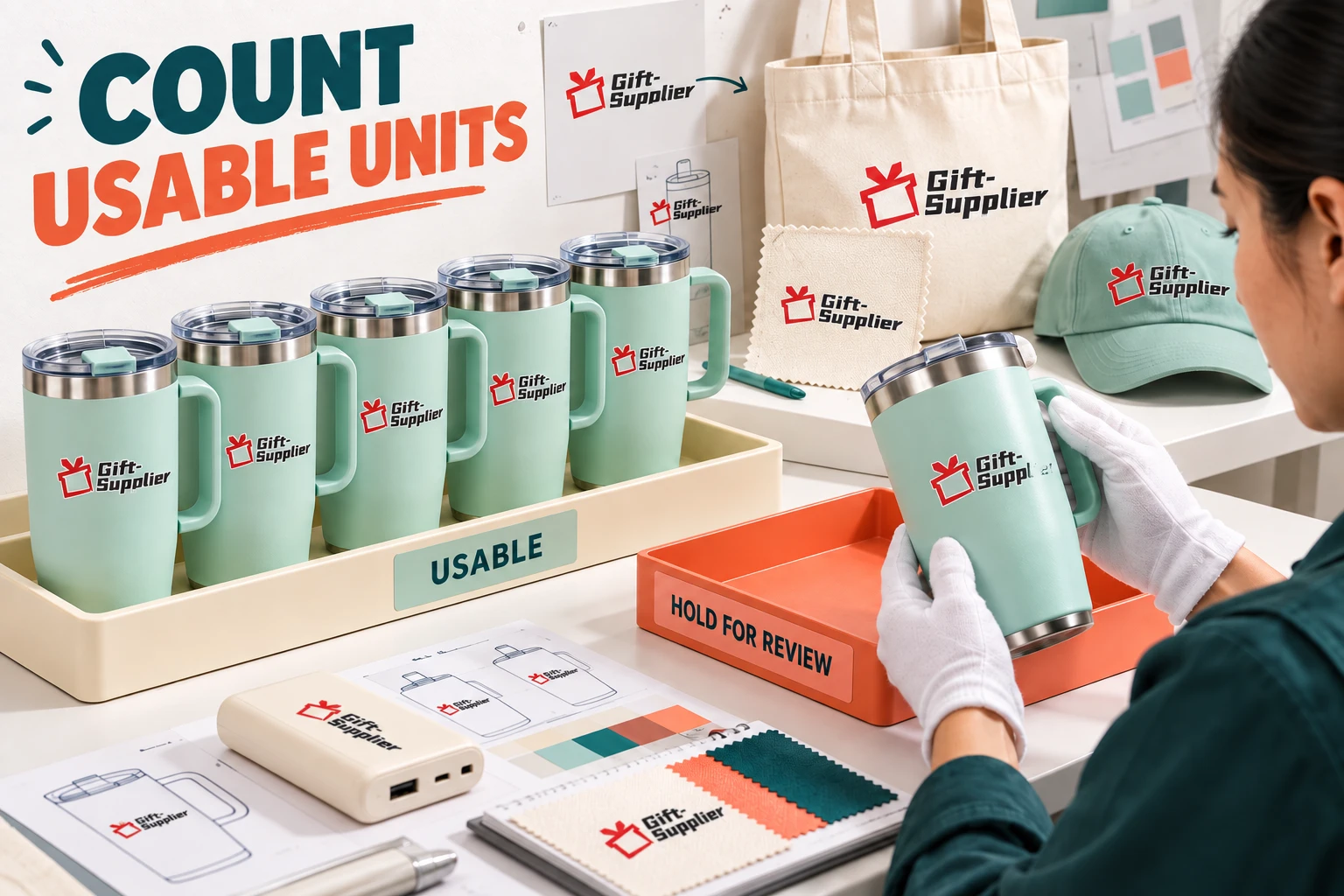
Why Unit Price Misleads Procurement Budgets
A unit price describes one line of a quote: the cost of a single finished piece at a stated quantity. It does not describe what the order costs to arrange, ship, clear, inspect, and absorb. Two suppliers can quote the same product with very different mixes of what is included and what is billed separately, so the lower unit price is not automatically the lower cost.
Promotional product total cost of ownership reframes the comparison around one question: what does each usable unit cost once every expense tied to the order is counted? Landed cost is a large part of that answer, but so are testing, rejects, and the hours your own team spends chasing proofs and receiving stock.
Decision Table: The Cost Components Behind a Quote
Use the table below to check whether each component is stated, estimated, or missing when you compare quotes.
| Cost component | What it includes | Evidence to request | Risk if omitted from the comparison |
| Tooling | Molds, dies, screens, or plates needed to make the item | Itemized tooling charge and whether it is one-time or per run | A low unit price hides a large one-time charge |
| Setup and artwork | Artwork preparation, color matching, and proof creation | Stated setup fee and number of proof rounds included | Extra proof rounds billed after the quote is accepted |
| Testing and compliance | Laboratory testing and documentation for the product and market | Test reports, or a quote for testing if it is buyer-arranged | A compliance cost appears late, or a required test is skipped |
| Freight | Transport from factory to your destination, plus any packaging | Stated Incoterms rule and an itemized freight estimate | Quotes priced on different bases cannot be compared |
| Duties and taxes | Import duty and taxes payable at the destination market | Commodity code and duty estimate confirmed with a customs broker | Landed cost is understated until the shipment clears |
| Rejects and rework | Units that fail inspection, plus reproduction or credit terms | Stated quality tolerance and written remedy for failed units | Usable quantity falls short of the quantity paid for |
| Internal handling | Your team’s time for proofs, approvals, receiving, and returns | Internal time estimate multiplied by a loaded hourly rate | Cheap quotes that need heavy management look cheaper than they are |

The Total Cost of Ownership Formula
The calculation is deliberately simple, so that any team can rebuild it in a spreadsheet and audit each input.
| Total cost per usable unit = (Product cost + Tooling + Setup + Testing + Freight + Duties + Internal handling) ÷ Usable units received |
Usable units received equals the quantity ordered minus units that fail inspection and cannot be used. Dividing by usable units, rather than ordered units, is what makes rejects show up in the cost.
Buyer Framework: How to Model Total Cost Before You Choose
The steps below turn the formula into a repeatable process. The decision owner is typically the marketing procurement lead, with finance confirming budget treatment and logistics or a customs broker confirming freight and duty inputs.
- Fix the specification and quantity so every supplier quotes the same item, decoration, and volume.
- Request itemized quotes stating tooling, setup, testing, freight basis, and remedy for rejected units.
- Enter each quote into the same worksheet, marking any missing component as an open question rather than zero.
- Estimate internal handling by counting the proof rounds, approvals, and receiving tasks, then applying a loaded hourly rate.
- Apply a reject-rate assumption based on your own inspection history or the supplier’s documented tolerance.
- Calculate cost per usable unit for each quote, then run the sensitivity test below before ranking suppliers.
- Record the assumptions with a date so the comparison can be revisited when freight or duty conditions change.
If you are working within a fixed per-recipient budget, see our promotional gifts by budget page for product options organized by spend level, then apply this cost model to your shortlisted quotes.

Evidence From the Field: Illustrative Two-Quote Calculation
The example below is an illustrative calculation created to show how the formula changes a decision. Replace the sample figures with your own verified quotes before presenting this as a real comparison.
A marketing procurement lead at a mid-market consumer brand compares two quotes for 1,000 units of the same branded item. Quote A has the lower unit price but bills several items separately. Quote B has a higher unit price and includes more.
| Cost element | Quote A (lower unit price) | Quote B (higher unit price) |
| Unit price per piece | $4.00 | $4.60 |
| Product cost (1,000 units) | $4,000 | $4,600 |
| Tooling | $350 | Included |
| Setup and artwork | $100 | Included |
| Testing | $400 (buyer-arranged) | $150 (partly included) |
| Freight | $600 | $500 |
| Duties | $300 | $300 |
| Internal handling | $250 | $150 |
| Total cost | $6,000 | $5,700 |
| Assumed reject rate | 5% | 1% |
| Usable units received | 950 | 990 |
| Cost per usable unit | $6.32 | $5.76 |
In this illustrative case, Quote A’s unit price is roughly 13% lower than Quote B’s, yet its cost per usable unit is roughly 10% higher once tooling, setup, testing, handling, and a higher reject rate are included. The ranking reverses because the costs sat outside the unit price.

Reject Rate Sensitivity: How Quality Losses Move the Cost
Reject rates are the least certain input, so test a range. The table below holds Quote A’s total cost at $6,000 and changes only the share of units that cannot be used. It assumes rejected units are neither replaced nor credited.
| Reject rate | Usable units | Cost per usable unit |
| 0% | 1,000 | $6.00 |
| 2% | 980 | $6.12 |
| 5% | 950 | $6.32 |
| 10% | 900 | $6.67 |
Each additional point of rejects raises the effective price of every remaining unit. A supplier who documents a remedy for failed units is offering something with a measurable value, which the unit price alone cannot show.
Price Trade-Offs: When a Higher Unit Price Can Lower Total Cost
Not every higher-priced quote is cheaper overall, and not every low price is a trap. Use the table below to see what a price difference may be trading against.
| Trade-off | A lower unit price may mean | A higher unit price may include | What to verify |
| MOQ | A higher minimum order quantity than your program needs | A lower minimum, with a smaller commitment | MOQ in writing for your exact specification |
| Lead time | A longer or unconfirmed production schedule | A confirmed schedule with proofing time shown | Whether the stated lead time includes proof approval |
| Material | A lower-grade or unspecified material | A specified material and grade | Material specification matched to the purchase order |
| Testing | Testing left to the buyer | Testing or documentation included | Which reports are included and for which market |
| Freight basis | Ex-works pricing with freight added later | Delivered pricing with freight stated | The Incoterms rule stated on each quote |
| Recovery terms | No written remedy for failed units | A stated reproduction or credit process | Remedy terms and timelines in writing |
Where to Get Each Input
A model is only as reliable as its inputs. The table below shows where each figure typically comes from and who is well placed to supply it.
| Input | Where to get it | Suggested owner |
| Tooling and setup | Itemized supplier quote | Marketing procurement lead |
| Testing | Supplier documentation or a laboratory quote for the exact product and market | Procurement with compliance input |
| Freight | Supplier or forwarder quote that states the Incoterms rule | Logistics or procurement |
| Duties | The US Harmonized Tariff Schedule or the UK Trade Tariff, confirmed with a customs broker | Logistics or a customs broker |
| Internal handling | Time logged for proofs, approvals, and receiving, multiplied by a loaded hourly rate | Marketing procurement lead with finance |
| Reject rate | Prior inspection records, or the supplier’s stated quality tolerance | Quality or procurement |
Risks and Limitations of This Cost Model
- Freight rates, duty rates, and tariff treatment change over time and by route, so any figure should be confirmed against current primary sources before a decision.
- Reject rates and internal handling time are estimates; a wrong assumption can shift the ranking, which is why the sensitivity test matters.
- Testing requirements depend on product category, intended use, and destination market, and regulated categories may need more than this general model covers; see our promotional product compliance guidance for category-specific documentation.
- This model is scoped to US and UK programs and does not cover other markets, currency effects, or tax treatment that your finance team may need to apply.
- Total cost of ownership measures cost, not value; it does not capture recipient response, brand fit, or campaign outcomes.
- The worked example is illustrative; actual quotes, tolerances, and outcomes will differ by supplier, product, and season.
Request a Scoped Quote
If you are comparing quotes for an upcoming program, share your specification, quantity, destination market, and budget per recipient. Our team can help you request itemized quotes that make total cost comparable.
Prefer a lighter first step? Send us two supplier quotes for a landed-cost comparison review before you decide.
Frequently Asked Questions
Should internal handling time really be counted?
Yes, if it differs between suppliers. A quote that needs more proof rounds, more chasing, or more receiving work consumes real hours, and those hours belong in the promotional product total cost of ownership comparison even though they never appear on a supplier invoice.
What reject rate should we assume?
There is no universal figure. Use your own inspection history where you have it, or the supplier’s stated quality tolerance where you do not, and then test a range as shown in the sensitivity table rather than relying on a single number. This helps make price trade-offs more realistic.
Do duties apply to every order?
Not necessarily. Whether duty applies depends on the product’s classification, where it is made, and where it is imported. These factors should be included when calculating landed cost and planning the procurement budget.
Who normally pays for product testing?
It varies by supplier and contract, which is why the quote should state it. Confirm which reports are included and for which market, and see our promotional product compliance resource for what documentation to request.
How often should the cost model be refreshed?
Refresh it whenever a quote changes, a new supplier is added, or freight or duty conditions shift, and date-stamp the assumptions each time so the reasoning behind a past decision can be reviewed. This keeps the promotional product total cost of ownership model aligned with the current procurement budget and landed cost.
Sources and Further Guidance
International Chamber of Commerce — Incoterms® Rules
US International Trade Commission — Harmonized Tariff Schedule (HTS) search
UK Government — Trade Tariff: look up commodity codes, duty and VAT rates
US Consumer Product Safety Commission — Children’s Product Certificate
Author & Reviewer
Written by Claire Morgan, Senior Content Writer, with professional experience comparing quotes and modeling landed cost for branded merchandise programs.
Freshness & Update Log
- Published: September 27, 2026
- Last Reviewed: September 27, 2026
- Next scheduled review: within 6 months, or sooner if duty, tariff, or freight guidance changes materially.
Related Resources
- /questions-to-ask-a-promotional-product-supplier/ — 18 evidence-based questions to ask once quotes are in hand.
- /promotional-product-supplier-audit-checklist/ — the 25-point checklist for auditing a supplier before you award the order.
- /promotional-merchandise-vendor-consolidation/ — how vendor consolidation interacts with ongoing performance scoring.