
A promotional product supplier red flag is any element of a quote that looks complete on the surface but omits the information a buyer needs to verify cost, compliance, or delivery risk before committing budget. The most common promotional product supplier red flags cluster into four groups: vague specifications, unsupported capability or compliance claims, incomplete freight and landed-cost terms, and production timing that doesn’t match stated capacity. This guide applies to North American procurement teams sourcing branded merchandise, apparel, and event giveaways from domestic or overseas suppliers, and assumes quotes are being compared for orders large enough to justify a formal vendor evaluation. Assumptions and thresholds reflect the last-reviewed date above.
For a procurement manager comparing three or four supplier proposals, a quote’s polish rarely correlates with its reliability. Professional formatting, a fast turnaround on the estimate, and confident language about certifications can mask the exact gaps that turn into change orders, missed in-hands dates, or a failed compliance check. This matters most at the evaluation stage — after a shortlist has been built and before purchase orders are cut — when the cost of catching a problem is a follow-up email rather than a reprint.
This guide walks through the twelve most common promotional product supplier red flags, shows how to score a quote against verifiable criteria, and lays out a six-step vendor evaluation process a procurement team can run before signing. It draws on recurring patterns from quote reviews, publicly documented CPSC/CPSIA supplier obligations, and ICC Incoterms® 2020 definitions, each cited below so the claims can be checked independently rather than taken on faith.
Scope, Market, and Assumptions Behind This Guide
- Market: North America-based procurement and marketing teams sourcing decorated promotional products, apparel, and event merchandise from domestic distributors, overseas factories, or hybrid supply chains.
- Order context: Applies to formal, multi-supplier RFQ situations as part of a procurement process — not one-off retail purchases.
- Pricing: No universal price, MOQ, or lead-time benchmarks are cited here; these vary too widely by category, decoration method, and factory to generalize responsibly.
- Compliance scope: References to CPSIA, Prop 65, and Incoterms® 2020 describe how these frameworks typically appear in a quote, not full legal guidance — confirm specific obligations with compliance counsel.
- Currency of data: Terminology and standards reflect the state of the promotional products supply chain as of the last-reviewed date; rules and Incoterms® versions are periodically updated.
The 12 Supplier Red Flags Hidden Inside a Promotional Product Quote
The twelve red flags below fall into four clusters that map directly to the buyer question this guide answers: vague specs, unsupported claims, incomplete freight terms, and unrealistic timing. Each one is verifiable — the table lists the exact question to put back to the supplier.
| Red Flags | How It Shows Up in the Quote | Verification Question to Ask |
|---|---|---|
| Material named vaguely | “Premium cotton” or “durable plastic” with no fabric weight, resin type, or spec sheet | What is the exact material name, grade, and spec sheet reference? |
| Decoration method unnamed | “Logo applied” with no imprint method or PMS color-match process stated | Which decoration method and color-match process will be used? |
| Dimension ranges, not fixed specs | “Approx. 10–12 oz” or “one size fits most” with no tolerance stated | What is the manufacturing tolerance on this dimension? |
| Stock photography, not the actual SKU | Same image reused across several product listings | Can you send a photo or sample of this exact SKU, not a similar item? |
| Compliance claims with no certificate | “CPSIA compliant” or “Prop 65 safe” stated with no certificate number or lab named | Can you provide the current Children’s Product Certificate or GCC and the lab’s accreditation? |
| “Factory direct” pricing, no factory named | Below-market price with no supply-chain disclosure | Which facility produces this item, and is it disclosed in your documentation? |
| Capacity claims with no evidence | “We can produce 50,000 units in 10 days” with no backlog or line-capacity reference | What is your current production backlog, or can you share a capacity report? |
| No named Incoterm | “Plus freight” with no Incoterm® naming the cost/risk transfer point | Which Incoterm® 2020 rule applies, and where does risk transfer? |
| Freight excludes duties/brokerage | Priced “FOB factory” with no total landed-cost estimate | What is the estimated total landed cost, including duties, brokerage, and surcharges? |
| No named carrier or transit data | “Standard shipping” with no carrier, service level, or transit history | Which carrier and service level, and what was the actual transit time on recent comparable shipments? |
| Lead time excludes approval cycles | Quoted lead time starts at “order placement,” excluding art approval and pre-production sample sign-off | Does this lead time include art approval and sample sign-off, or start after approval? |
| In-hands date with no contingency | Firm delivery date promised with no buffer for customs holds or carrier delays | What contingency buffer is built into this date, and what happens if it slips? |
Vague Specs: What They’re Hiding
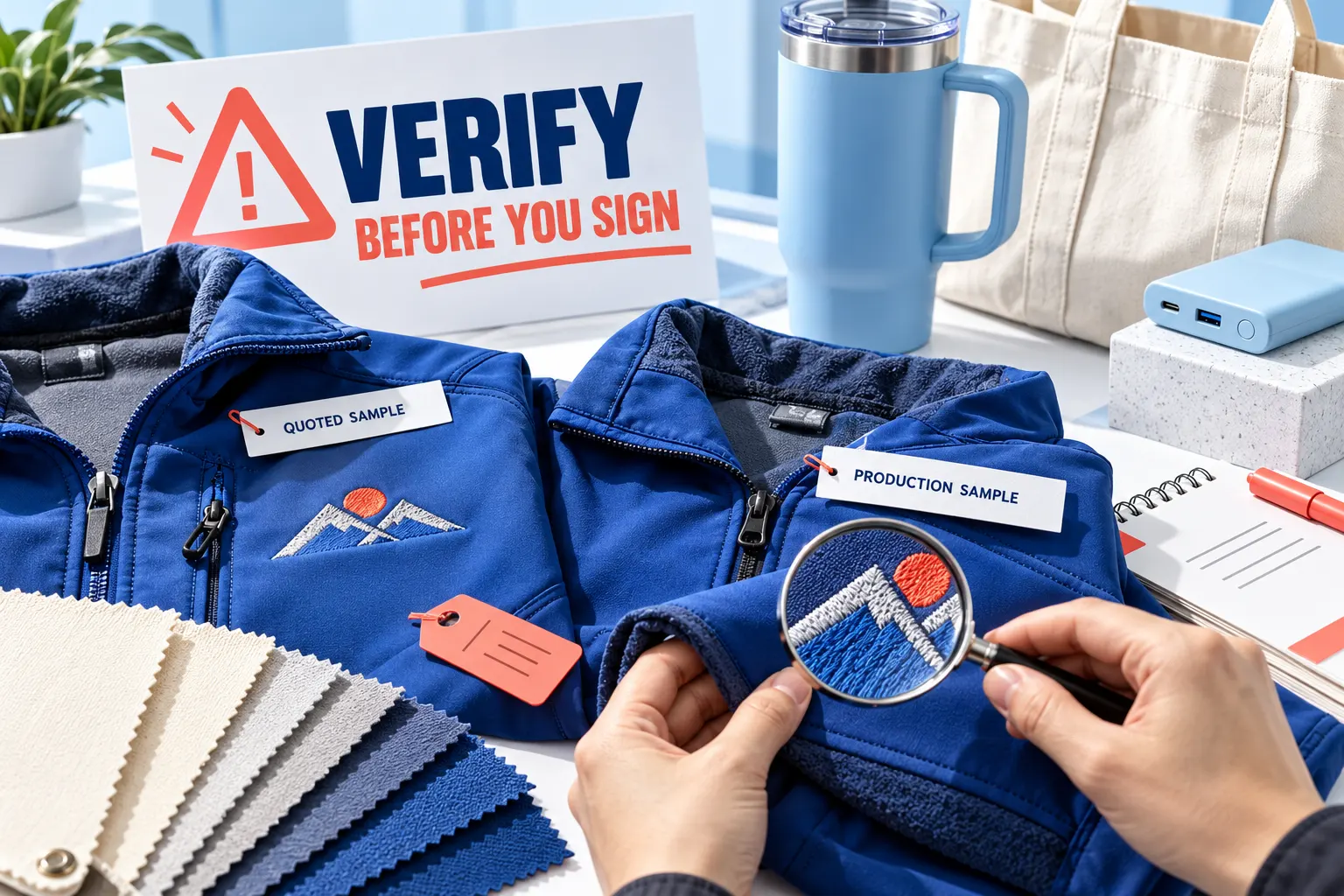
Vague specs are the easiest red flag to miss because the quote still looks complete — it has a price, a quantity, and a turnaround date. What’s missing is the information a production team needs to catch a problem before tooling or dye lots are committed. A material line reading “premium cotton” instead of naming a fabric weight leaves room for a supplier to substitute a lighter stock mid-run if costs rise. An unnamed decoration method makes it impossible to compare PMS color-match accuracy across competing bids. And reused stock photography — one of the more common promotional product supplier red flags in fast-turnaround RFQs — means the buyer has never actually seen the SKU they’re about to commit budget to.
None of these gaps are necessarily dishonest; they’re often just a template quote sent before scope was finalized. The verification step is the same either way: request the spec sheet before comparing price.

Unsupported Capability and Compliance Claims
Compliance and capacity claims are where an attractive quote can create the most downstream risk. Under CPSC rules, the domestic manufacturer or product importer of a covered consumer product must issue certification confirming the product meets applicable federal safety standards — for children’s products, that means a written Children’s Product Certificate based on testing by a CPSC-accepted laboratory, plus permanent tracking information on the product and its packaging.
A quote line that states “CPSIA compliant” without naming the certificate, the testing lab, or the product category it covers is not evidence — it’s a claim. The same logic applies to capacity: a supplier promising a large order in an aggressive window with no reference to current backlog is asking the buyer to trust a number, not verify one. This is where supplier due diligence earns its cost: requesting a certificate number or a redacted capacity report takes one email and either confirms the claim or surfaces the gap before a purchase order is signed.
Incomplete Freight and Landed-Cost Terms
Freight terms are one of the most consistently underspecified sections of a promotional product quote, largely because Incoterms® rules aren’t always familiar outside logistics teams. Paying attention to the freight terms in a supplier quote is critical for understanding which party is responsible for transportation, insurance, and customs clearance, and Incoterms® rules define, within a shipping contract, who pays for what, where responsibility for a shipment begins and ends, and how risk is managed between buyer and seller. A quote that lists “plus freight” without naming one of these terms leaves that entire allocation undefined.
| Incoterm® 2020 | What It Means for the Buyer | Freight Red Flag If Undefined |
|---|---|---|
| EXW – Ex Works | Seller makes goods available at its own warehouse; buyer arranges and pays all transport, export clearance, and duties. | Buyer may be blindsided by the full logistics cost if this isn’t named. |
| FOB – Free On Board | Supplier delivers to port and loads the shipment; buyer takes on freight, marine insurance, and risk from that point. | Ambiguity hides who pays main carriage and insurance. |
| CIF – Cost, Insurance & Freight | Seller delivers goods onboard vessel and contracts insurance covering the buyer’s risk from port of shipment to port of destination. | Undefined terms can hide insurance coverage gaps or excluded duties. |
| DAP – Delivered at Place | Supplier arranges delivery, port formalities, and land transport to the buyer’s address; import duties remain the buyer’s responsibility. | Quote may look “delivered” while still excluding duties and import clearance. |
| DDP – Delivered Duty Paid | Supplier is responsible for the shipment through import duties and final delivery. | Rare in promotional-product freight; a quoted DDP price below market deserves a landed-cost breakdown request. |

Unrealistic Production and Shipping Timing
The final red flag cluster is timing that looks achievable in isolation but doesn’t survive contact with the full order cycle. A lead-time line that starts counting from “order placement” skips art approval, a pre-production sample, and at least one revision round — stages that commonly add one to three weeks depending on the decoration method and how quickly the buyer’s team turns around approvals.
A guaranteed in-hands date with no stated contingency is the second version of the same problem: it looks confident on a quote, but it hides how the supplier handles a customs hold, a peak-season carrier delay, or a failed QC checkpoint. Neither issue means the supplier is unreliable. It means the timing hasn’t been stress-tested yet — exactly what the verification step in the framework below is built to catch.
How to Score a Quote at a Glance: A Vendor Evaluation Decision Table
Once red flags are identified, the next step in the procurement process is comparing quotes side by side using criteria a buyer can verify — not just price. The table below scores three common quote patterns against six verifiable criteria a procurement manager can check in a single follow-up email.
| Criterion | Fully Documented Quote | Partially Documented Quote | Red-Flag Quote |
|---|---|---|---|
| MOQ clarity | Fixed MOQ with break quantities and reasons stated | MOQ given, break-quantity logic not explained | MOQ described as “flexible” with no number |
| Lead time | Stated PO-to-in-hands, approval stages itemized | Lead time given, approval stages not itemized | Single lead-time figure with no defined start point |
| Material / spec | Named material and grade, spec sheet attached | Material named, no spec sheet provided | Generic material description only |
| Freight terms | Named Incoterm® with itemized landed-cost estimate | Incoterm® named, landed cost not itemized | No Incoterm® or freight basis named |
| Compliance evidence | Certificate number and testing lab named | Compliance claimed, no documentation offered | No compliance language despite a regulated category |
| Capacity / risk evidence | Capacity or QC evidence available on request | Some production history shared informally | No production evidence offered |

A 6-Step Vendor Evaluation Framework Procurement Teams Can Run Before Signing
This is the workflow a procurement team can run against any shortlisted quote. It assigns a named decision owner at each step rather than a shared inbox — accountability is what keeps a red flag from slipping through in the rush before a PO deadline.
| Step | Action | Decision Owner | Evidence to Collect |
|---|---|---|---|
| Flag the gaps | Read the quote line by line against the 12 red-flag list and mark any missing spec, claim, term, or date. | Category buyer / requester | Annotated copy of the quote |
| Request spec and sample | Ask for the named material, decoration method, and a physical or high-resolution photo of the exact SKU. | Category buyer | Spec sheet, sample or photo |
| Verify compliance | Request certificate numbers and lab accreditation; confirm the product category (children’s vs. general use). | Compliance / QA lead | Certificate copy, lab name |
| Confirm freight and landed cost | Ask the supplier to name the Incoterm® and itemize freight, duties, and brokerage into one landed-cost figure. | Procurement manager | Landed-cost breakdown |
| Stress-test the timeline | Map quoted lead time against internal approval turnaround; ask for the contingency buffer on the in-hands date. | Project / program manager | Timeline with milestones |
| Score and decide | Score the quote against the decision table criteria, compare to competing bids, document the rationale. | Procurement manager (sign-off) | Completed scorecard, decision memo |

What This Looks Like in Practice: An Illustrative Quote Walkthrough
To make the framework concrete, here is how it plays out on a typical quote line for a 2,500-unit soft-shell jacket order (figures illustrative, built from recurring patterns rather than attributed to a specific client). The quote states: “100% polyester shell, embroidered logo, $18.40/unit, FOB, 4–6 weeks.” Running it through step 1 flags three gaps: no fabric weight or water-resistance rating, no Incoterm® location (FOB which port?), and a lead-time range with no stated start point. Step 2 requests the mill spec sheet, which returns a lighter shell weight than expected — workable for a fall event but not for a winter outdoor activation, a distinction the original line item didn’t surface.
Step 4 gets the supplier to confirm the shipping port, which shifts an estimated 20–25% in ocean freight and duties onto the buyer’s landed cost once itemized — a swing that wasn’t visible in the headline unit price. None of this makes the supplier disqualified; it means the comparison against a competing bid now happens on the same basis instead of two different ones.
Risks and Limitations of This Framework
- This checklist reduces information gaps; it does not replace a formal supplier audit, factory visit, or legal compliance review for regulated categories.
- CPSIA and Prop 65 references apply to specific U.S. product categories and may not cover every promotional item or every state; confirm current requirements with compliance counsel.
- Incoterms® rules are periodically revised by the ICC; confirm which edition (this guide references Incoterms® 2020) a supplier is quoting against.
- Landed-cost figures in a quote remain estimates until duties, tariffs, and carrier surcharges are confirmed at time of shipment — volatile trade conditions can shift them between quote and delivery.
- A supplier declining to provide documentation immediately is not automatic disqualification; smaller or newer suppliers may have a legitimate documentation lag a direct conversation can resolve.
- This guide does not evaluate price competitiveness — a fully documented quote can still be priced above market, and a red-flag quote can still be corrected once the gaps are raised.
Documentation Checklist to Request Before Signing
| Document | Why It Matters | Who Should Review It |
| Spec sheet / material data | Confirms weight, grade, and tolerance match the quoted line item | Category buyer |
| Physical or photo sample of the exact SKU | Confirms color, finish, and construction before bulk production | Category buyer / QA |
| Compliance certificate (CPC or GCC) + lab accreditation | Confirms regulated-category products meet federal safety standards | Compliance / QA lead |
| Named Incoterm® + landed-cost breakdown | Confirms who pays freight, duties, and brokerage, and where risk transfers | Procurement manager |
| Production timeline with milestone dates | Confirms lead time includes approval and sample stages, not just production | Project / program manager |
| Reference or capacity evidence for large orders | Confirms the supplier can meet quantity and deadline without overcommitting the line | Procurement manager |
Verify Before You Commit Budget
Every red flag in this guide has the same fix: ask the supplier to show, not just tell. Run your next quote through the six-step framework above before a purchase order gets cut, not after a problem shows up on the dock. If you want a second set of eyes on a live quote, the two options below get you there.
Frequently Asked Questions
What’s the difference between a vague quote and a red-flag quote?
A vague quote is often just an early-stage estimate sent before scope is finalized — normal in a fast RFQ process. It becomes one of the promotional product supplier red flags when the supplier can’t or won’t fill in the missing spec, freight term, or compliance detail once asked directly.
Is a low unit price by itself a supplier red flag?
Not on its own. Price only becomes a useful signal during vendor evaluation once it’s compared against a full landed cost and a documented spec. An unusually low FOB price with an undefined freight term can look cheaper than it is once duties and brokerage are added.
How many suppliers should be compared before running this framework?
Three to five shortlisted quotes is typical for a formal vendor evaluation; fewer makes it hard to tell whether a red flag is supplier-specific or a category-wide pattern, and more slows the decision without adding much signal.
What if a supplier refuses to provide compliance documentation before the order is placed?
Treat it as a data point within supplier due diligence, not an automatic disqualifier — ask why (documentation lag, category ambiguity, or a genuine gap) before ruling the supplier out. That said, do not place a purchase order for a regulated category without the certificate in hand, as this is an important part of a controlled procurement process.
Sources and Further Guidance
US Consumer Product Safety Commission — Children’s Product Certificate
California OEHHA — Proposition 65 Frequently Asked Questions for Businesses
UK Government — Placing Manufactured Products on the Market in Great Britain
Google Search Central — Creating Helpful, Reliable, People-First Content
Author & Reviewer
Written by Claire Morgan, Senior Content Writer, with professional experience running multi-market RFP processes for branded merchandise programs.
Freshness & Update Log
- Published: September 25, 2026
- Last Reviewed: September 25, 2026
- Next scheduled review: within 12 months, or sooner if referenced regulatory guidance changes.
Related Resources
- /questions-to-ask-a-promotional-product-supplier/ — 18 evidence-based questions to ask once quotes are in hand.
- /promotional-product-supplier-audit-checklist/ — the 25-point checklist for auditing a supplier before you award the order.
- /promotional-merchandise-vendor-consolidation/ — how vendor consolidation interacts with ongoing performance scoring.