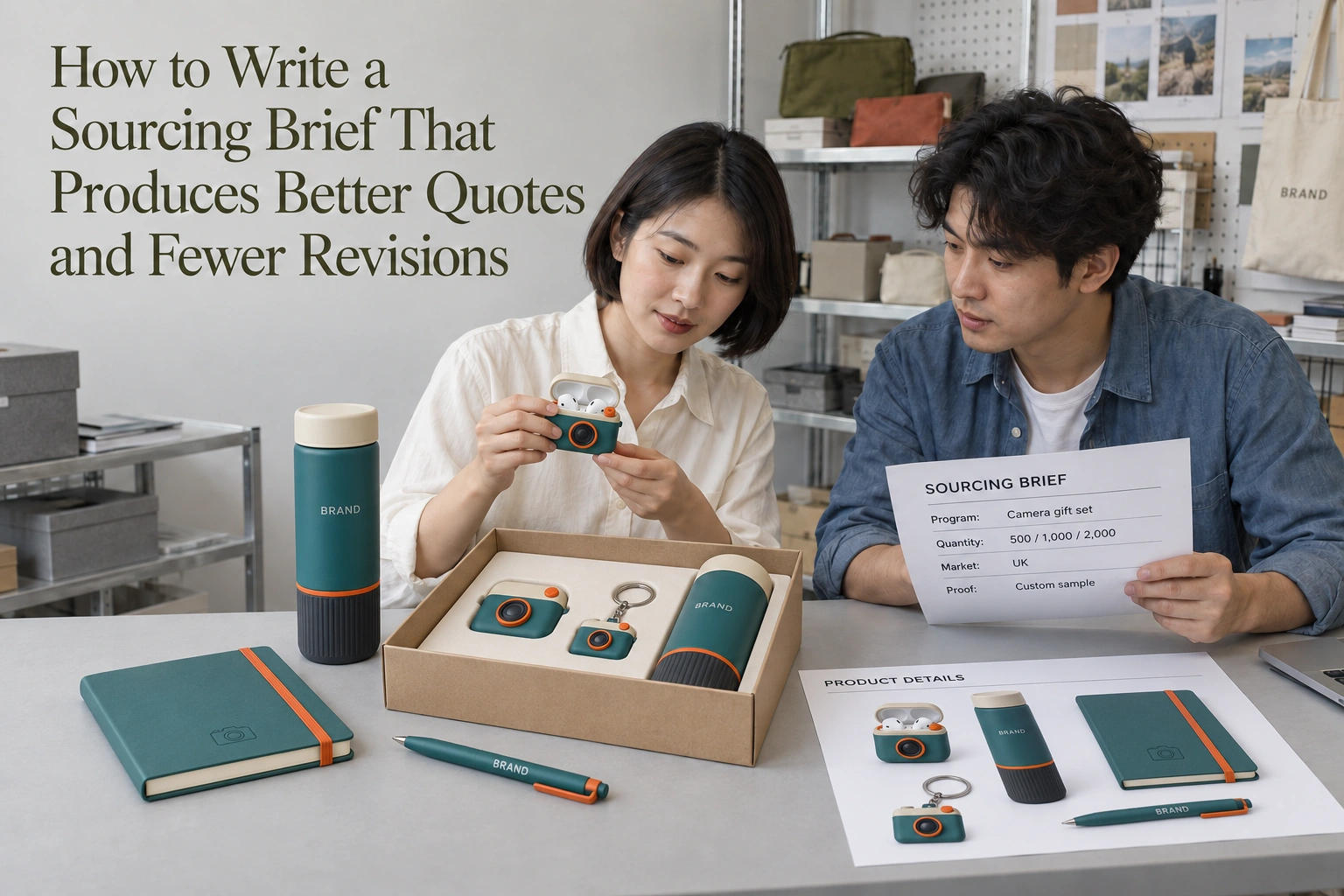
A promotional product sourcing brief template that produces better quotes and fewer revisions should specify six categories of information: program and contact details, exact product specification, compliance and market scope, proofing expectations, production and logistics requirements, and commercial terms. This guide is written for procurement managers sourcing branded merchandise for mid-market and enterprise programs in US and UK markets, preparing a brief to send to a shortlist of two to four suppliers. It assumes the buyer has a product idea and a target delivery date but has not yet finalized every specification. A complete brief lets suppliers quote against the same information, which is what makes quotes comparable and reduces clarification rounds.
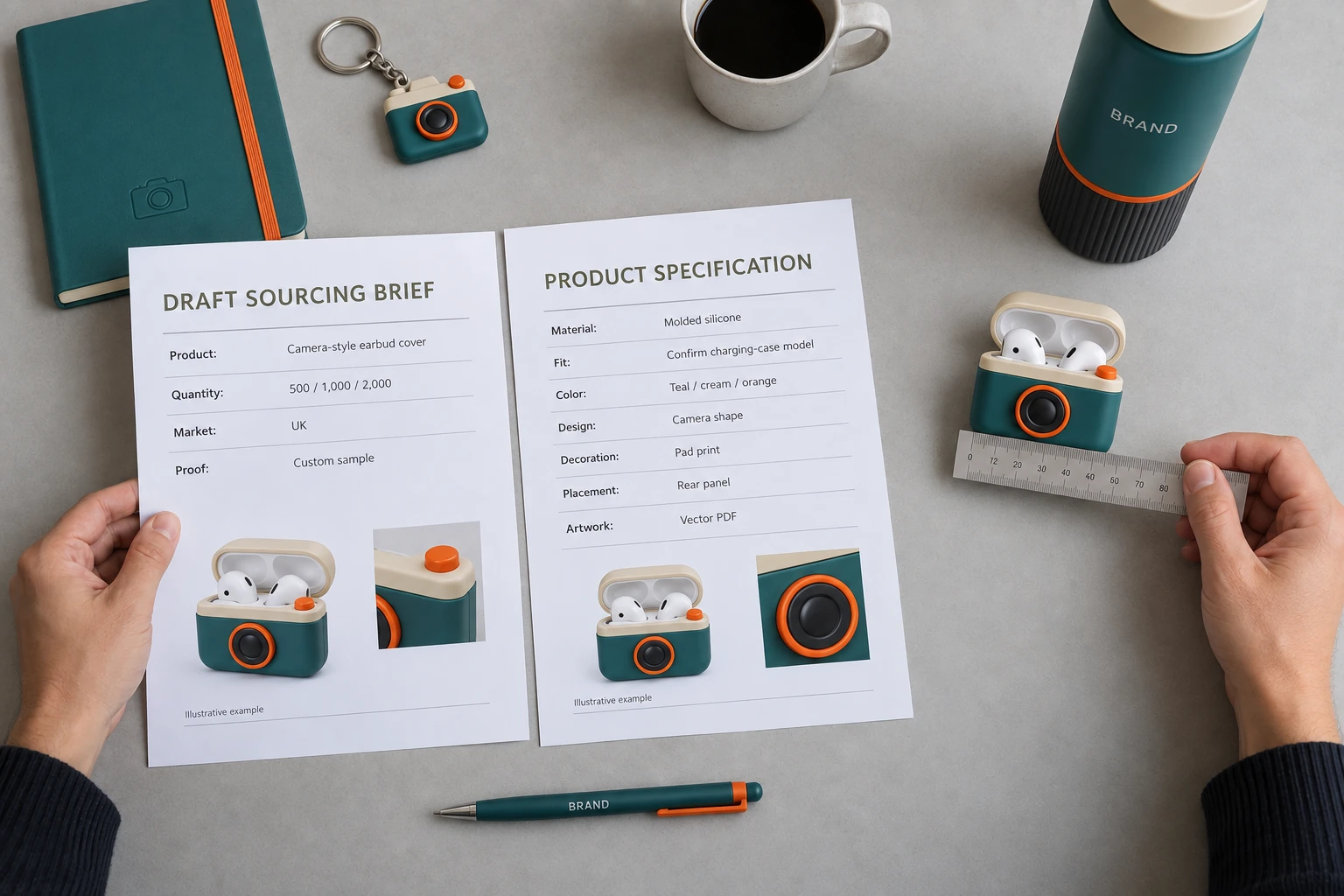
Most quote revisions do not happen because a supplier made an error — they happen because the original brief left a detail open to interpretation. A missing material grade, an unstated destination market, or an undefined proofing expectation forces a supplier to guess, quote, and then requote once the gap surfaces. The sections below provide a decision table for what to include, a reusable sourcing brief template, a repeatable framework for using it, and an illustrative before-and-after example.
Figures, tiers, and examples used in this article are illustrative only. Confirm actual specifications, quantities, and compliance requirements directly with your own product and legal or compliance teams before sending a brief to suppliers.
Why a Complete Sourcing Brief Reduces Quote Revisions
A supplier can only quote against the information it receives. When a brief leaves out a material grade, a destination market, or a proofing expectation, the supplier fills the gap with an assumption, prices the order accordingly, and issues a quote that looks complete but is not usable once the buyer corrects the assumption.
A promotional product sourcing brief template that states scope, specification, and expectations up front removes that guesswork. It also makes quotes from different suppliers genuinely comparable, since every supplier is pricing the same defined order rather than their own interpretation of an incomplete request.
Decision Table: What to Include in a Sourcing Brief
Use the table below to check a draft brief against the components that most often affect quote accuracy and revision risk.
| Brief component | Why it matters | What to specify | Risk if missing |
| Product specification | Prevents a supplier from quoting the wrong material or decoration method | Exact material, decoration method, dimensions, and tolerances | Wrong-spec quote that requires a full re-quote |
| Compliance & market scope | Ensures the quote reflects testing and labeling costs for your market | Destination market, end use, and any known certification requirements | Non-compliant quote or a compliance gap found after ordering |
| Proofing requirements | Sets expectations for what evidence you will see before production | Proof type, number of rounds included, and the approval owner | Ambiguous proofing costs or a delayed approval cycle |
| Production timeline | Aligns supplier capacity planning with your real deadline | Target quantity, required delivery date, and any fixed event date | Missed launch date from an unstated deadline |
| Commercial terms | Clarifies price basis and payment expectations up front | Budget range, payment terms, and whether a recovery clause is required | Renegotiation delays once the quote is already issued |
| Point of contact & approval | Keeps revisions from stalling on internal delays, not supplier delays | Named requester and approval owner, with an expected response time | Slow internal turnaround mistakenly blamed on the supplier |

The Sourcing Brief Template: Core Fields
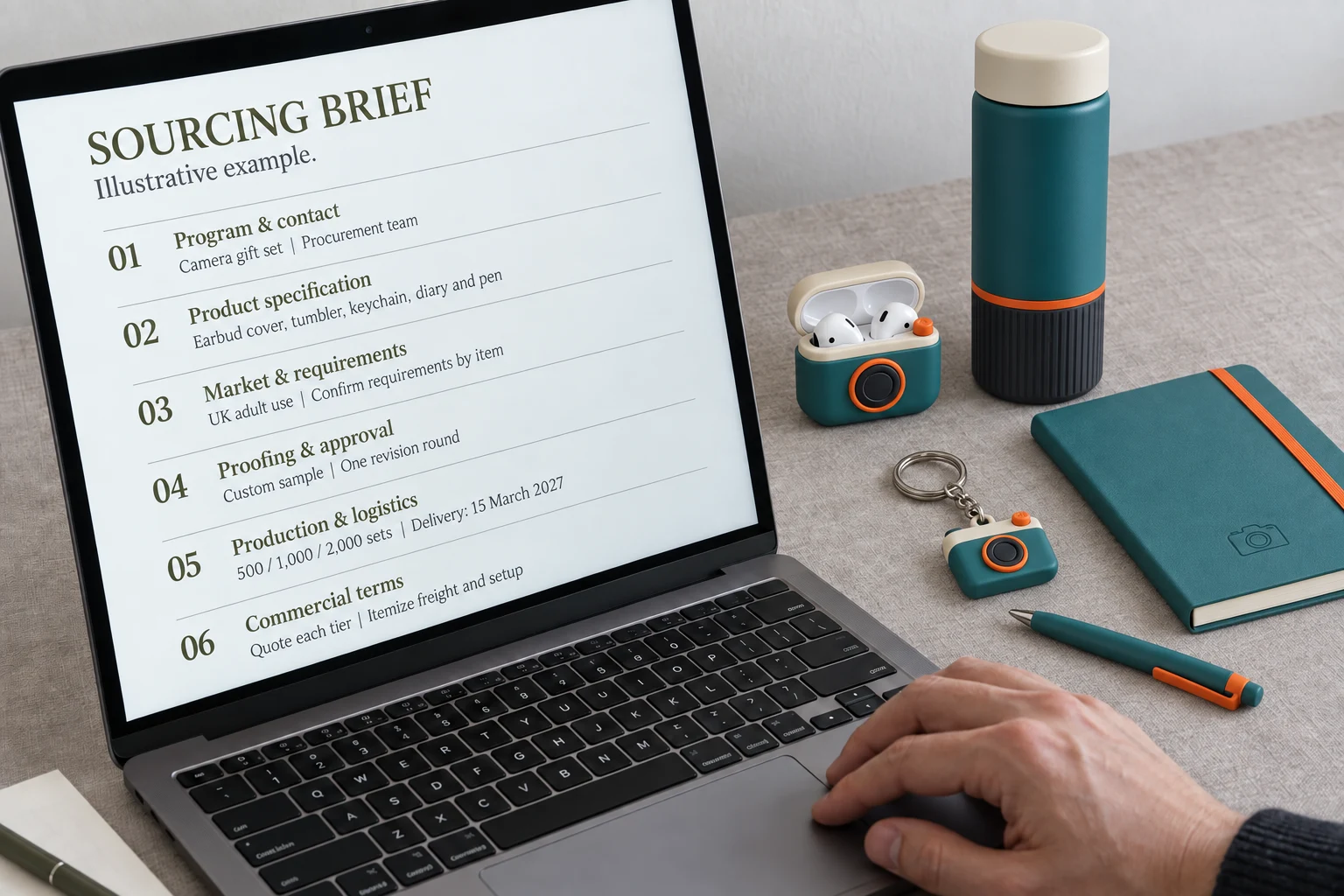
The fields below make up a reusable promotional product sourcing brief template, grouped into six sections. Complete every field before sending the brief to a supplier — a field marked “supplier to recommend” is still a deliberate answer, not a gap.
Program & Contacts
- Program name and internal project or reference code
- Requesting department and budget owner
- Named point of contact for supplier questions
- Required quote response deadline
Product Specification
- Exact product type, model, or base item reference
- Material specification and any approved substitutes
- Decoration method and artwork file format
- Color, placement, and size tolerances
Compliance & Market
- Destination market or markets for the finished product
- Intended end use and end user, such as adult retail, children’s product, or food-contact
- Required certifications or test standards, if known
- Labeling and packaging requirements
Proofing & Approval
- Type of proof required: digital mockup, stock sample, custom sample, or pre-production proof
- Internal approval owner and expected turnaround
- Number of proof rounds included before additional charges apply
- Criteria for proof rejection — what counts as a fail
Production & Logistics
- Target quantity and any tiered volume options
- Required delivery date and any fixed deadline, such as an event date
- Shipping destination and delivery method preference
- Packaging and kitting requirements, if any
Commercial Terms
- Budget range or target unit cost, if available
- Payment terms preference
- Whether a written recovery or remedy clause is required
- Reorder likelihood — one-time order versus a recurring program
Proof Terminology Used in a Sourcing Brief
The proofing section of the brief depends on using these terms precisely, since suppliers interpret them differently if left vague.
| Term | Meaning |
| Digital mockup | A visual layout showing approximate branding position and scale. Does not confirm material, color, or production quality. |
| Custom sample | A physical sample made to the buyer’s specification for evaluation before bulk production. |
| Pre-production proof | The approved reference made just before bulk production begins, with any permitted tolerances recorded. |
How to Build and Use a Sourcing Brief
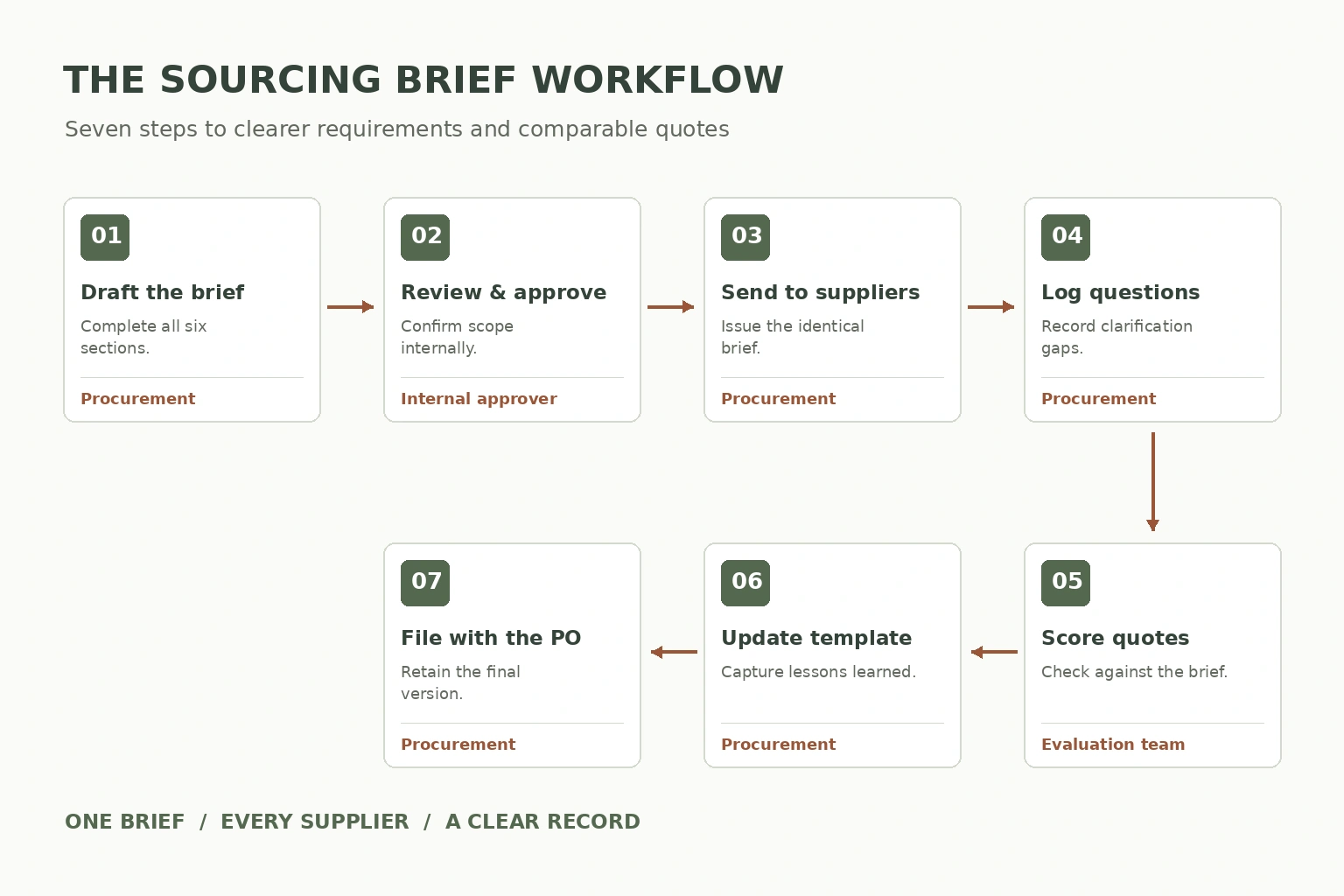
The steps below turn the template into a repeatable part of the sourcing process, with a clear decision owner — typically the category procurement manager running the sourcing decision.
- Draft the initial brief using the six core sections: program, specification, compliance, proofing, logistics, and commercial terms.
- Have the internal approval owner review and sign off on the brief before it goes to any supplier.
- Send the identical brief to every shortlisted supplier at the same time, so quotes stay comparable.
- Log the clarification questions suppliers ask back — repeated questions usually point to a gap in the brief itself, not the supplier.
- Score returned quotes against the brief’s stated requirements, not price alone.
- Update the brief template with any gap discovered during this cycle, before the next sourcing round.
- Store the finalized brief with the purchase order file, for reference if a dispute arises later.
Our team can help translate a completed sourcing brief into a scoped quote — see promotional product sourcing for how we support procurement teams through this process.
Common Sourcing Brief Gaps and Their Effect on Quotes
The table below shows the gaps that most often turn a single quote request into two or three rounds of clarification.
| Gap in the brief | Effect on the quote | Fix |
| Missing material specification | Supplier quotes on an assumed material, requiring a re-quote once corrected | State the exact material and grade, or explicitly note “supplier to recommend” |
| No target quantity range | Supplier returns a single-tier price that may not reflect the real order volume | Provide at least two volume tiers in the brief |
| No destination market stated | Compliance costs are left out of the quote, or the wrong documentation is quoted | State every destination market up front, not just the primary one |
| No proofing expectations | Proofing rounds and their cost become a point of renegotiation later | Define the proof type and included rounds directly in the brief |
| No fixed deadline | Supplier assumes a standard lead time and misses a real event date | State the actual required delivery date, not “as soon as possible” |
Evidence From the Field: Illustrative Before-and-After Example
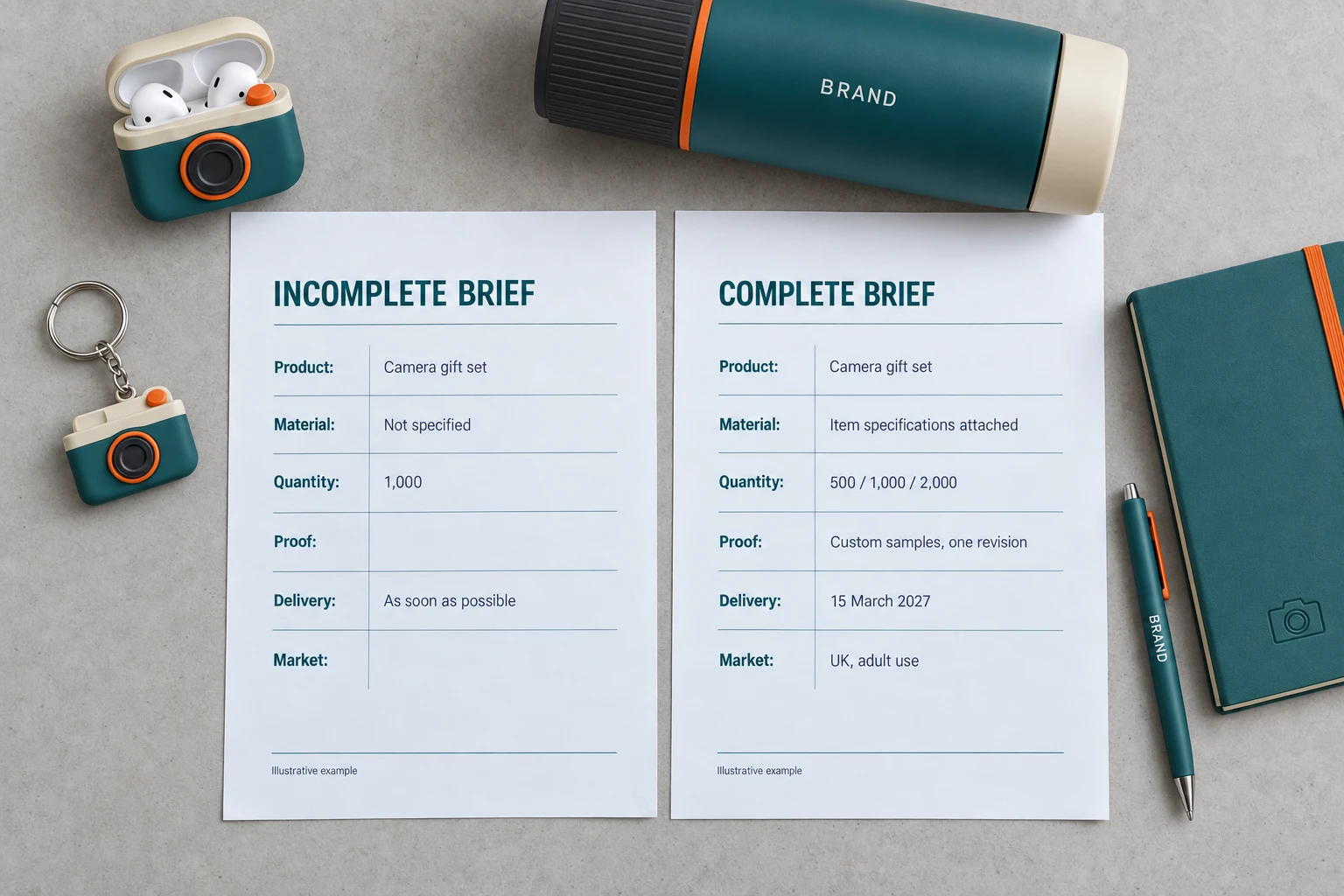
The example below is an illustrative sourcing brief scenario created to show how completing the template changes the quote outcome. Replace the sample details with your own verified project records before presenting this as a real case study.
A procurement team requests a quote for a branded apparel program twice: once using an incomplete brief, and once using the completed sourcing brief template above, for the same product and supplier.
| Brief element | Incomplete brief (illustrative) | Complete brief (illustrative) |
| Material specification | Fabric type only, no grade specified | 100% cotton, specified weight, pre-shrunk, with an approved substitute noted |
| Target quantity | Single quantity, no tiers | Three volume tiers requested for comparison |
| Proofing expectation | Not specified | Pre-production proof required, with one revision round included |
| Delivery deadline | “As soon as possible” | Fixed delivery date stated, with an internal review buffer noted |
| Outcome | Quote returned for clarification before it was usable | Quote usable on first return, with no clarification round needed |
In this illustrative scenario, the same supplier and the same product produced a usable quote on the first attempt once the brief specified material, quantity tiers, proofing, and a fixed deadline. The revision round in the first attempt traced back to gaps in the brief, not to a supplier error.
Fields That Need Extra Detail by Product Category
Every brief should cover the six core sections above, but some product categories need extra detail in specific fields. Use the table below to flag where to add depth for your product type.
| Product category | Field that needs extra detail | Why |
| Apparel & textiles | Fabric composition, weight, and care labeling | Sizing and fabric substitutions are common sources of quote revision |
| Hard goods (drinkware, tech accessories) | Material grade and decoration-method compatibility | Certain decoration methods do not adhere to every material or finish |
| Printed materials (notebooks, packaging) | Paper stock, finish, and binding type | Print quality and finish vary widely by stock and production process |
| Children’s or food-contact items | Full compliance and test requirement detail | These categories carry the highest risk from an incomplete brief |
Risks and Limitations of This Sourcing Brief Approach
- A complete brief reduces ambiguity but does not guarantee a supplier will honor every stated term; verify quoted terms in writing before ordering.
- An overly rigid brief can crowd out cost-saving alternatives a supplier might otherwise propose; leave room for supplier-recommended options where appropriate.
- The compliance fields in a brief are only as reliable as the buyer’s own knowledge of applicable requirements for that product and market.
- A sourcing brief template is a starting point for a quote, not a substitute for contract or legal review of the final agreement.
- Revisions can still occur for reasons outside a brief’s control, such as material shortages or factory scheduling changes.
- The before-and-after example in this guide is illustrative; actual revision counts and outcomes vary by supplier and product complexity.
Request a Scoped Quote
If you have a sourcing brief ready, or want help completing one, share your product specifications, quantity, branding, destination market, and required delivery date. Our team can turn a completed brief into a scoped quote.
Prefer a lighter first step? Send us your draft brief for a quick gap review before you send it out to suppliers.
Frequently Asked Questions
How detailed should a sourcing brief be for a first-time order?
Complete all six core sections even for a first order, since a new supplier relationship has no prior context to fill gaps. Fields you genuinely do not know yet, such as an exact unit cost target, can be marked as open rather than left blank, so the supplier knows it was considered.
Should the brief include a target price?
Including a budget range, where one exists, helps a supplier propose realistic options rather than quoting a premium specification by default. If no budget range is available, state that explicitly rather than leaving the field blank.
What is the difference between a sourcing brief and an RFQ?
A sourcing brief defines the product, compliance, and proofing requirements that make a quote accurate. An RFQ is the formal request that uses the brief as its basis, often adding commercial process requirements such as submission format and evaluation criteria across multiple suppliers.
Can the same brief be reused for a reorder?
Yes, with a quick review. Confirm that material, compliance requirements, and destination market have not changed since the original brief before resending it, since any of the three can shift between orders.
How does a sourcing brief help with compliance-sensitive products?
A complete brief states the destination market and known certification requirements up front, which lets a supplier quote compliance costs accurately instead of adding them later. For category-specific documentation, see our promotional product compliance resource.
Sources and Further Guidance
US Consumer Product Safety Commission — Children’s Product Certificate
California OEHHA — Proposition 65 Frequently Asked Questions for Businesses
UK Government — Placing Manufactured Products on the Market in Great Britain
Google Search Central — Creating Helpful, Reliable, People-First Content
Author & Reviewer
Written by Claire Morgan, Senior Content Writer, with professional experience preparing sourcing briefs and RFQs for branded merchandise programs.
Freshness & Update Log
- Published: September 19, 2026
- Last Reviewed: September 19, 2026
- Next scheduled review: within 12 months, or sooner if referenced regulatory guidance changes.
Related Resources
- /promotional-product-sourcing/ — primary commercial page: request a scoped quote and sourcing review.
- /questions-to-ask-a-promotional-product-supplier/ — 18 evidence-based questions to ask once quotes are in hand.
- /promotional-product-supplier-audit-checklist/ — the 25-point checklist for auditing a supplier before you award the order.