
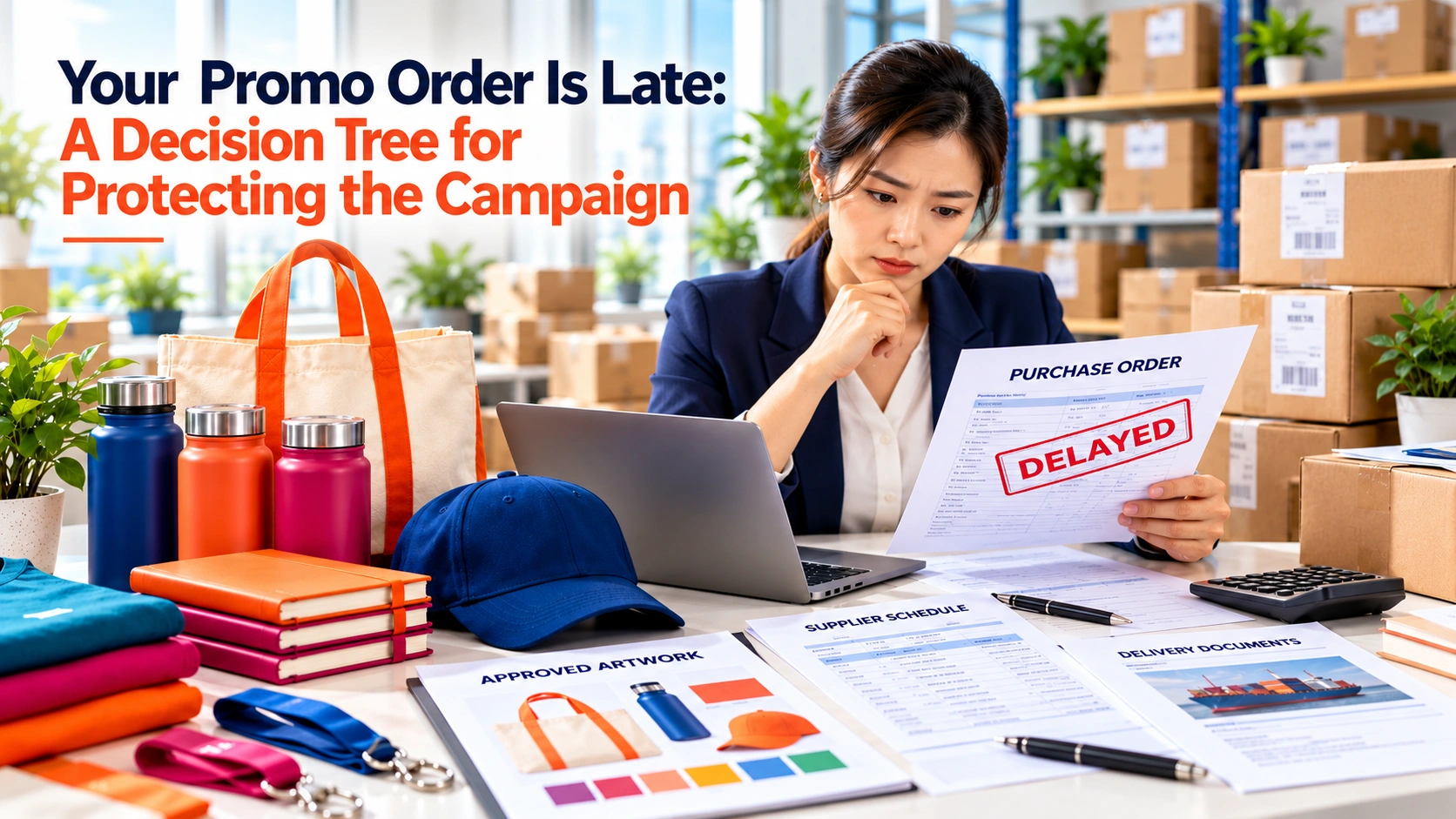
When a promotional order runs late, the best recovery option depends on two facts: the production stage the order has reached and how critical the event date is. Early-stage delays usually leave room to re-source or re-baseline the date, while late-stage delays usually leave only air freight, a partial delivery or a substitute item. This guide gives operations managers a practical decision tree for promotional product production delay contingency on custom, overseas-manufactured orders. Assumptions: the order is decorated, the event date is fixed, and every cost and lead time shown is illustrative until your supplier confirms it in writing.
Most late orders do not fail suddenly. A proof approval slips, a blank runs short or a decoration batch fails inspection, and the delay only becomes visible when it is expensive to fix. Good promotional product production delay contingency means choosing your fallback early, while options are cheap, and writing it down so the supplier, the marketing team and the event owner all work from the same plan. The sections below show how to identify the stage, score event criticality, walk the decision tree, compare recovery options, verify them with the supplier and prevent a repeat.
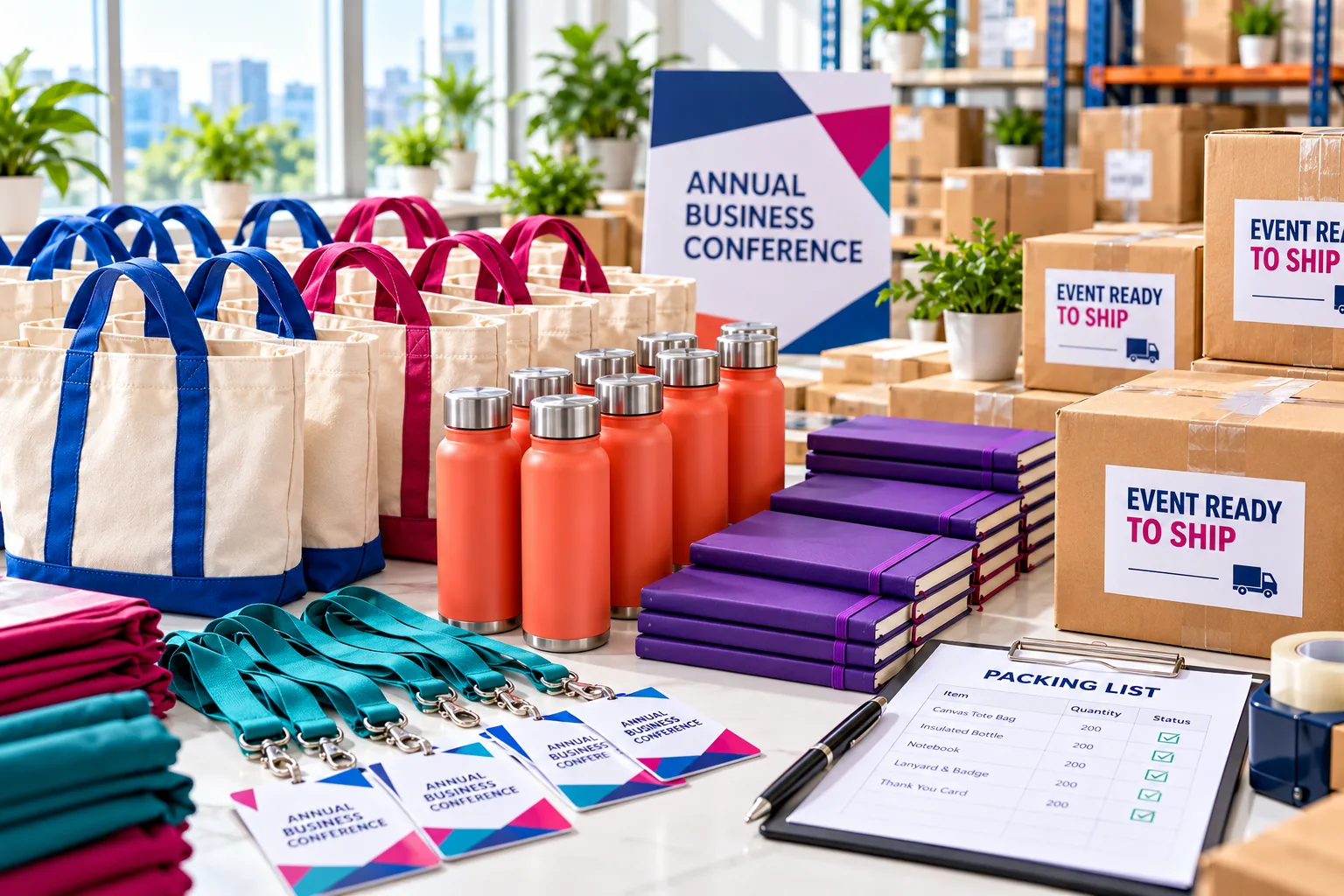
Scope, Market and Assumptions
- Product type: custom-branded promotional goods that are printed, embroidered or engraved, so a missed run cannot be replaced from stock.
- Market: overseas manufacturing with international freight to a B2B buyer. Destination customs and labelling rules vary and are outside this guide.
- Definition of late: the projected in-hand date falls after the date the event or campaign needs the goods.
- Numbers: all prices, rates and lead times are illustrative. This promotional product production delay contingency framework does not state universal figures.
- Freshness: reviewed on 25 October 2026. Freight rates and carrier capacity are volatile, so re-check them before acting.
Identify the Production Stage Behind Your Promotional Product Production Delay Contingency
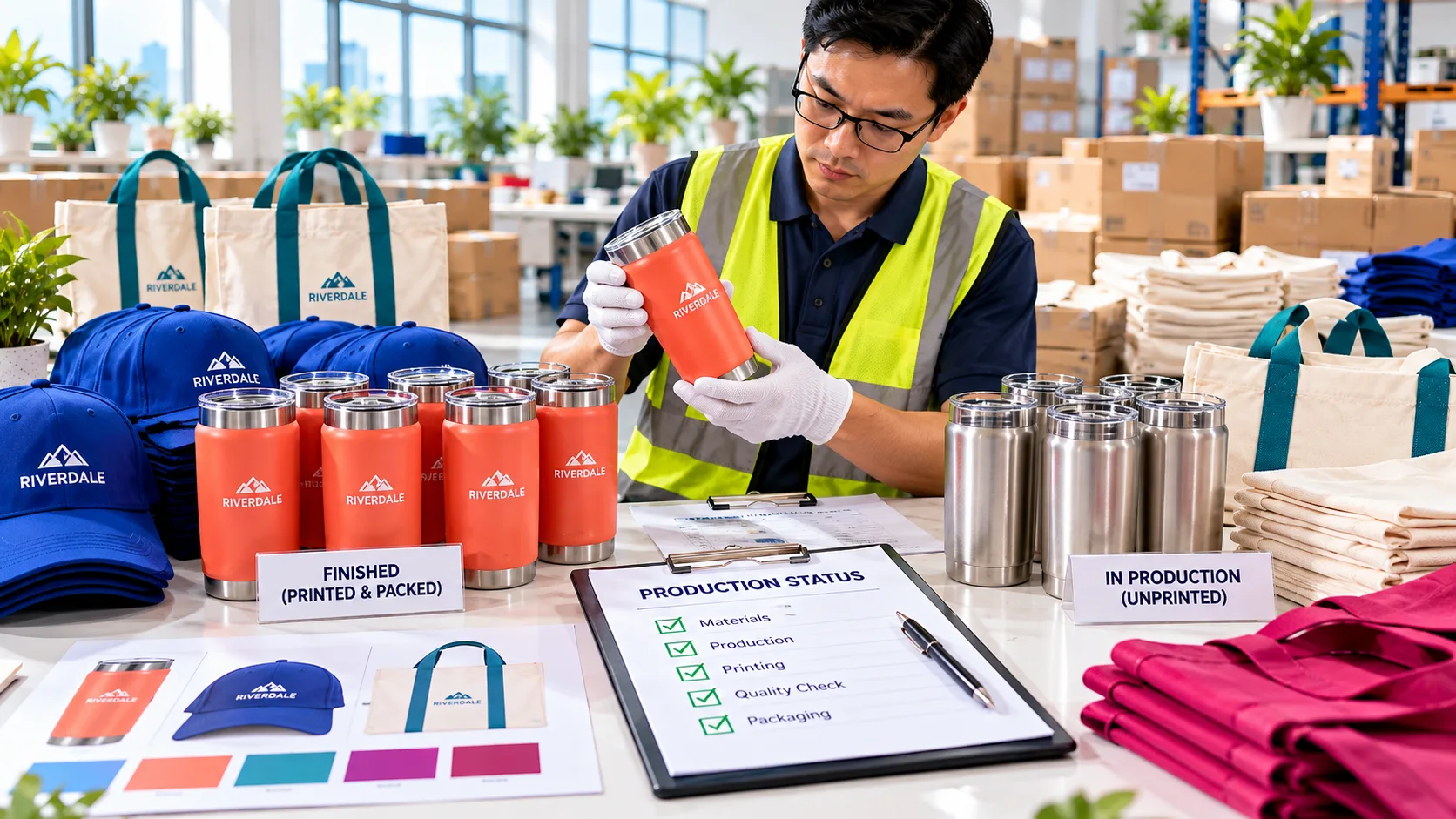
A notice that says “production is delayed” is not actionable. Before you choose a fallback, pin the order to one of six stages and ask the supplier for proof of where it sits. Each stage has different options still open, which is why the same delay can be a minor reschedule at proof approval and a freight emergency after packing.
| Stage | Typical delay signal | Question to ask the supplier | Evidence to request |
| Proof and artwork approval | Proof not returned; artwork corrections | Is anything besides our approval blocking release to production? | Dated proof log; approved proof copy |
| Materials and blanks sourced | Blank or material shortage; colour matching | Are all materials on site, and from the same batch? | Receiving record or photo of materials |
| Bulk production and decoration | Line capacity, rework, decoration defects | What quantity is finished, and what is the daily output? | Quantity-complete count; dated line photos |
| QC and packing | Failed inspection; carton or labelling issues | What is the inspection result, and what is being reworked? | Inspection report; carton photos |
| Dispatch and transit | Missed booking cut-off; port or carrier delay | What is the booking status and updated ETA? | Booking confirmation; tracking reference |
| Customs and last mile | Documentation query; hold; delivery appointment | Which document or action is holding the shipment? | Customs reference; document copy |
If a supplier cannot show evidence for the stage they claim, treat the order as one stage earlier until they can. That conservative reading keeps your turnaround planning honest.
Score Event Criticality Before You Spend on Recovery
Recovery options cost money, so match the spend to what the event actually needs. Score each criterion from 1 to 3 and add the points. The scorecard belongs to the decision owner, usually the operations manager together with the event or campaign lead.
| Criterion | 1 point | 2 points | 3 points |
| Date flexibility | Date can move a week or more | Date can move a few days | Date is fixed |
| Reliance on the goods | Nice-to-have giveaway | Part of the programme | Core item; the event depends on it |
| Substitute availability | Easy local substitute | Substitute with a compromise | No acceptable substitute |
| Brand or contract exposure | Internal use only | Client-facing, no penalty | Client commitment or contractual deadline |
A total of 4 to 6 points is low criticality, 7 to 9 is medium and 10 to 12 is high. These bands are a starting point for your own decision owner, not an industry standard.

Walk the Decision Tree for Promotional Product Production Delay Contingency
With the stage and the criticality in hand, the tree below gives the default recovery path. Treat it as a first answer for your promotional product production delay contingency, then test it against the supplier’s evidence in Step 5.
- Start with the stage. If bulk production has not started, the order is still flexible on source, material and date.
- Production started, goods not packed. The choice is usually between a split run and a revised ship date, decided by event criticality.
- Packed or shipped. The remaining levers are freight mode, local top-up stock, or accepting a later delivery for part of the quantity.
- Record every branch. Write down the decision, the owner and the date so the plan survives staff changes.
Compare Recovery Options on Criteria You Can Verify
The decision table compares the common recovery options. Costs are described as exposure rather than price, because freight rates and factory terms vary by lane, season and contract. Use it to shortlist options, then ask the supplier for the verification items in the last column.
| Option | Best stage | Criticality fit | Cost exposure | Quality or brand risk | Verify before approving |
| Re-baseline the date | Any stage | Low to medium | Low; no extra freight | Low | Revised schedule in writing |
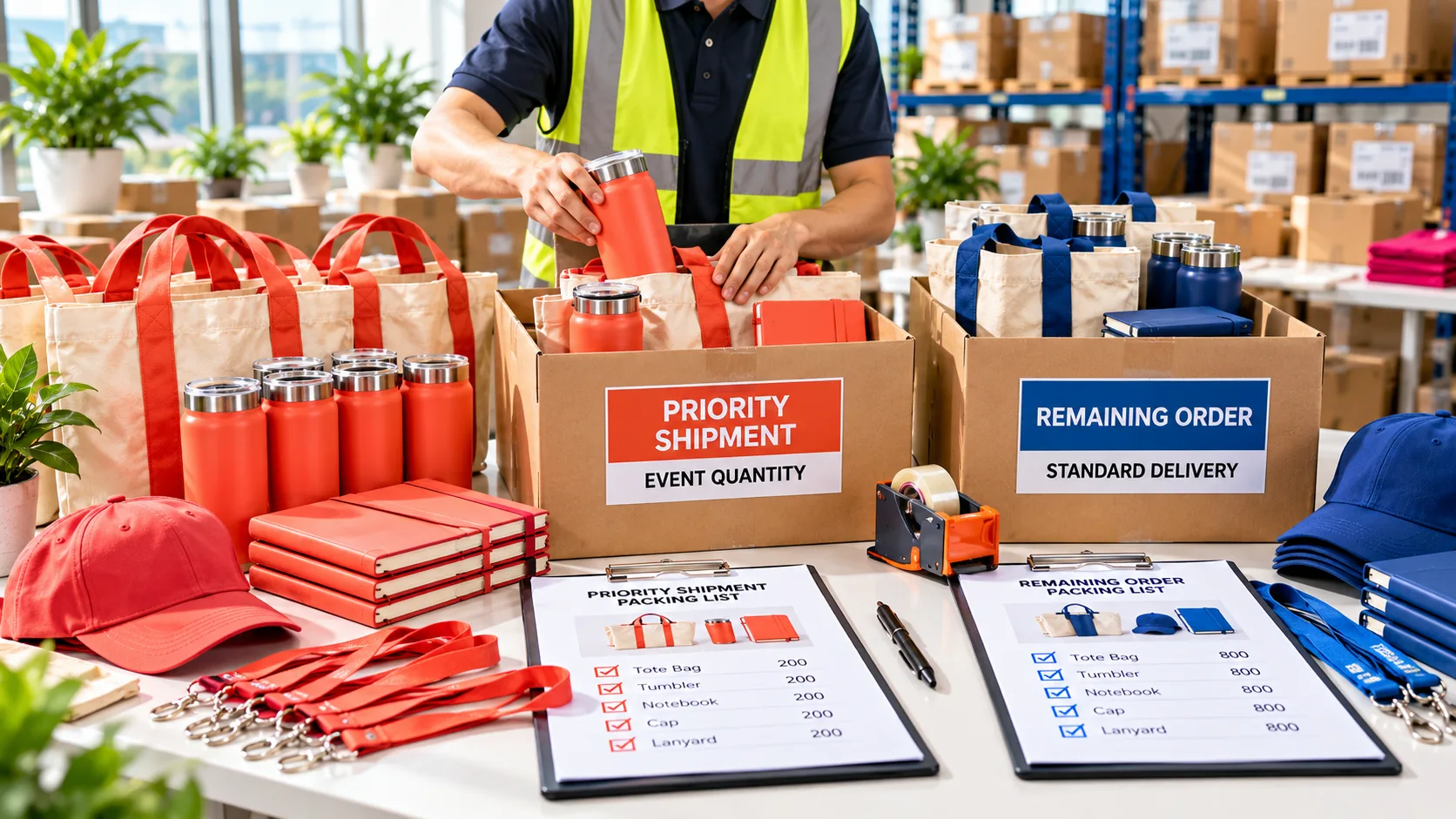
| Split shipment | In production; packed | Medium | Moderate; two freight legs | Moderate if batches differ | Material lot and colour match to approved sample |
| Partial run plus air freight | In production | High | High per unit on the air portion | Low to moderate | Quantity complete; air booking; cut-off time |
| Expedited or upgraded freight | Packed; in transit | Medium to high | Moderate to high | Low | Carrier ETA; booking reference |
| Re-source to an alternate supplier | Pre-production | Medium to high | Moderate; new set-up and proofing | Moderate; new sample needed | Sample approval; MOQ; lead time quote |
| Substitute item | Pre-production; in production | High, no workaround | Variable | Moderate to high; brand fit | Approved sample; stock; MOQ |
| Local top-up stock | Packed; in transit | High | Moderate to high | Moderate; finish may differ | Local lead time; branding method |
Worked Example: Is Paying for Recovery Worth It?
This illustrative example shows how a decision owner can test a recovery option. It is a calculation template, not a client case or a quote, and every input should be replaced with confirmed figures. Solid promotional product production delay contingency work puts a number against the risk before approving any spend.
| Input | Assumed value | Replace with |
| Order | 2,000 custom tote bags | Purchase order |
| Order value | USD 5,000 (USD 2.50 per unit) | Supplier invoice |
| Status at notice | 40% produced; ex-factory date slips 9 days | Supplier’s written schedule |
| Priority quantity for the event | 800 units | Event plan |
| Air weight | 0.18 kg per unit (144 kg for 800 units) | Packed carton weight |
| Air rate / sea rate | USD 6.00 per kg / USD 0.50 per kg | Forwarder quotes |
| Campaign spend tied to the event date | USD 12,000 | Marketing budget |
| Share of the event relying on the bags | 40% | Event owner |

| Calculation | Formula | Result |
| Air cost, priority quantity | 144 kg × USD 6.00 | USD 864 |
| Sea cost, same goods | 144 kg × USD 0.50 | USD 72 |
| Incremental recovery cost | 864 − 72 | USD 792 |
| Incremental cost vs order value | 792 ÷ 5,000 | 15.8% |
| Value at risk | 12,000 × 40% | USD 4,800 |
| Decision test | 792 < 4,800 | Split run plus air freight is justified under these assumptions |
The remaining 1,200 units travel by sea on the revised date. If the value at risk were lower than the incremental cost, the better answer would be to re-baseline the date or accept a substitute. The calculation ignores handling fees, duty, tax differences and insurance, so add them before you decide.
Verify the Recovery Option With the Supplier
A recovery plan is only as good as the evidence behind it. Before approving paid acceleration, the decision owner should be able to tick every item below, and the supplier should be able to supply the documents in Table 6. This is the step that keeps a promotional product production delay contingency plan from becoming a guess.
☐ Supplier confirms the production stage in writing, with dated evidence.
☐ Revised ex-factory date and the cause of the delay are stated.
☐ Finished and remaining quantities are counted, not estimated.
☐ Split batches use the same material lot and are checked against the approved sample.
☐ Freight booking and cut-off times are confirmed before acceleration is paid for.
☐ Responsibility for acceleration cost is agreed in writing, with the trade term in the contract checked.
☐ Carton marking separates the priority quantity from the later shipment.
☐ Decision owner, approver and deadline for the choice are recorded.
| Document | What it proves | Red flag |
| Dated production schedule | Stage and a realistic ex-factory date | Dates keep sliding with no stated cause |
| Quantity-complete count with photos | Finished versus remaining units | Round numbers and no photos |
| Pre-shipment inspection report | Quality status before freight spend | Inspection only after dispatch |
| Forwarder booking and ETA | Acceleration is real | “Space requested” with no booking |
| Revised proforma or amendment | Cost and responsibility for the change | Verbal agreement only |
Build Promotional Product Production Delay Contingency Into the Next Order
The cheapest recovery is the one you planned before the delay. Good turnaround planning and early sourcing risk checks cost little, while a rushed delivery contingency after packing costs a great deal.
- Add a freight buffer. For high-criticality events, schedule so the slower freight mode still lands before the in-hand date, with inspection time included.
- Set stage checkpoints. Agree dates for proof return, materials received, 50% complete and inspection, and ask for evidence at each.
- Reduce sourcing risk. Approve an alternate material or a second source on high-criticality items before the main order starts.
- Split by design. For large quantities, plan a priority tranche from day one rather than inventing it during a crisis.
- Write the fallback into the PO. State the trigger, the responsibilities and the cost sharing for recovery options.
Risks and Limits of This Framework
- Illustrative numbers. Freight rates, carrier capacity and factory lead times change. Verify them with current quotes before using any figure in this guide.
- Quality consistency. Split batches and alternate sources can differ in colour, finish or dimension, so sample approval remains essential.
- Cost allocation depends on the contract. The trade term agreed in the order, for example an Incoterms rule, affects who bears cost and risk at each point.
- Market-specific rules. Customs, product regulation and labelling vary by destination and product type. This guide does not cover compliance.
- Reporting risk. Evidence lowers but does not remove the chance that a delay is misreported.
- No guarantees. No promotional product production delay contingency framework can promise on-time delivery. It improves the quality of the decision, not the outcome.
Frequently Asked Questions
How much buffer should a promotional product production delay contingency plan include?
There is no universal figure. A promotional product production delay contingency plan should base its buffer on the supplier’s on-time record, the difference between slower and faster freight options, and inspection time. For high-criticality events, schedule the order so the slower freight mode still arrives before your required in-hand date.
Can I split an order without hurting decoration consistency?
Usually, yes, if both batches use the same material lot and decoration method and are checked against the approved sample. As part of your promotional product production delay contingency strategy, ask the supplier for side-by-side photos before approving a split shipment to help verify consistency.
Who pays for expedited freight when the factory is late?
Responsibility depends on the contract, the agreed trade term, and the cause of the delay. A promotional product production delay contingency plan should specify who pays for expedited freight and any related recovery costs in writing before the shipment is booked, rather than after the extra costs arise.
What should a supplier delay notice contain?
A supplier delay notice should include the current production stage, finished and remaining quantities, the cause of the delay, a revised delivery date, and the recovery options available. These details help you evaluate your promotional product production delay contingency options. If you are weighing sourcing options, our factory and supply network page provides useful context.
When should I switch to a substitute item?
Consider switching when the event is highly critical, the revised delivery date misses your in-hand deadline, and no freight option can recover the schedule. A promotional product production delay contingency plan should identify substitute items in advance where possible. Approve a sample and confirm minimum order quantity (MOQ) and stock availability before making the switch.
Get Your Recovery Plan Scoped
If an order is at risk, send the purchase order, approved proof and current schedule and we will scope the options against your event date. Request a scoped quote to start a promotional product production delay contingency review. Prefer to begin smaller? Ask for a document review of your schedule and proforma first.
Sources and Further Guidance
ISO — ISO 31000:2018 Risk management — Guidelines
US Consumer Product Safety Commission — Children’s Product Certificate
UK Government — Placing Manufactured Products on the Market in Great Britain
International Chamber of Commerce — Incoterms® Rules
Author & Reviewer
Written by Claire Morgan, Senior Content Writer, with professional experience managing supply chain risk for branded merchandise programs.
Freshness & Update Log
- Published: October 25, 2026
- Last Reviewed: October 25, 2026
- Next scheduled review: within 6 months, or sooner if cited standards or compliance guidance changes materially.
Related Resources
- /promotional-products-budget-allocation/ — how to decide which portfolio tier a price-break decision should apply to.
- /questions-to-ask-a-promotional-product-supplier/ — 18 evidence-based questions to ask once quotes are in hand.
- /promotional-product-supplier-audit-checklist/ — the 25-point checklist for auditing a supplier before you award the order.
- /promotional-merchandise-vendor-consolidation/ — how vendor consolidation interacts with ongoing performance scoring.