
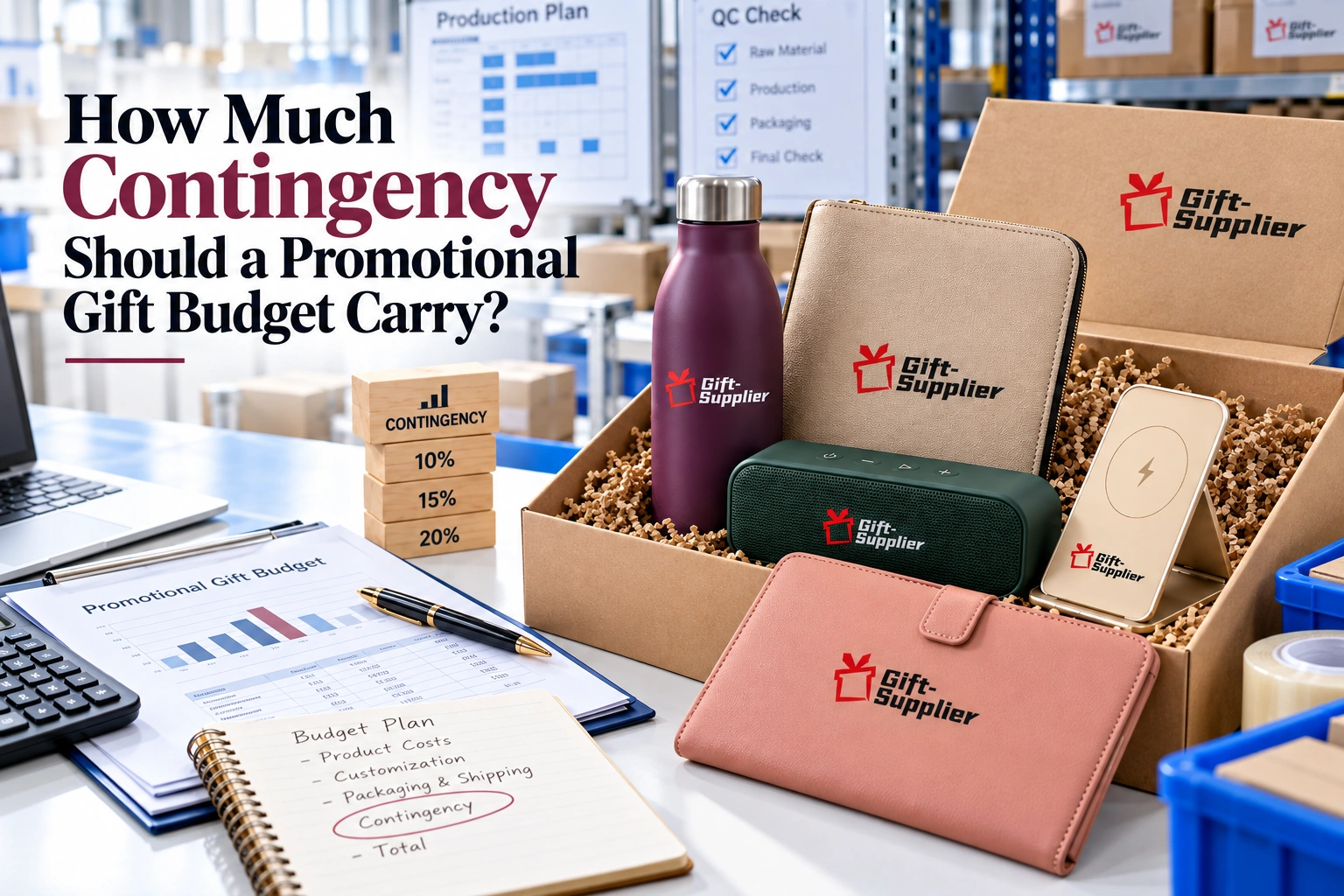
A promotional gift budget contingency should usually sit between roughly 3% and 20% of the landed cost, set by risk band rather than one flat figure. Score four drivers (freight, currency, duties and deadline rigidity) from 1 to 3, convert each score into a percentage, and add them together. This guide covers imported, customised promotional gifts bought in a single production run by a marketing procurement team, using planning assumptions dated 7 October 2026. The percentages are starting heuristics to calibrate against your own quotes, not market benchmarks, and they exclude artwork changes, quantity changes and quality rejections.
Most overruns on a procurement budget for gifts do not come from the unit price. They come from the lines that move after the purchase order is signed: freight, exchange rates, customs duties, and the cost of rushing when an event date cannot slip. A sound promotional gift budget contingency makes those moving parts visible before approval, so you can defend the number to finance and still keep room for sensible price trade-offs. Below you will find a scoring framework, a worked calculation, a buyer checklist and the limits of the method. If you are still choosing a spend tier, start with our promotional gifts by budget page, then return here to size the buffer.
What a promotional gift budget contingency should cover
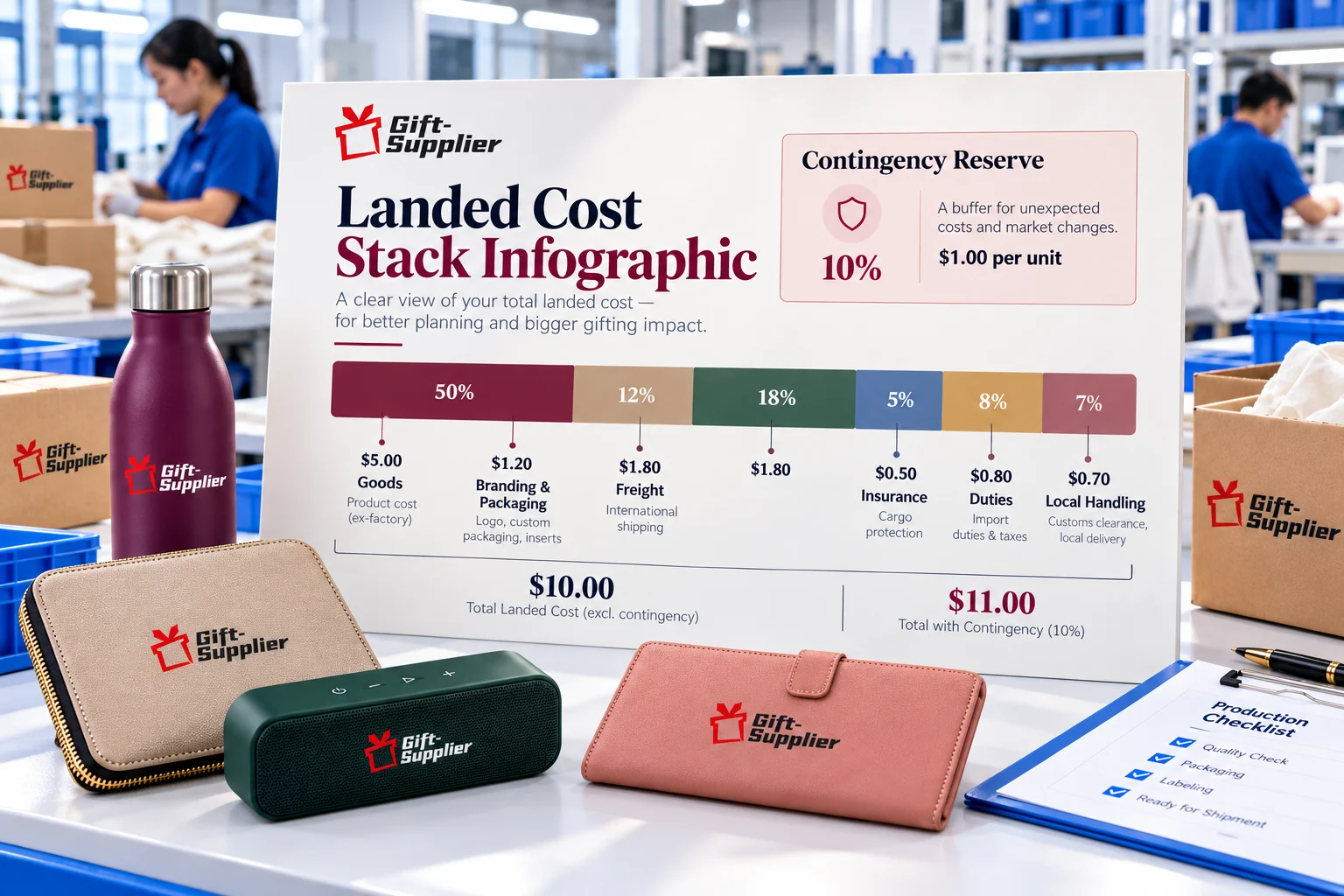
A promotional gift budget contingency is a pre-approved reserve, held on top of the base landed cost, that absorbs cost movements you can name but cannot yet fix. Landed cost is the full delivered cost: goods, branding, packaging, freight, insurance, duties, any taxes you cannot recover, and local handling. The reserve is not a hidden margin and it is not a substitute for a clear brief.
Keeping that boundary clear protects your procurement budget. Contingency covers price movement on defined lines. It does not cover scope changes such as a new logo version, extra units or a different material, which belong in a change request. When the two are mixed, the promotional gift budget contingency is spent in week one and nothing is left for freight in week eight.
- Covered: freight rate and surcharge movement, exchange-rate movement between quote and payment, duty or classification corrections, and expedite costs needed to protect a fixed date.
- Not covered: artwork or specification changes, quantity increases, quality rejections (handle under your QC terms) and destination-specific compliance work.
Why a flat percentage fails the promotional gift budget contingency test
Many teams add 10% to every project. That works until it does not. A flat figure treats a same-currency, low-duty order with a flexible date exactly like an air-freighted, foreign-currency order tied to a trade show. One of those is over-buffered and the other is under-buffered, and neither can be explained to finance beyond “it is our standard”.
| Criterion | Flat 10% rule | Line-by-line padding | Risk-banded (this guide) |
| Can a buyer verify it? | No. No link to any driver. | Partly. Many separate estimates. | Yes. Each score maps to a quote line or document. |
| Reflects freight exposure | No | Yes, if freight is itemised | Yes. Scored by quote basis and validity. |
| Reflects currency exposure | No | Often ignored | Yes. Scored by currency and payment timing. |
| Reflects deadline rigidity | No | Rarely | Yes. Scored by the cost of a missed date. |
| Effort to prepare | Minimal | High | Low to moderate once the quote pack is in hand |
| Audit trail for finance | Weak | Moderate | Strong. Scorecard stored with the purchase order. |
The four drivers behind promotional gift budget contingency risk bands
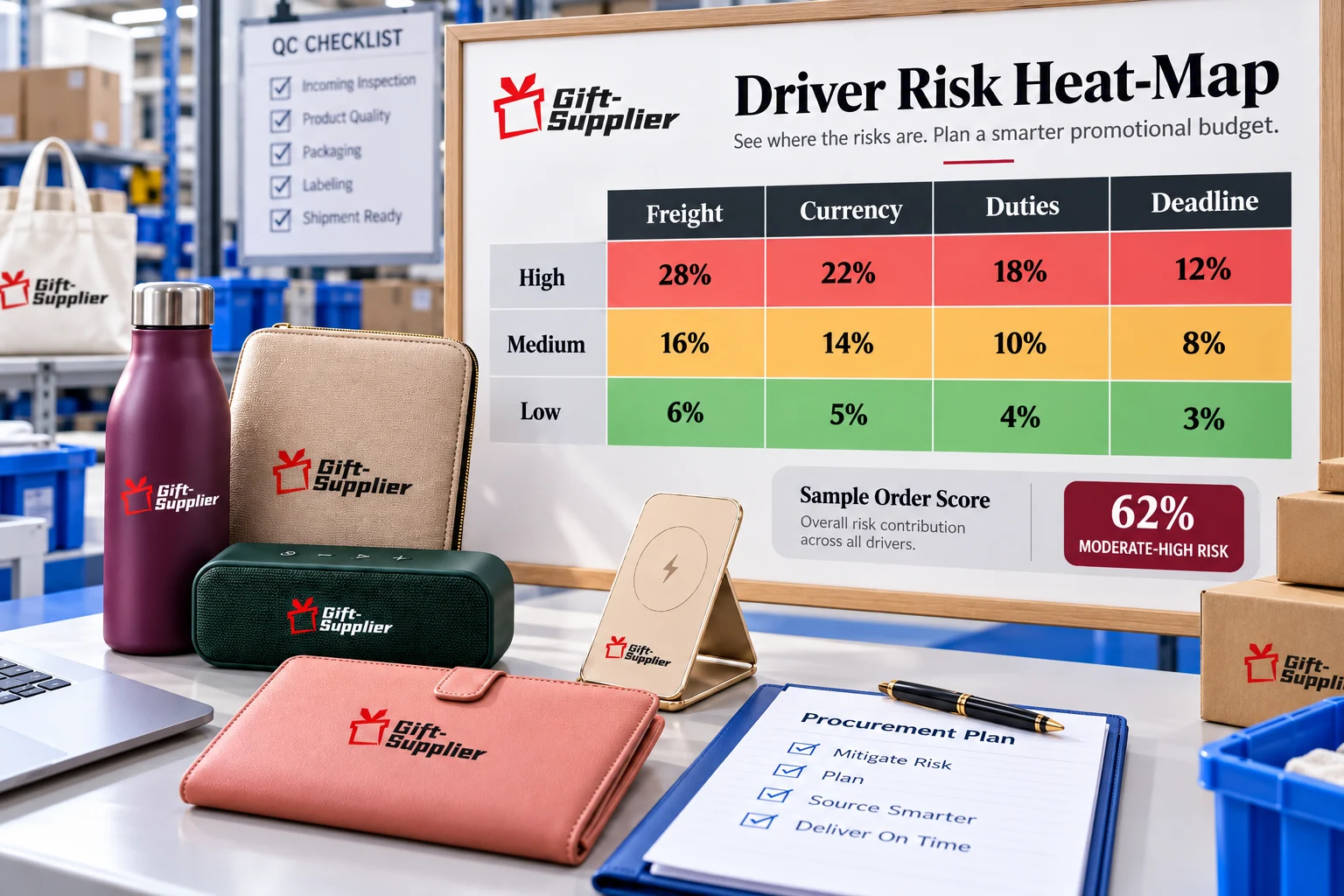
The framework scores four drivers: freight, currency, duties and deadline rigidity. Each is rated 1 (low), 2 (medium) or 3 (high) using evidence in the quote pack, not instinct. A verbal “should be fine” from a supplier scores as high until it is written down.
Freight exposure
Check whether the freight line is fixed, estimated or “at cost”, which shipping mode is assumed, and whether the quote’s validity date covers your purchase order and payment dates. An estimated freight line on an expiring quote is a high-exposure input to any promotional gift budget contingency. Confirm which Incoterms 2020 rule applies so you know where your cost responsibility starts.
Currency exposure
If the quote currency differs from your reporting currency, exposure runs from quote date to the final payment. A single payment within days carries less risk than a deposit followed by a balance weeks later. Check the movement of the relevant pair using the ECB euro foreign exchange reference rates or your bank’s equivalent, and treat the contingency as a buffer, not a hedge.
Duties and classification
Duty depends on product classification, country of origin and destination. Composite products, such as a gift set mixing textile, metal and electronic parts, can be harder to classify than single-material items. Ask your customs broker to confirm the code in writing before the order is placed, using the WCO Harmonized System overview and your destination’s official tariff for the rate.
Deadline rigidity
Ask one question: what does it cost if the goods land a week late? For an evergreen welcome kit the answer may be nothing. For an event giveaway the answer may be an air-freight upgrade or a failed campaign moment. Rigid dates push a procurement budget towards a higher band even when every other driver is calm.
| Driver | Score 1 (low) | Score 2 (medium) | Score 3 (high) |
| Freight | Fixed, itemised freight; validity covers PO date (+1%) | Estimated freight, standard mode, short validity (+3%) | “At cost” freight, or peak-season or air shipment required (+6%) |
| Currency | Quoted and paid in your reporting currency (+0%) | Foreign currency, single payment soon after quote (+2%) | Foreign currency, deposit and balance weeks apart (+4%) |
| Duties | Duties included in the landed quote, or code confirmed by broker (+1%) | Code believed correct, not confirmed in writing (+2%) | Composite product, or code or origin uncertain (+5%) |
| Deadline | Date flexible by two weeks or more (+1%) | Date firm, some schedule slack (+3%) | Fixed event or launch, no slack (+6%) |
Step-by-step: how to set your promotional gift budget contingency
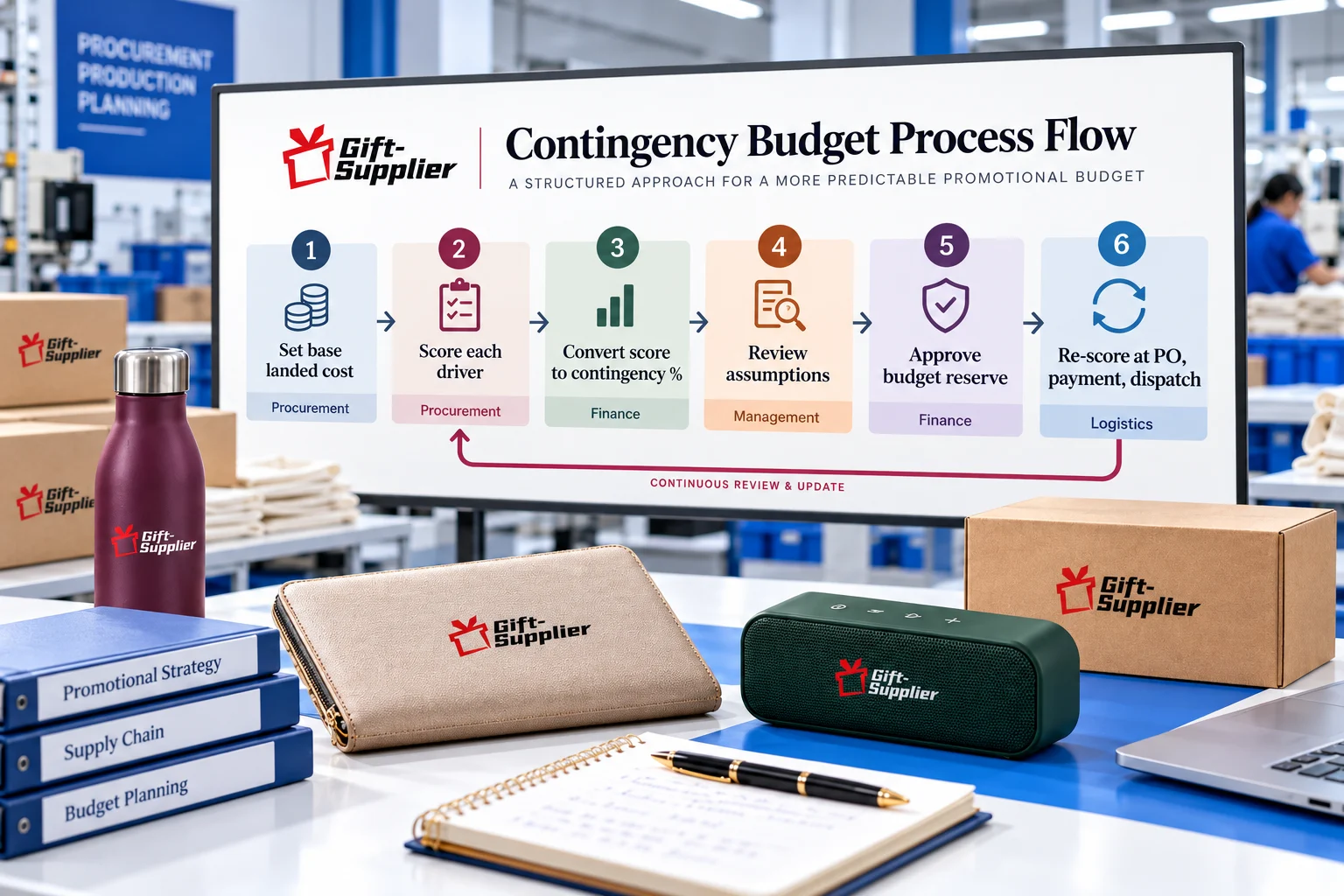
Follow these six steps for each order to set a defensible promotional gift budget contingency. Each step has a named decision owner so the number is accountable, not just calculated.
- Build the base landed cost (owner: Procurement lead). Use the supplier’s itemised quote and separate goods, branding, packaging, freight, insurance, duties and handling.
- Request the evidence for each driver (owner: Procurement with the supplier). Ask for freight basis and validity, quote currency and payment terms, the product classification, and the latest acceptable in-hand date.
- Score each driver 1 to 3 using Table 2 (owner: Procurement lead). Write down the document that justifies each score, so the promotional gift budget contingency can be audited later.
- Add the percentages. The formula is: contingency % = freight + currency + duties + deadline.
- Calculate the reserve (owner: marketing budget holder signs). Contingency amount = base landed cost x contingency %. Approved budget = base landed cost + contingency amount.
- Set release rules. Hold the reserve centrally, re-score at purchase order, at balance payment and at dispatch, and return any unused amount to the programme.
Turning scores into risk bands for your promotional gift budget contingency
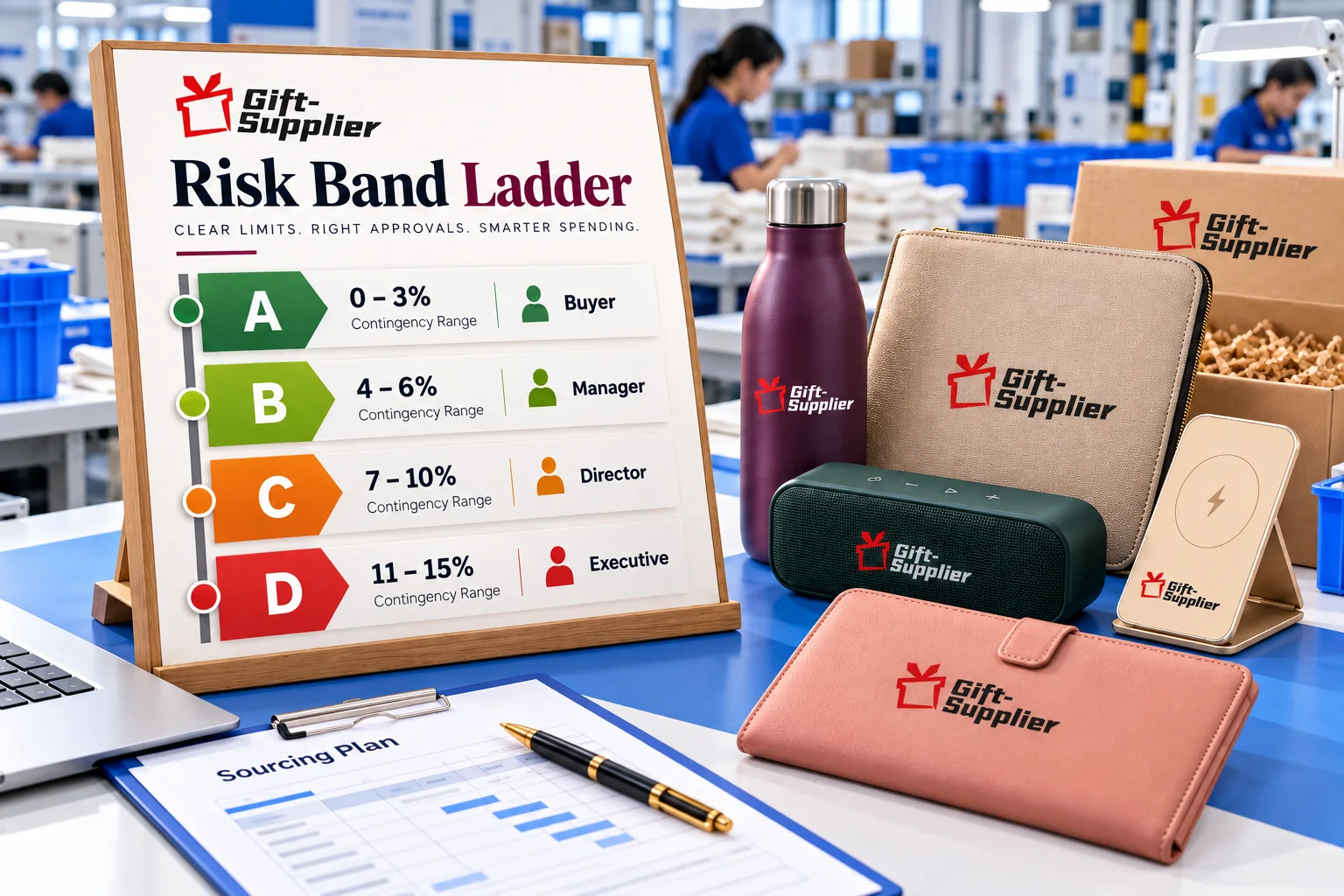
Totals are easier to approve when they are grouped into bands, because each band can carry its own release rule and approver. Use Table 3 to match your total to a band and the release rule that governs your promotional gift budget contingency.
| Band | Total contingency | Typical profile | Release rule | Approver |
| Low | 3% to 6% | Fixed freight, home currency or duties included, flexible date | Release after delivery once the invoice matches the quote | Procurement lead |
| Moderate | 7% to 11% | One or two drivers at medium, date firm but not critical | Re-score at balance payment; release unused reserve after delivery | Procurement lead and marketing manager |
| Elevated | 12% to 16% | Firm deadline plus at least one high driver | Review at PO, balance payment and dispatch | Procurement, marketing and finance partner |
| High | 17% to 21% | Several high drivers, often with a fixed event date | Pause and review trade-offs before approving; formal sign-off | Finance approval |
If an order lands in Band D, the answer is often not a bigger buffer but a different order. Moving the date, simplifying the product or changing the quote basis can lower the score and the reserve at the same time. The next sections show how.
Worked example: sizing a promotional gift budget contingency
The figures below are an illustrative calculation, not a client case. They use assumptions dated 7 October 2026 and should be replaced with numbers from your own quote. The example is a 2,000-unit order of customised gifts shipped by sea and quoted in US dollars.
| Item | Basis or assumption | Result |
| A. Base landed cost | ||
| Goods | 2,000 units at $4.50 | $9,000 |
| Branding and packaging | Assumed from itemised quote | $600 |
| Freight | Sea freight, estimated line | $900 |
| Duty | Assumed 4% of customs value of $10,500 (illustrative rate; confirm code and rate) | $420 |
| Insurance and local handling | Assumed | $180 |
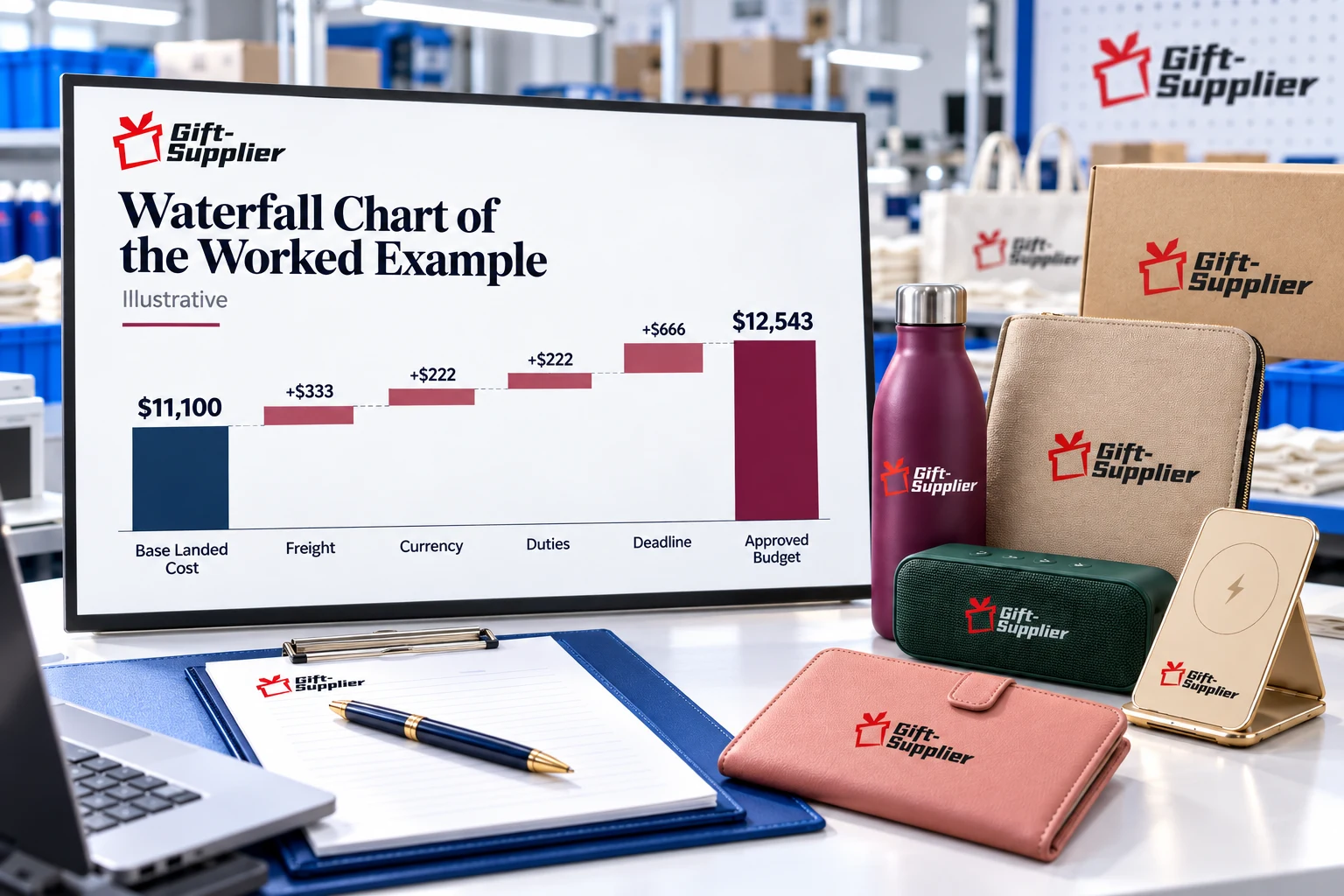
| Base landed cost | Sum of lines above | $11,100 |
| B. Driver scores | ||
| Freight | Score 2: estimated line, standard mode | +3% |
| Currency | Score 2: foreign currency, single payment soon after quote | +2% |
| Duties | Score 2: code believed correct, not confirmed | +2% |
| Deadline | Score 3: fixed event date, no slack | +6% |
| Total contingency (Band C) | 3% + 2% + 2% + 6% | 13% |
| C. Approved procurement budget | ||
| Contingency reserve | $11,100 x 13% | $1,443 |
| Approved budget | $11,100 + $1,443 | $12,543 |
In this illustration the deadline drives 6 of the 13 percentage points. That points to the cheapest lever: if marketing can confirm an earlier order date and a little schedule slack, the deadline score drops from 3 to 2. That removes 3 points from the promotional gift budget contingency, or about $333 on this base, without touching the product.
Price trade-offs when the promotional gift budget contingency looks too high
A high promotional gift budget contingency is a signal, not a verdict. Before you accept it, test which input can be improved at a reasonable cost. Each lever below has a trade-off, so decide with the full landed cost in view and not freight alone.
- Order earlier. Lowers the deadline score, but shortens the time for internal approvals and sample sign-off.
- Change the shipping mode. Can protect the date, but compare total landed cost, since a faster mode can raise freight and insurance.
- Ask for a quote basis that fixes more lines. A written freight validity date or a quote in your reporting currency lowers two scores, but the supplier may price in the risk they absorb.
- Confirm the product classification before the PO. Reduces the duties score, at the cost of a broker’s time.
- Simplify the product. Fewer materials or components can ease classification, but may change the perceived value of the gift.
- Step down a spend tier. Preserves a safe reserve inside a fixed procurement budget.
Buyer checklist before approving a promotional gift budget contingency
Use this checklist as the evidence pack that accompanies the purchase requisition and supports the promotional gift budget contingency. If an item is missing, score the related driver as high until it arrives.
| Check | Evidence to request | Decision owner |
| Itemised landed-cost quote | Supplier quote splitting goods, branding, packaging, freight, insurance | Procurement lead |
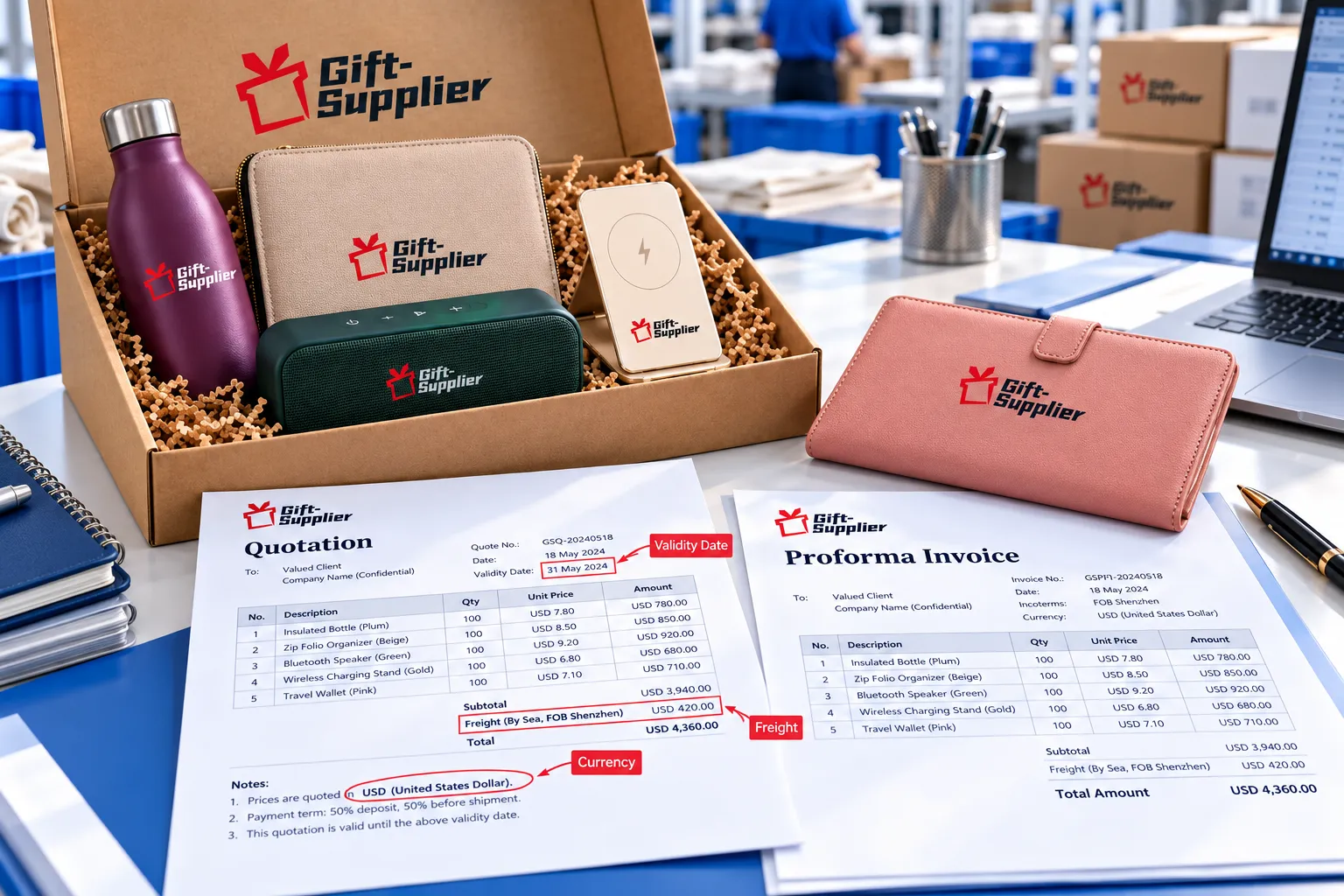
| Freight basis and validity | Written statement of fixed or estimated freight, mode and expiry date | Procurement lead |
| Quote currency and payment schedule | Proforma invoice showing currency, deposit and balance dates | Procurement and finance |
| Classification and duty basis | Product code and origin noted; broker confirmation where possible | Procurement and customs broker |
| Latest in-hand date and cost of missing it | Campaign or event brief signed by the marketing owner | Marketing manager |
| Approved sample | Sample photos and sign-off before mass production | Marketing and procurement |
| Re-score dates | Calendar entries for PO, balance payment and dispatch | Procurement lead |
Risks and limits of this promotional gift budget contingency method
- Heuristics, not benchmarks. The percentages in this promotional gift budget contingency method are starting points. Test them on two or three completed orders before relying on them.
- Destination rules vary. Duties, taxes and product-specific requirements differ by market and product type. Verify with your customs broker and the official tariff before ordering.
- Policy can change. Duty rates and trade measures may change between quote and arrival. Check official sources close to the order date.
- A buffer is not a hedge. Currency can move in either direction and by more than the allowance. Use treasury tools if exposure is material.
- Scope and quality sit outside the reserve. Spec changes, extra units and rejected goods need their own approval route.
- Domestic or same-currency orders will usually score lower and may not need the full framework.
Sources and date-stamped assumptions
| Assumption | Value used | Where to verify |
| Scenario | Imported, customised gifts, single production run, 2,000 units | Your own quote pack |
| Quote currency | US dollars (illustrative) | Supplier proforma invoice |
| Duty rate | 4% of customs value (illustrative only) | Destination official tariff and customs broker |
| Freight | Sea freight, estimated line | Supplier or forwarder quote with validity date |
| Trade terms | Incoterms 2020 rules | ICC Incoterms 2020 page |
| Exchange rates | No forecast used | ECB reference rates or your bank |
Request a Scoped Quote
Request a scoped quote with your quantity, destination market and latest in-hand date, and we will return an itemized landed-cost view you can score. Send your current quote or proforma invoice for a document review before you finalize the promotional gift budget contingency.
Frequently asked questions
Should the contingency be applied before or after duties?
Apply the promotional gift budget contingency after duties. Include your best estimate of duties in the base landed cost, then let the reserve cover movement in that estimate, along with freight and currency.
Can unused contingency be released?
Yes, and you should define when. A common rule is to re-score at purchase order, balance payment and dispatch, then release the unused amount once the final invoice matches the quote.
What changes if the supplier quotes duties included?
The duties score usually falls, but read what “included” covers. Destination taxes, local delivery and storage may sit outside the quote and still need a place in the promotional gift budget contingency.
Is a bigger buffer better than ordering earlier?
Often not. Moving the order date can lower the deadline score and the reserve together, while a larger buffer only locks up more of the procurement budget.
How do I request a quote that supports this method?
Ask for itemised lines, a freight validity date, the quote currency and payment schedule, and the product classification used. You can share your target spend tier through the promotional gifts by budget page.
Sources and Further Guidance
International Chamber of Commerce — Incoterms® Rules
US International Trade Commission — Harmonized Tariff Schedule (HTS) search
UK Government — Trade Tariff: look up commodity codes, duty and VAT rates
US Consumer Product Safety Commission — Children’s Product Certificate
Author & Reviewer
Written by Claire Morgan, Senior Content Writer, with professional experience comparing supplier quotes and pricing in downstream risk for branded merchandise programs.
Freshness & Update Log
- Published: October 7, 2026
- Last Reviewed: October 7, 2026
- Next scheduled review: within 12 months, or sooner if referenced freight or duty guidance changes materially.
Related Resources
- /promotional-products-budget-allocation/ — how to decide which portfolio tier a price-break decision should apply to.
- /questions-to-ask-a-promotional-product-supplier/ — 18 evidence-based questions to ask once quotes are in hand.
- /promotional-product-supplier-audit-checklist/ — the 25-point checklist for auditing a supplier before you award the order.
- /promotional-merchandise-vendor-consolidation/ — how vendor consolidation interacts with ongoing performance scoring.