
A supply chain risk register for branded merchandise programs lists each risk once, scores it by likelihood times impact, assigns an owner and a response, and is reviewed on a schedule. For promotional products supply chain risk, the useful categories are material, factory, freight, compliance, and single points of failure. This guide is written for operations managers running branded merchandise programs for US and UK markets, who can obtain supplier quotes and document status. The scales and thresholds below are illustrative, dated October 20, 2026, and should be adjusted to your own tolerance. The register turns scattered worries into a ranked list you can act on before ordering.
Time and budget pressure make this a current priority, because most failures in a merchandise program are not surprises in hindsight. A stock-out, a booked-up factory, or a missing test report was visible earlier, but it sat in someone’s inbox. A register puts each exposure in one place, in a form that lets you compare a freight delay with a compliance gap. The sections below provide a category table, scoring scales, a framework with a named decision owner, a worked register, residual-risk scoring, response rules, and a check for single points of failure.
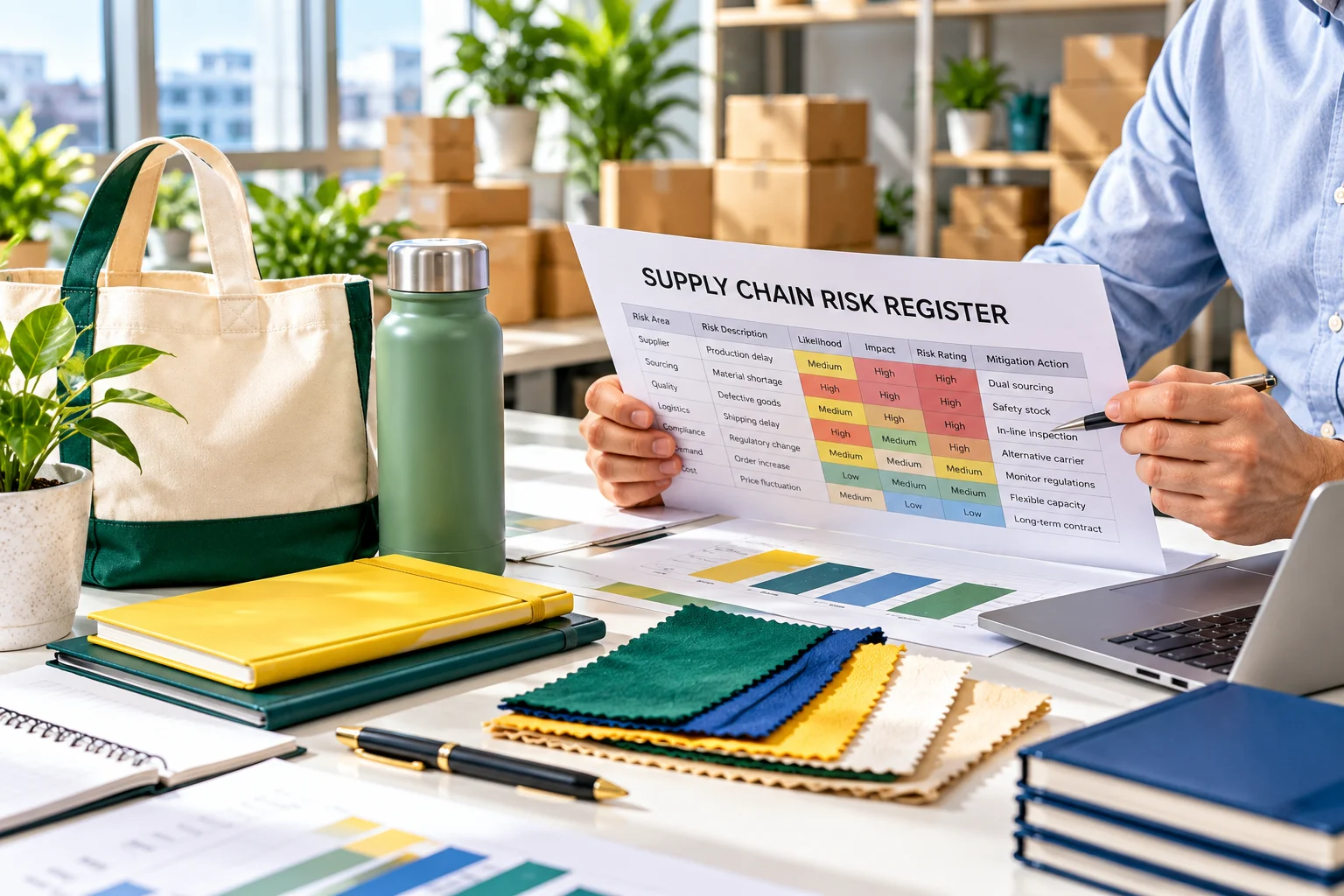
Why a Register Beats a Checklist for Sourcing Risk
A checklist tells you whether a step was done. A register tells you how much each exposure matters and who is dealing with it. For sourcing risk, the second question is the one that decides where limited time goes: a missing certificate on an event-critical item and a late courier on a low-value item are not the same problem, and a flat list treats them as equals.
A register also keeps risk visible over time. Each entry has a score, an owner, a mitigation, and a date, so a risk that has been reduced stays on the record at its new score, and one that is getting worse can be spotted at the next review. The approach follows the general process in ISO 31000, which describes identifying, analyzing, and treating risk in a way that is not specific to any industry, and the register below applies it to a merchandise program.
Decision Table: The Five Risk Categories
Use the table below to decide what to look for in each category and what evidence to request. Each category has a leading indicator, a sign you can check before a problem occurs.
| Category | What drives the risk | Leading indicator | Evidence to request | First mitigation |
| Material | Availability, substitution, and drift from the specification | Supplier stock status and any substitution wording on the quote | Material specification sheet and written stock confirmation | Approve alternates in advance and require written notice of substitution |
| Factory | Capacity, quality control, and stability | Whether your window is booked, and the defect history | Written capacity statement, audit note, and golden sample | Capacity confirmation with a deposit, and pre-shipment inspection |
| Freight | Carrier and port delays, documents, and mode choice | A dated quote and documents that are ready | Freight quote with a validity date, and the packing list | An alternative service quoted, and a buffer in the schedule |
| Compliance | Test reports, certificates, and labeling matched to product and market | Document dates and whether they match the exact product | Test reports, certificates, and labeling approvals | A document check before sample approval |
| Single point of failure | One supplier, factory, lane, approver, or document holder | A name that appears only once in the chain | A supply map and a backup supplier list | Qualify a backup and cross-train approvers |

The Scoring Model: Likelihood Times Impact
Score each risk on two five-point scales and multiply them. Agree the scales before scoring, so that two people give the same risk the same number.
| Score | Likelihood | Impact |
| 1 | Rare: no history and controls are in place | Minor: absorbed within the schedule buffer at little cost |
| 2 | Unlikely: has happened once or twice | Moderate: costs money or a few days, but the event is unaffected |
| 3 | Possible: has happened in comparable programs | Significant: threatens part of the program or causes a major cost overrun |
| 4 | Likely: expected in some form | Major: key items are late or unusable, or a compliance gap is documented |
| 5 | Almost certain: already visible | Severe: an event-critical failure, a safety exposure, or an unrecoverable loss |
Then convert the score into a band, which sets the response. The thresholds below are illustrative and should reflect how much risk your organization will carry.
| Band | Score | Response rule | Review cadence |
| Critical | 20–25 | Do not order until the risk is mitigated or a fallback is agreed; escalate to the decision owner | Weekly |
| High | 12–19 | A mitigation plan with an owner and a due date before ordering | Every two weeks |
| Medium | 6–11 | Monitor against a trigger, with a defined fallback | At each program milestone |
| Low | 1–5 | Accept and record | At program close |
Buyer Framework: How to Build and Run the Register
The steps below turn the model into a repeatable process. The decision owner is typically the operations manager, with procurement, a quality or compliance reviewer, and supplier account managers supplying evidence.
- Map the supply chain for the program: each item, its material, factory, freight lane, compliance documents, and approvers.
- List risks in each of the five categories, with a plain description and the trigger that would reveal each one.
- Score likelihood and impact using the shared scales, and record who scored and when.
- Rank by score and apply the band response rules.
- Assign an owner, a mitigation, a due date, and a delivery contingency fallback to every high and critical risk.
- Re-score after mitigation to show residual risk, and accept only what falls within your tolerance.
- Review on a set schedule and after every incident, and keep the register for the next program.

Evidence From the Field: Illustrative Register
An operations manager at a mid-market company runs a conference giveaway program with one event-critical item. The register holds eight risks across the five categories, ranked by score. In the table, L is likelihood and I is impact.
| ID | Risk | L | I | Score | Band | Mitigation and fallback |
| R1 | Single supplier for the event-critical item, with no qualified backup | 4 | 5 | 20 | Critical | Qualify a backup supplier and share the approved sample before ordering |
| R2 | Key blank item or material out of stock at the supplier | 3 | 4 | 12 | High | Approve an alternate material in advance and confirm stock in writing |
| R3 | Factory capacity committed to other clients in the peak week | 3 | 4 | 12 | High | Written capacity confirmation and a booking deposit |
| R4 | Customs hold or missing documents at import | 2 | 5 | 10 | Medium | Complete the document pack before dispatch and brief the broker |
| R5 | Test reports missing or not matching the product | 2 | 5 | 10 | Medium | Check documents before sample approval |
| R6 | Carrier or port delay | 3 | 3 | 9 | Medium | Keep a schedule buffer and quote an alternative service |
| R7 | Material substituted without notice | 2 | 4 | 8 | Medium | Written substitution notice clause and an incoming check |
| R8 | Quality drift between the approved sample and the bulk run | 2 | 4 | 8 | Medium | Golden sample and pre-shipment inspection |
The register shows one critical risk, two high, and five medium, and the combined score of all eight is 89. The single-supplier risk stands out, because it combines a likely failure with a severe impact. The order of work follows the ranking: qualify a backup first, then secure stock and capacity, then tidy the medium risks.
| Risk | Score before | Mitigation applied | Score after | Change |
| R1 Single supplier | 20 (4 × 5) | Backup supplier qualified, which lowers likelihood to 2 | 10 (2 × 5) | −10 |
| R2 Material stock-out | 12 (3 × 4) | Alternate material approved and stock confirmed, which lowers likelihood to 2 | 8 (2 × 4) | −4 |
| R3 Factory capacity | 12 (3 × 4) | Capacity confirmed in writing with a deposit, which lowers likelihood to 2 | 8 (2 × 4) | −4 |
| Combined | 44 | 26 | −18 |
Mitigating the top three lowers their combined score from 44 to 26, a reduction of about 41%, and no entry is left above medium. Impact does not change in any of the three, so these controls reduce how likely the failure is, not how bad it would be. That is the reason to keep fallbacks for the scenarios the controls do not remove.

Turnaround Planning and Delivery Contingency: Linking Risk to the Schedule
A register is only useful if it changes the plan. Each high or critical risk should map to something concrete in the schedule: a buffer of a stated number of days, a fallback supplier or item, or a decision point with a trigger. Turnaround planning then reflects the risks you have chosen to carry, instead of a standard schedule that assumes nothing will go wrong.
For example, the stock-out risk in the register calls for a decision point at the material confirmation step, and the factory capacity risk calls for a deposit and written confirmation before the production window opens. If a trigger is reached and the fallback has not been agreed in advance, the decision is made under pressure. Writing the fallback into the register, with an owner, removes that.
Where Single Points of Failure Hide
Single points of failure are the category most often missed, because the dependency is usually a name or a habit, not a document. The table lists common places they hide and the question that exposes each.
| Dependency | Question to ask | Evidence to request |
| One supplier for an event-critical item | Is there a qualified backup that has seen the approved sample? | Backup supplier name and a sample record |
| One factory for the whole run | Could part of the order move to another line or site? | A written statement of alternative capacity |
| One freight lane or carrier | Is an alternative service quoted, and are the documents portable? | A second freight quote with a validity date |
| One material source | Is an approved alternate material on file? | An approved alternate specification |
| One person approves artwork or releases orders | Who can approve if that person is unavailable? | A named deputy and delegated authority |
| One holder of compliance documents | Are reports stored where others can retrieve them? | A shared document register |

Risks and Limitations of This Approach
- Scores are judgments, so two reviewers may rate the same risk differently; agree the scales in advance and record who scored each entry.
- A register is a snapshot, so it needs a review schedule, and a register that is not updated can create false comfort.
- Likelihood scores are estimates and not probabilities, and the combined score is a tracking aid, not a measure of overall exposure.
- Supplier evidence may be incomplete or self-reported, so verify capacity, stock, and documents where the risk is high.
- Compliance requirements depend on product category, intended use, and market, and a compliance reviewer should confirm them for your order.
- This model is scoped to general promotional merchandise in US and UK markets, and the worked example is illustrative.

Request a Scoped Quote
If you are building a register for an upcoming program, share your items, quantities, event date, and current suppliers. Our team can help you request written capacity, stock, and document evidence from suppliers in our network, so the scores rest on evidence.
Prefer a lighter first step? Send us your supplier list and event date for a quick review of single points of failure before you order.
Frequently Asked Questions
How often should a promotional products supply chain risk register be reviewed?
Review your promotional products supply chain risk register according to the severity of each risk, such as weekly for critical risks and at each milestone for medium risks. Review it again after any incident. The right frequency depends on how quickly your program moves, the sourcing risk involved, and how much is at stake.
Who should own the register?
A single named owner, typically the operations manager, should manage the register, with each risk assigned to the person best placed to act on it. During turnaround planning, clear ownership helps ensure that risks are addressed on time. A register owned by everyone tends to be updated by no one.
Should we score risk before or after mitigation?
Both. Record the inherent risk score first, then calculate the residual score once the mitigation is in place, as shown in the worked example. The difference shows what the control achieves, while the residual score identifies the remaining promotional products supply chain risk that still needs attention.
How is this different from a supplier audit?
A supplier audit checks a supplier’s evidence at a point in time, while a risk register ranks and tracks exposures across the entire program. Both support sourcing risk management and turnaround planning. They work together; see our supplier audit checklist for the audit side.
How many risks should a register hold?
Include enough risks to cover each relevant category in your program, including materials, suppliers, logistics, compliance, and delivery contingency, while keeping the register short enough to review properly. A long register that nobody reads is less useful than a focused one that stays current and supports timely decisions.
Sources and Further Guidance
ISO — ISO 31000:2018 Risk management — Guidelines
US Consumer Product Safety Commission — Children’s Product Certificate
UK Government — Placing Manufactured Products on the Market in Great Britain
International Chamber of Commerce — Incoterms® Rules
Author & Reviewer
Written by Claire Morgan, Senior Content Writer, with professional experience managing supply chain risk for branded merchandise programs.
Freshness & Update Log
- Published: October 20, 2026
- Last Reviewed: October 20, 2026
- Next scheduled review: within 6 months, or sooner if cited standards or compliance guidance changes materially.
Related Resources
- /promotional-products-budget-allocation/ — how to decide which portfolio tier a price-break decision should apply to.
- /questions-to-ask-a-promotional-product-supplier/ — 18 evidence-based questions to ask once quotes are in hand.
- /promotional-product-supplier-audit-checklist/ — the 25-point checklist for auditing a supplier before you award the order.
- /promotional-merchandise-vendor-consolidation/ — how vendor consolidation interacts with ongoing performance scoring.