
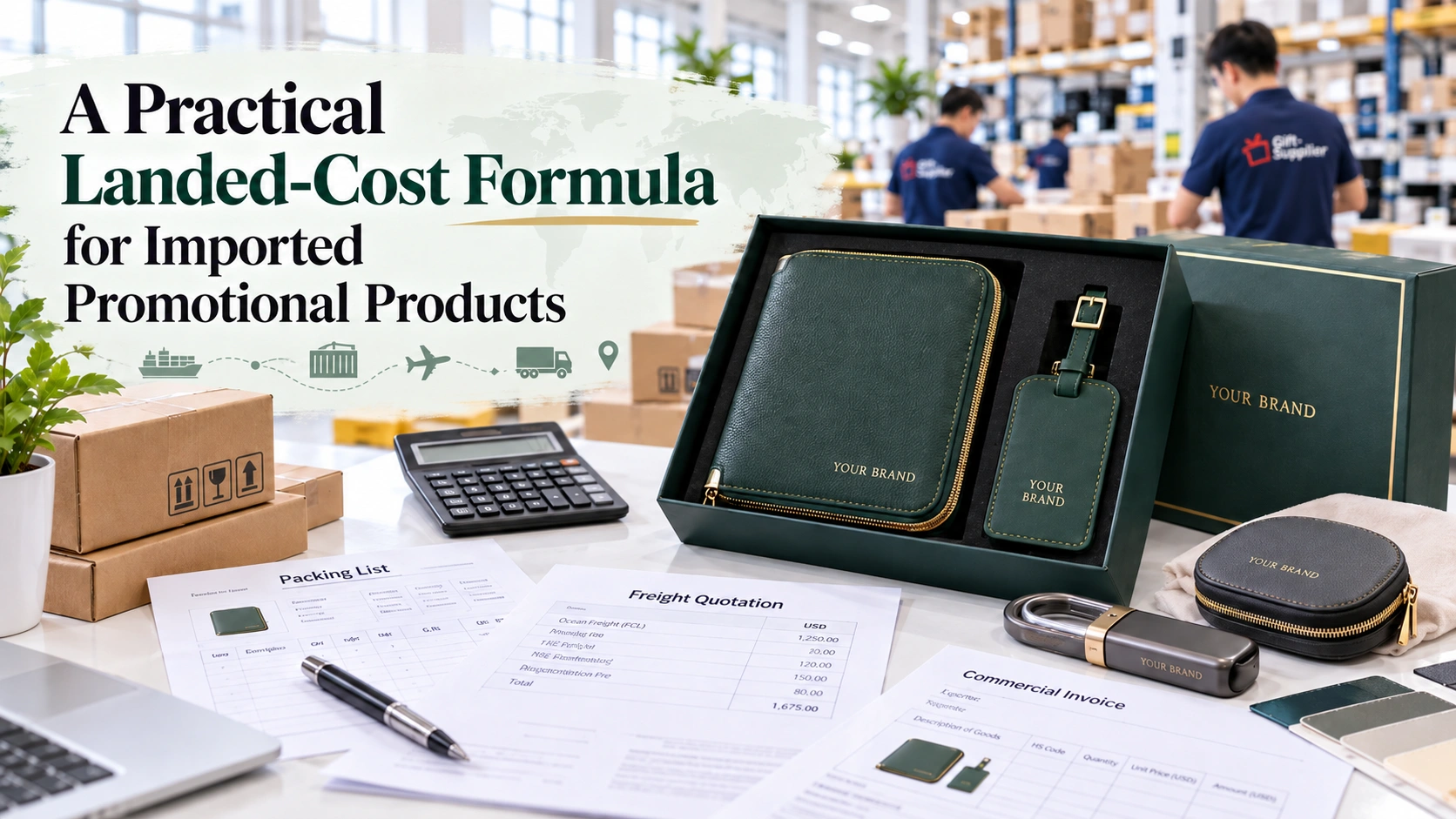
To estimate what imported promotional products really cost, add every charge between the factory gate and your receiving dock to the supplier’s unit price, then add a contingency line before comparing quotes. A promotional product landed cost calculator does exactly this: unit price, decoration, packaging, origin charges, freight, insurance, duties and taxes, destination handling and contingency, all expressed per unit. This guide gives a seven-line formula, the documents a supplier needs to quote accurately, and a worked example. It assumes a business buyer importing 1,000 to 10,000 branded units by sea on a FOB basis, with figures dated October 13, 2026.
Marketing procurement leads rarely lose money on the headline price. They lose it on lines that were never in the quote: a pallet fee, a customs entry, a re-pack after a carton failed. This article is written for the person who owns the procurement budget and has to defend a landed cost number to finance. It comes from the quoting side of the desk, because gift-supplier.com prepares scoped quotes for B2B buyers of promotional gifts, and the questions below are the ones that most often decide whether an estimate holds. If you are still choosing a product tier, start with our promotional gifts by budget page and come back here to pressure-test the numbers.
Why a Promotional Product Landed Cost Calculator Beats a Price Comparison
Two quotes can look 40 cents apart and still be identical once freight, duty and handling are counted. The reverse also happens: the cheaper factory price can become the more expensive order. A promotional product landed cost calculator forces each supplier onto the same footing, so the comparison is about total landed cost per unit rather than whichever lines each quote chose to show.
This matters most for promotional items because the order mixes several cost types. Decoration setup is fixed, product cost scales with quantity, freight depends on carton volume and weight, and duty depends on how the item is classified. Treating them as a single “unit price” hides the price trade-offs a buyer actually needs to see, such as paying more per unit for a higher quantity that dilutes setup, or accepting a delivered quote that shifts customs risk to the supplier.
Scope, Market and Dated Assumptions
Every promotional product landed cost calculator is only as reliable as its assumptions, so we state ours up front. Change any row below and the result changes with it.
| Assumption | Value used in this guide | Why it matters |
| Buyer type | Business importer ordering branded promotional gifts | Consumer-style duty and tax relief rules do not apply |
| Order size | 1,000 to 10,000 units; worked example uses 5,000 | Quantity drives setup dilution, carton count and MOQ |
| Shipping mode | Sea freight, full or partial container | Air freight changes the freight line substantially |
| Quote basis | FOB (Incoterms 2020) unless stated | Defines who pays for which leg of the journey |
| Duty and tax | Illustrative 5% duty on customs value; destination tax handled separately | Rates depend on classification, origin and destination, and change |
| Currency and date | USD, figures dated October 13, 2026 | Freight and tariff conditions are volatile; re-check before ordering |
The Landed Cost Formula: Components of a Promotional Product Landed Cost Calculator
The formula below has nine lines. Landed cost per unit equals the sum of:
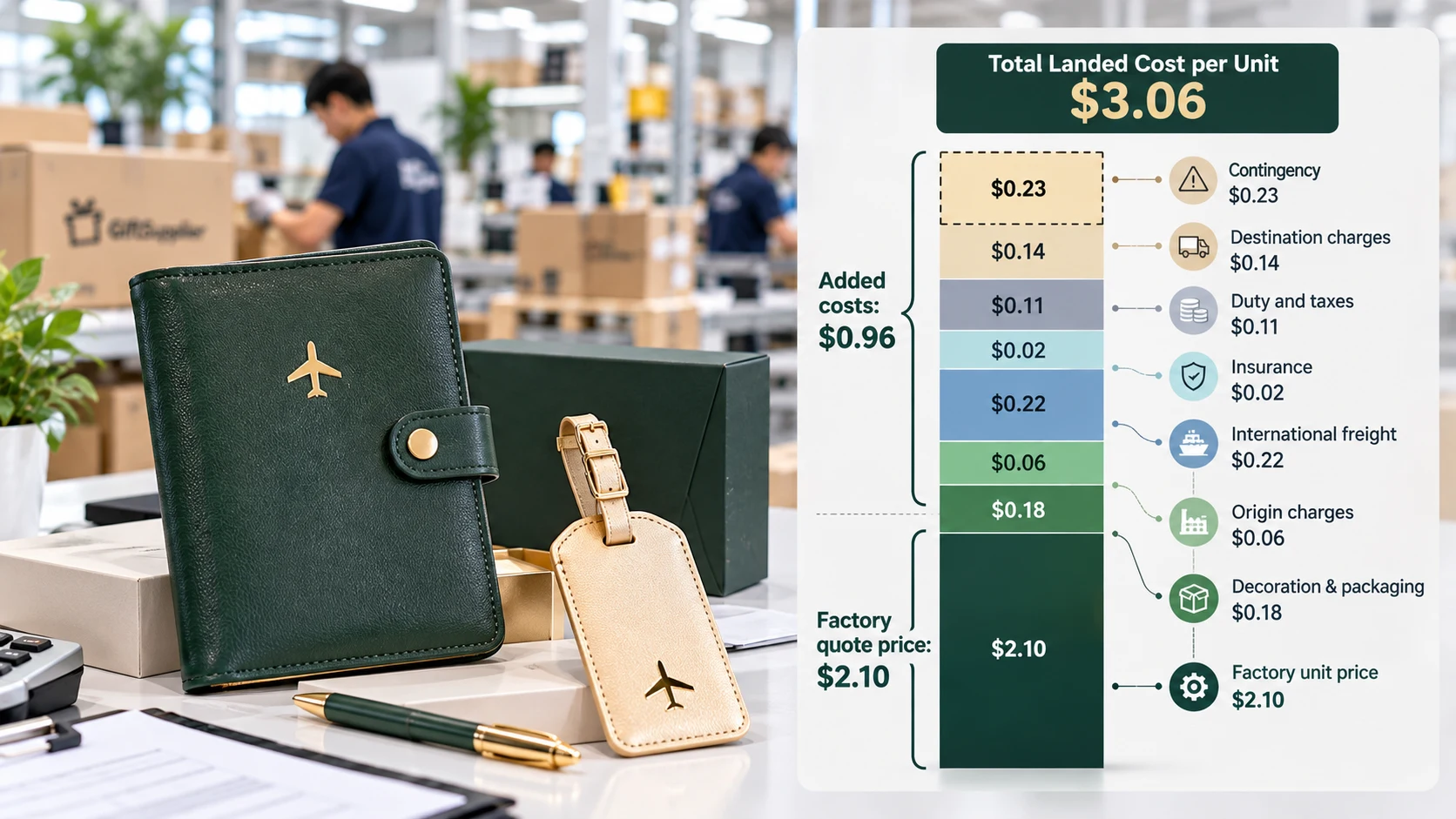
Landed cost per unit = Unit price + Decoration and packaging + Origin charges + International freight + Insurance + Duty and taxes + Destination charges + Contingency
Divide any total charge by the number of finished units to get its per-unit share. Fixed charges such as a mould, screen or digital proof are divided across the full order, which is why they shrink as quantity grows.
| Cost line | What it covers | Where the number comes from |
| Unit price | Product cost at the quoted basis (e.g. FOB) | Supplier quote; confirm the MOQ tier |
| Decoration and packaging | Logo setup, imprint method, individual and carton packaging | Supplier quote and approved artwork |
| Origin charges | Export clearance, inland haulage, port handling at origin | Supplier or forwarder quote |
| International freight | Ocean or air charge, allocated by carton volume or weight | Forwarder quote using the packing list |
| Insurance | Cargo cover for the declared value | Forwarder or insurer |
| Duty and taxes | Customs duty and import tax on declared value | Customs authority tariff and your broker |
| Destination charges | Port fees, customs entry, broker fee, delivery to your site | Broker or forwarder quote |
| Contingency | Reserve for rework, delays and rate movement | Your own policy, set by risk level |
Decision Table: Which Quote Basis Makes a Promotional Product Landed Cost Calculator Most Reliable?
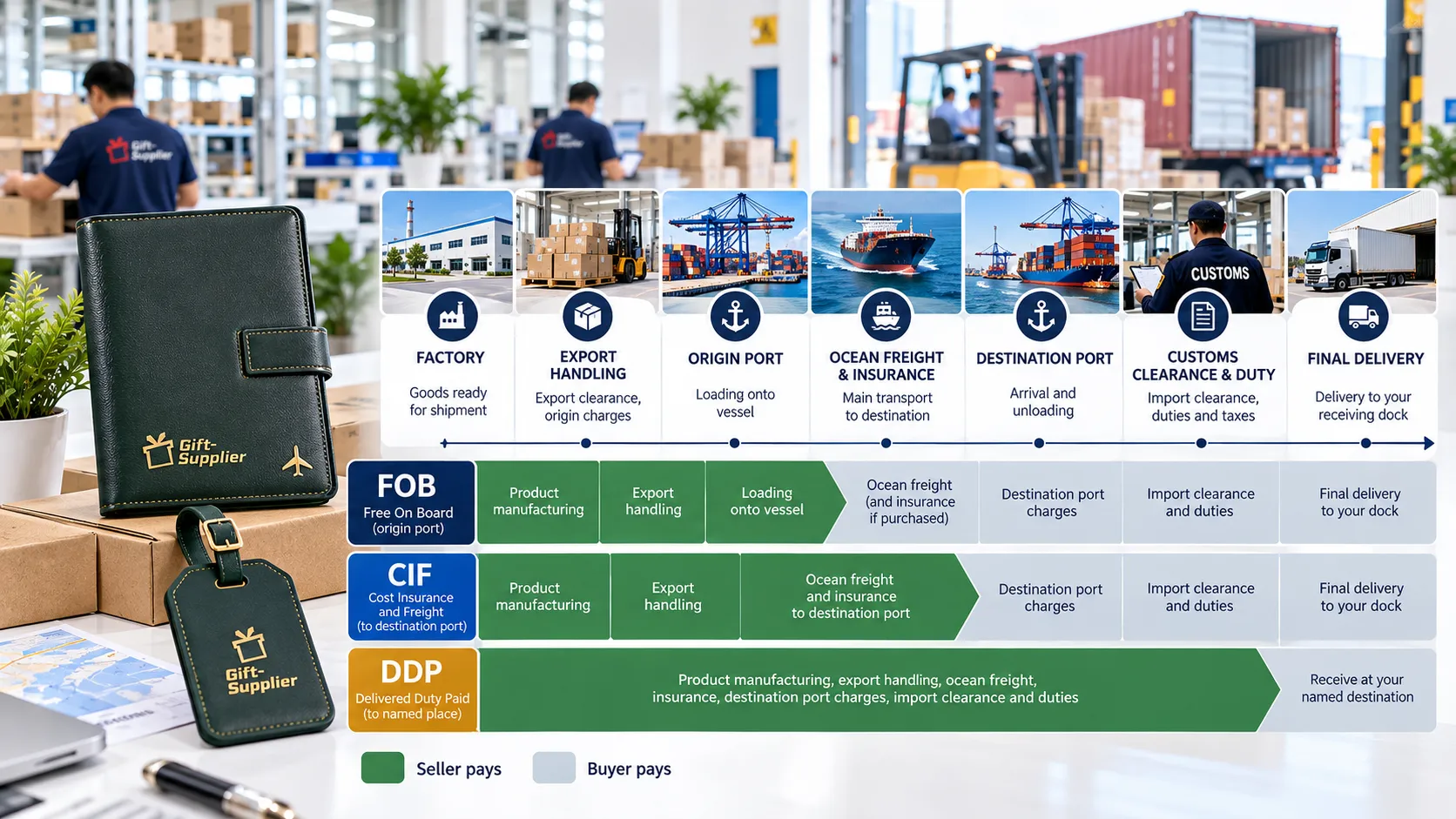
The quote basis decides how much of the landed cost you must estimate yourself. The table compares the three bases buyers meet most often, using criteria you can verify in the quote itself. No price or lead time is implied; those come from the supplier’s scoped quote.
| Criterion | FOB | CIF | DDP |
| Who pays main freight | Buyer | Seller (to destination port) | Seller (to named place) |
| Who clears import | Buyer or buyer’s broker | Buyer or buyer’s broker | Seller arranges, buyer should verify |
| Cost visibility | High; each line is separate | Medium; freight is bundled | Low; one all-in price |
| Budget risk for buyer | Freight and duty fluctuation | Duty and destination charges | Seller may add margin or exclusions |
| Document burden | Highest for buyer | Medium | Lowest for buyer |
| Best fit | Buyers with a trusted forwarder | Buyers wanting freight fixed | Buyers prioritising a simple budget line |
A delivered quote is not automatically cheaper or safer. Ask what a DDP price excludes (pallet fees, delivery appointments, inspection holds) and who carries the loss if the shipment is delayed. Your procurement budget is only protected if exclusions are written down.
Documents Required for an Accurate Landed Cost Estimate
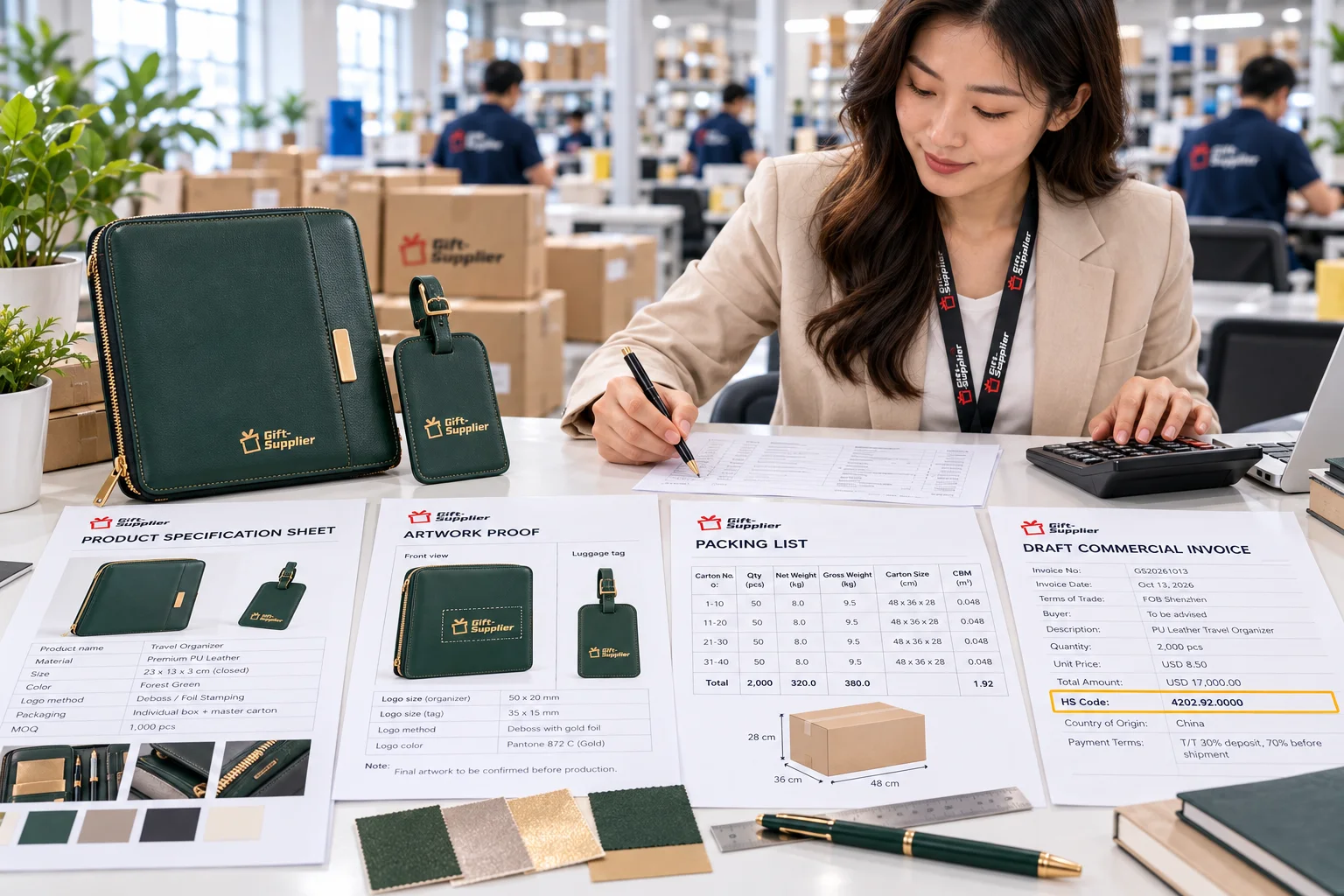
Most estimate errors come from missing information, not bad arithmetic. Give the supplier and forwarder the items below before asking for a final number, and the estimate from your promotional product landed cost calculator will survive contact with the invoice.
| Document or input | What it fixes in the estimate | Who provides it | Needed by |
| Product specification and material | Duty classification, safety testing, packaging size | Buyer and supplier | Before quote |
| Approved artwork and imprint method | Decoration setup and per-unit imprint cost | Buyer | Before quote |
| Quantity and MOQ tiers | Unit price break and setup dilution | Supplier | Before quote |
| Pre-production sample or mockup | Confirms quality, weight and carton size | Supplier | Before order |
| Packing list (cartons, weights, CBM) | Freight allocation and destination handling | Supplier | Before booking |
| Commercial invoice and HS code | Customs value and duty rate | Supplier, checked by broker | Before shipping |
| Production lead time and ship date | Delay exposure and event-date risk | Supplier | Before order |
| Delivery address and receiving rules | Last-mile cost and appointment fees | Buyer | Before booking |
The HS code deserves special attention. It is the single input that most changes the duty line, and it is the supplier’s proposal until your broker or customs authority confirms it. Treat an unconfirmed code as a reason to widen contingency, not as a fact.
A Seven-Step Buyer Framework for Your Promotional Product Landed Cost Calculator
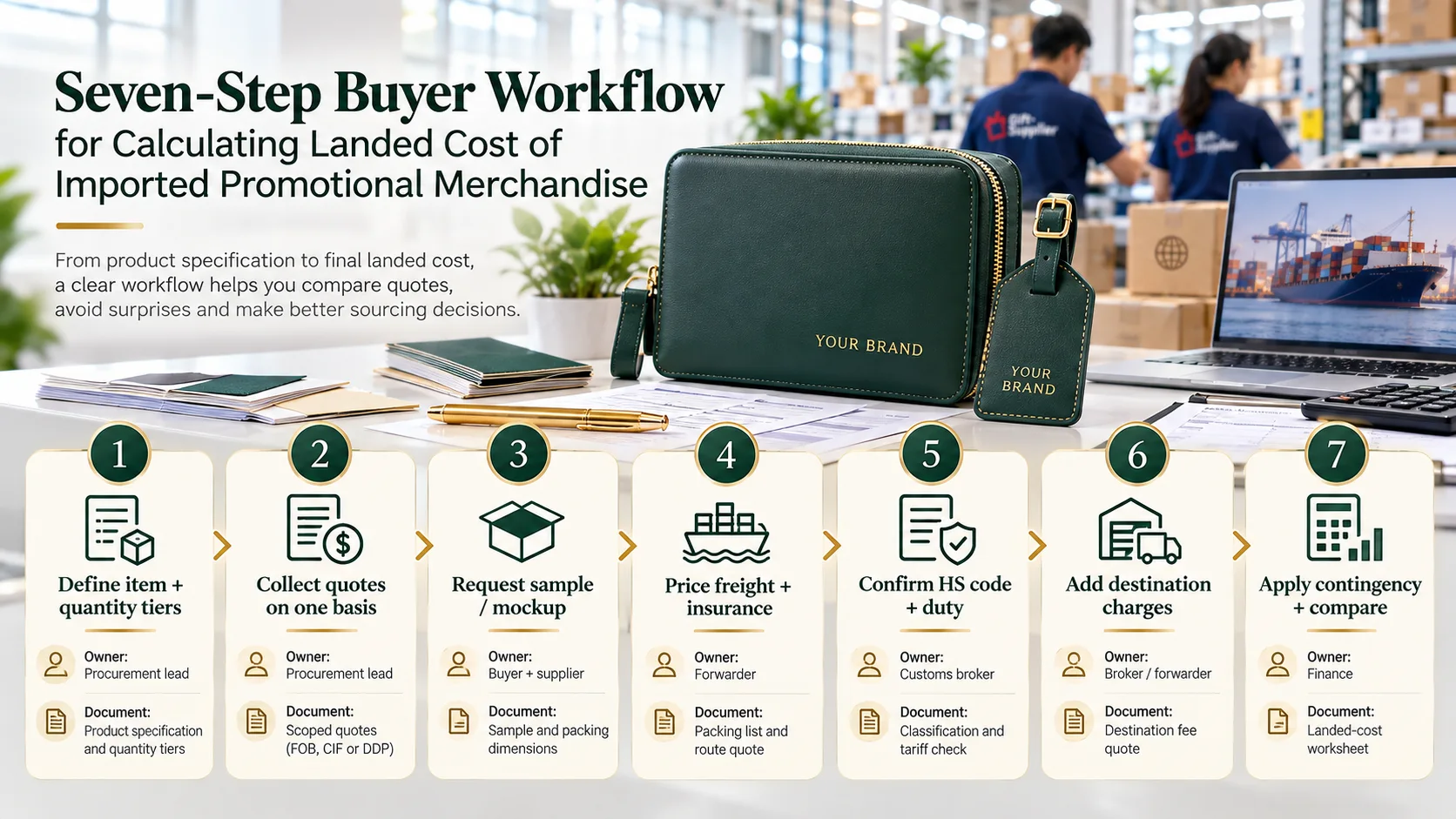
The steps below turn the formula into a workflow. The decision owner is the marketing procurement lead, with the forwarder or customs broker as reviewer on steps 4 to 6 and finance approving the final procurement budget in step 7.
- Define the item and the quantity tiers. Fix the specification, imprint method and two or three quantity breaks so every supplier quotes the same thing.
- Collect scoped quotes on one basis. Ask for FOB prices even if you expect to buy delivered, so you can see the components. Record MOQ, lead time and material for each.
- Request a sample or mockup. Weigh and measure the carton, because freight is calculated from it.
- Price freight and insurance. Send the packing list to a forwarder and get a written quote for your route.
- Confirm classification and duty. Have a broker verify the HS code and expected duty on the customs value.
- Add destination charges. Include port fees, entry, broker fee and delivery to the actual receiving address.
- Apply contingency and compare. Enter a contingency percentage that matches your risk into the promotional product landed cost calculator, then compare landed cost per unit and per order.
Worked Example: Running the Promotional Product Landed Cost Calculator on Two Quotes
| Cost line (USD per unit) | Supplier A (FOB) | Supplier B (DDP) | Note |
| Unit price including 1-colour logo | 2.10 | 2.95 | B is delivered |
| Custom packaging | 0.18 | Included | |
| Origin charges | 0.06 | Included | |
| Sea freight allocation | 0.22 | Included | |
| Insurance | 0.02 | Included | |
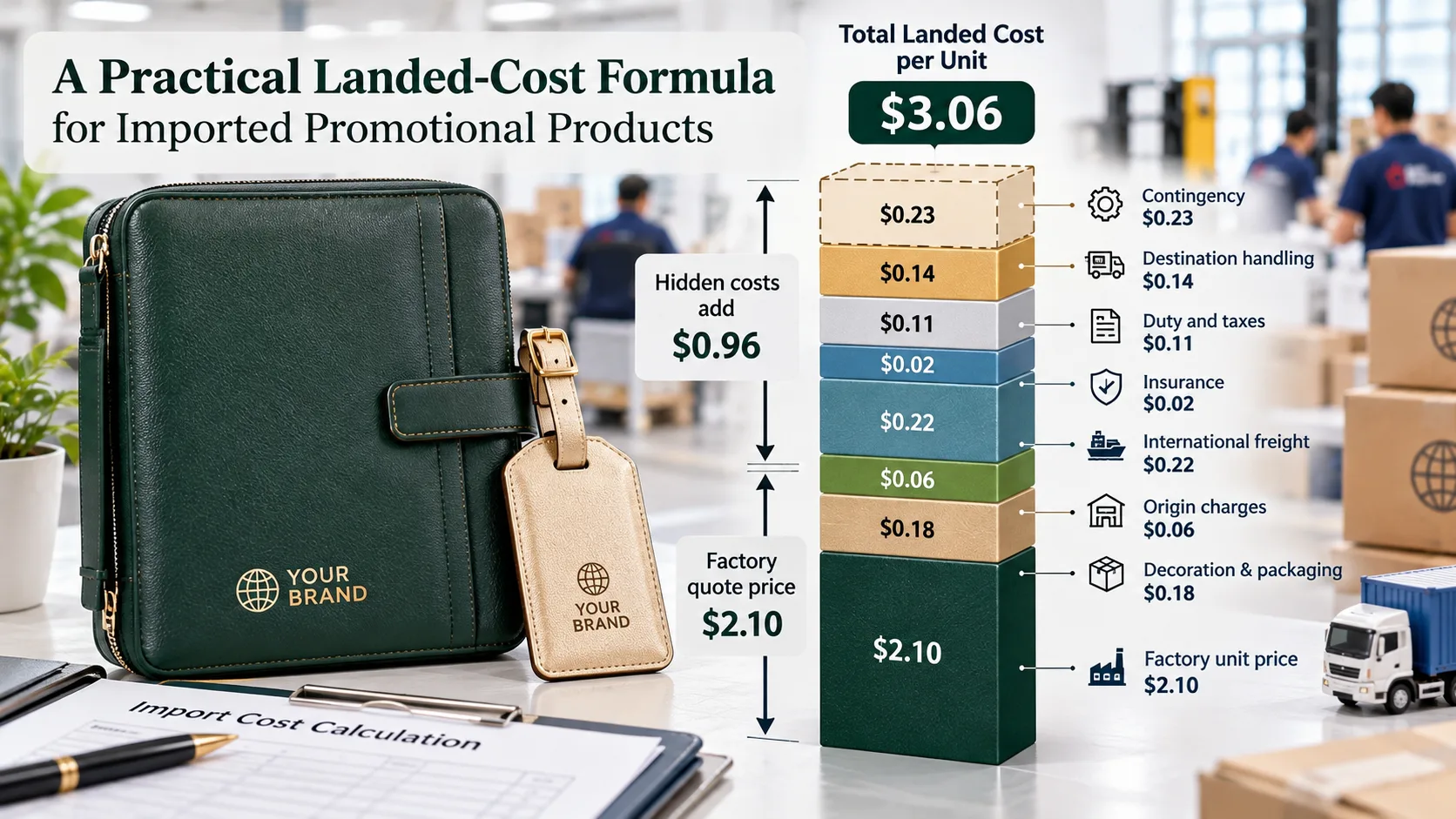
| Duty (5% of 2.28 customs value) | 0.11 | Included | Illustrative rate |
| Destination charges and delivery | 0.14 | Included | |
| Subtotal | 2.83 | 2.95 | |
| Contingency (A: 8%, B: 3%) | 0.23 | 0.09 | Risk differs |
| Landed cost per unit | 3.06 | 3.04 | |
| Order total (5,000 units) | 15,300 | 15,200 |
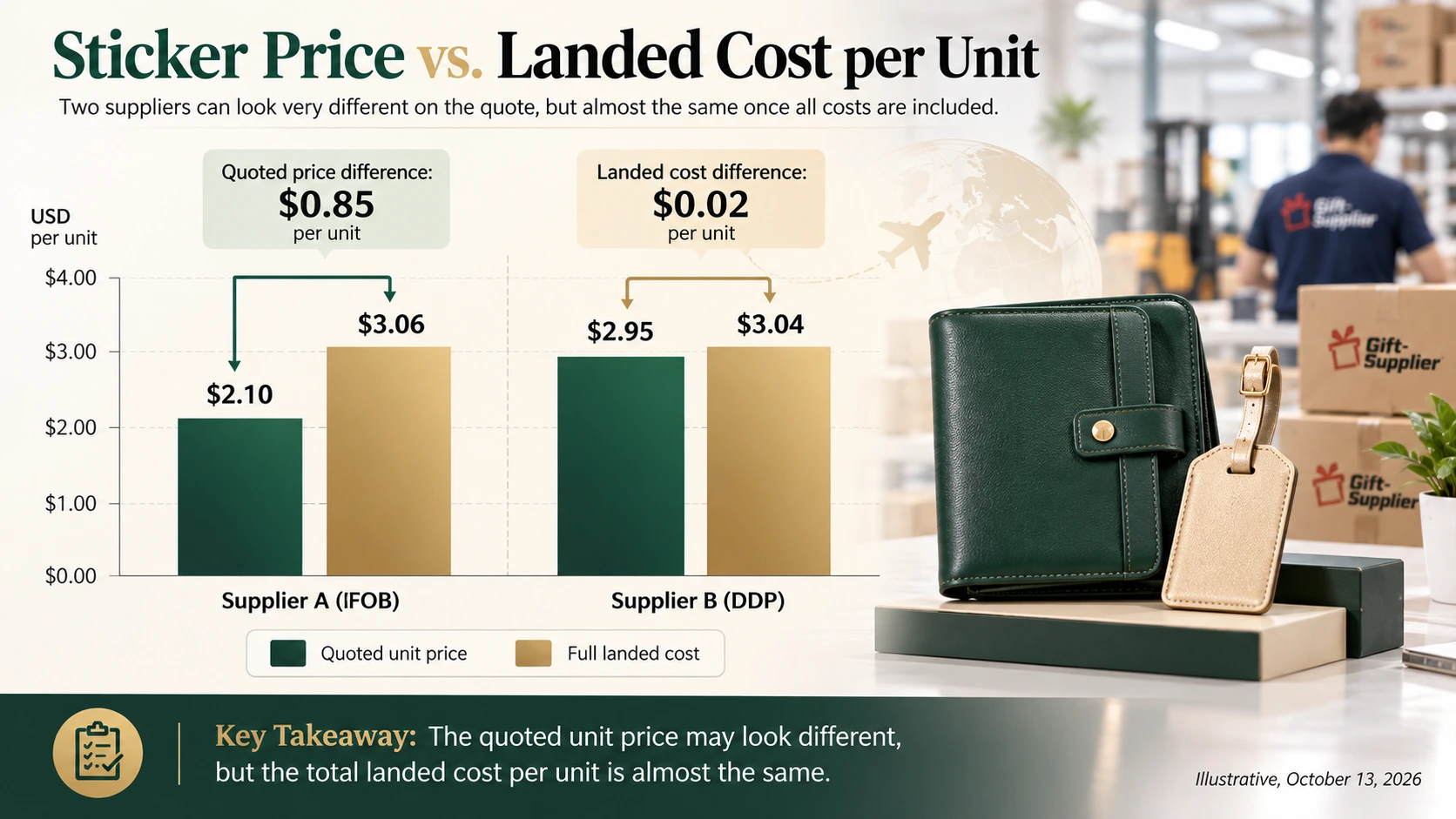
On sticker price Supplier B looks 85 cents per unit more expensive (2.95 against 2.10). After the landed cost lines and contingency are added, the gap shrinks to 2 cents per unit, or about 100 dollars across 5,000 units. At that point the decision should rest on the factors that the price does not capture: sample quality, lead time, the supplier’s stated exclusions and who bears customs risk.
Price Trade-Offs and Procurement Budget: Setting the Contingency Line
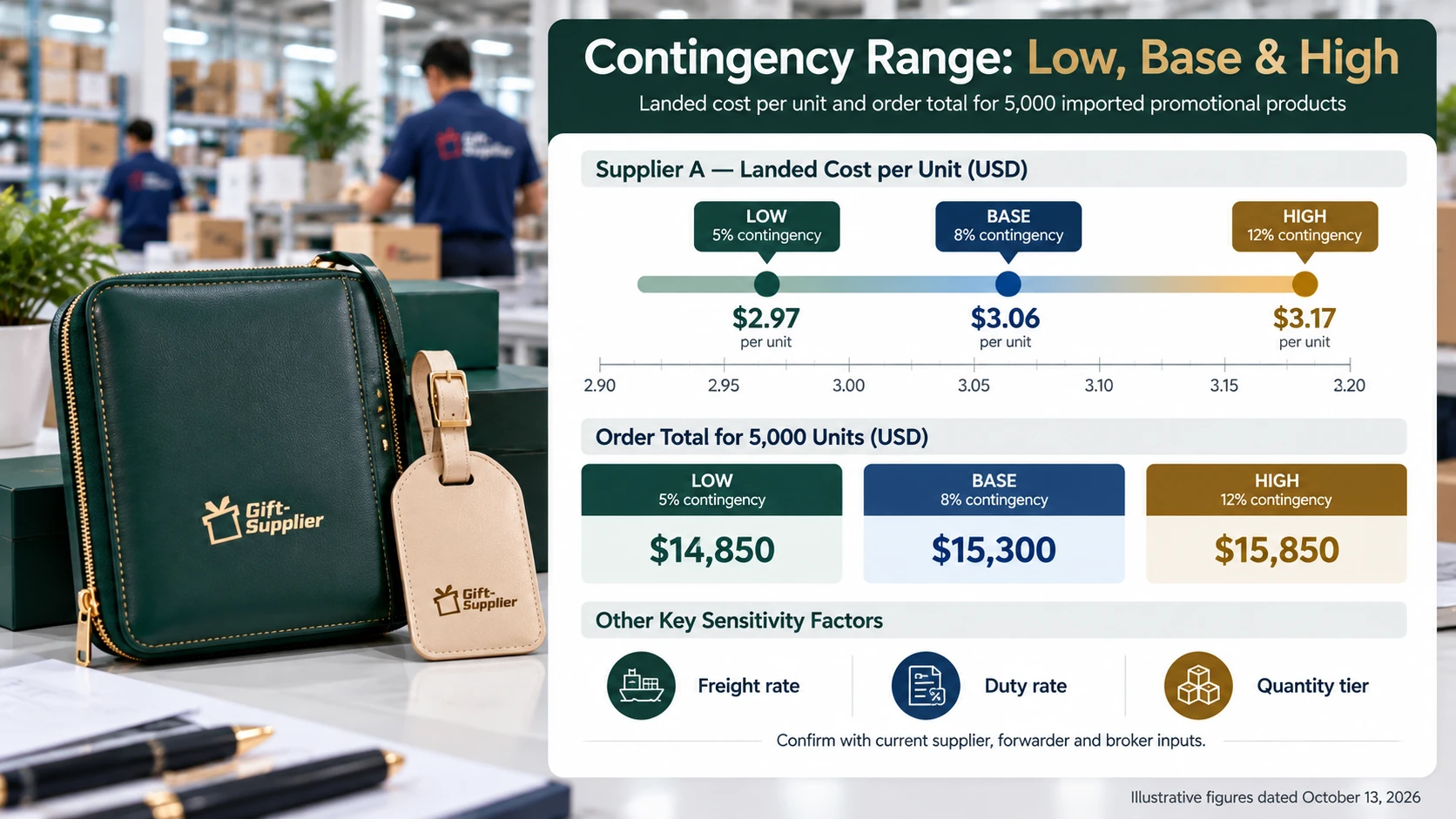
Contingency in a promotional product landed cost calculator is a procurement budget decision, not a guess. A repeat order with a known supplier and a confirmed HS code can carry a small reserve. A first order, a new material or a tight event deadline justifies more. The table shows how the reserve moves Supplier A’s total.
| Contingency level | Per unit (USD) | Landed cost per unit | Order total, 5,000 units |
| Low (5%) | 0.14 | 2.97 | 14,850 |
| Base (8%) | 0.23 | 3.06 | 15,300 |
| High (12%) | 0.34 | 3.17 | 15,850 |
Pick the level before quotes arrive, so the number is not tuned to make a favourite supplier win. If the high-contingency total breaks your approved procurement budget, the next lever is the product tier, not the contingency. Browse comparable options on the promotional gifts by budget page, and review related guidance such as [related resource: promotional gift budget contingency guide], [related resource: sampling and mockup approvals] and [related resource: compliance and product safety page; confirm URLs before publishing].
Risks and Limits of Any Promotional Product Landed Cost Calculator
- Duty and tariff rates change. The 5% duty used here is illustrative. Check the current rate for your destination and classification with a customs broker or the official tariff schedule before committing.
- Freight is volatile. Ocean rates and surcharges move with season and route. A freight quote has an expiry date; use only a current one.
- Classification can be disputed. If customs treats an item differently from the supplier’s HS code, duty and clearance time can change.
- Delivered quotes carry exclusions. DDP does not mean every cost is covered. Read what is excluded and who handles delays.
- Product rules vary by market. Materials, labelling and testing requirements differ by destination and product type, and may add cost this model does not include.
- The example is not a quote. Figures are illustrative and dated October 13, 2026. Only a scoped quote reflects your product, quantity and route.
Frequently Asked Questions
What is included in the landed cost of promotional products?
Landed cost includes the unit price, decoration, packaging, origin charges, freight, insurance, duty and taxes, destination charges and a contingency reserve, all divided by the finished units received.
How accurate is a promotional product landed cost calculator?
It is as accurate as its inputs. With a confirmed HS code, a forwarder quote and a packing list from a pre-production sample, the estimate tends to hold. With assumed freight and duty, treat it as a range.
Should I compare quotes on FOB or delivered prices?
Ask every supplier for FOB so you can see the components, then add delivered quotes as a second option. Compare all of them on landed cost per unit and per order.
How much contingency should be added to the procurement budget?
There is no universal figure. Set a lower reserve for repeat orders with confirmed documents and a higher one for first orders or tight deadlines, then decide before quotes arrive.
What do I need to send a supplier to get a firm estimate?
Specification, approved artwork, quantity tiers, delivery address and a deadline. Table 4 lists the full set. Our team can review the pack with you through a scoped quote request.
Turn the Formula into a Scoped Quote
Send your product, quantity and delivery location, and we will return line-by-line pricing you can drop straight into your promotional product landed cost calculator.
Sources and Further Guidance
UK Government — Bribery Act 2010 guidance
US Department of Justice — FCPA Resource Guide
International Chamber of Commerce — Incoterms® Rules
US International Trade Commission — Harmonized Tariff Schedule (HTS) search
UK Government — Trade Tariff: look up commodity codes, duty and VAT rates
Author & Reviewer
Written by Claire Morgan, Senior Content Writer, with professional experience comparing supplier quotes and pricing in downstream risk for branded merchandise programs.
Freshness & Update Log
- Published: October 13, 2026
- Last Reviewed: October 13, 2026
- Next scheduled review: within 12 months, or sooner if referenced anti-bribery, duty, or freight guidance changes materially.
Related Resources
- /promotional-products-budget-allocation/ — how to decide which portfolio tier a price-break decision should apply to.
- /questions-to-ask-a-promotional-product-supplier/ — 18 evidence-based questions to ask once quotes are in hand.
- /promotional-product-supplier-audit-checklist/ — the 25-point checklist for auditing a supplier before you award the order.
- /promotional-merchandise-vendor-consolidation/ — how vendor consolidation interacts with ongoing performance scoring.