
Reduce promotional product costs without lowering quality by changing specification, packaging, and production choices in a deliberate order, rather than cutting quantity or material indiscriminately. Packaging and production changes, such as a more efficient structural format or order consolidation, often reduce cost with little perceived-quality risk. Specification changes, such as a simpler decoration method or a verified mid-weight material, preserve perceived quality only when checked against a physical sample first. This guide is written for marketing procurement leads managing branded merchandise budgets for US and UK programs, revising an existing specification and quote rather than starting from a blank brief.
Budget pressure makes this a current priority, and the fastest instinct — ordering fewer units or picking a visibly cheaper item — is usually the one most likely to make the gift feel cheap. The sections below provide a decision table ranking cost levers by perceived-quality risk, all nine ways grouped into specification, packaging, and production choices, a framework for applying them in order, and an illustrative example of stacking several levers together.
Figures, savings estimates, and the worked example in this article are illustrative only. Confirm actual cost impact against your own itemized quotes before changing a specification.

Why Cutting Quantity or Material First Backfires
When a budget needs to shrink, the fastest moves are usually the most visible ones: order fewer units, or swap in a cheaper item altogether. Both change what the recipient actually experiences, which is the opposite of what most promotional merchandise programs are trying to protect.
Reducing promotional product costs without lowering quality starts from a different question: which parts of the current specification, packaging, and production plan are adding cost without adding anything the recipient would notice? Answered in the right order, several smaller changes can add up to real savings while the gift itself still looks and feels the same.
Decision Table: Cost Levers Ranked by Perceived-Quality Risk
Use the table below to compare cost levers by how much they typically affect what the recipient actually notices, and what evidence to request before changing each one.
| Cost lever | What it changes | Savings potential | Perceived-quality risk | Evidence to request |
| Order consolidation | Combines multiple small orders into fewer, larger ones | Can unlock a better pricing tier | Very low — same product, different order structure | Tiered pricing from the supplier at the consolidated volume |
| Production timeline | Places the order further ahead of the need date | Avoids rush production fees | Very low — same product, different timing | A standard-versus-rush quote comparison |
| Freight mode | Shifts from air freight to sea freight where timeline allows | Can meaningfully reduce freight on larger, non-urgent orders | Very low — same product, longer transit time | A freight quote comparing air and sea for the same order |
| Packaging format | Moves from a rigid box to a lighter structural format | Can reduce both material and freight cost | Low for broad tiers; higher for hero-tier gifting | A packaging sample and a dimensional-weight freight comparison |
| SKU variant count | Reduces the number of colors or sizes offered | Reduces setup and inventory cost as variants drop | Low, if the dropped variants weren’t actually needed | A tally of actual variant usage from a prior program |
| Decoration method | Changes how branding is applied to the item | Varies by method and order quantity | Low, if placement and contrast are verified on a sample | A physical pre-production sample comparing methods |
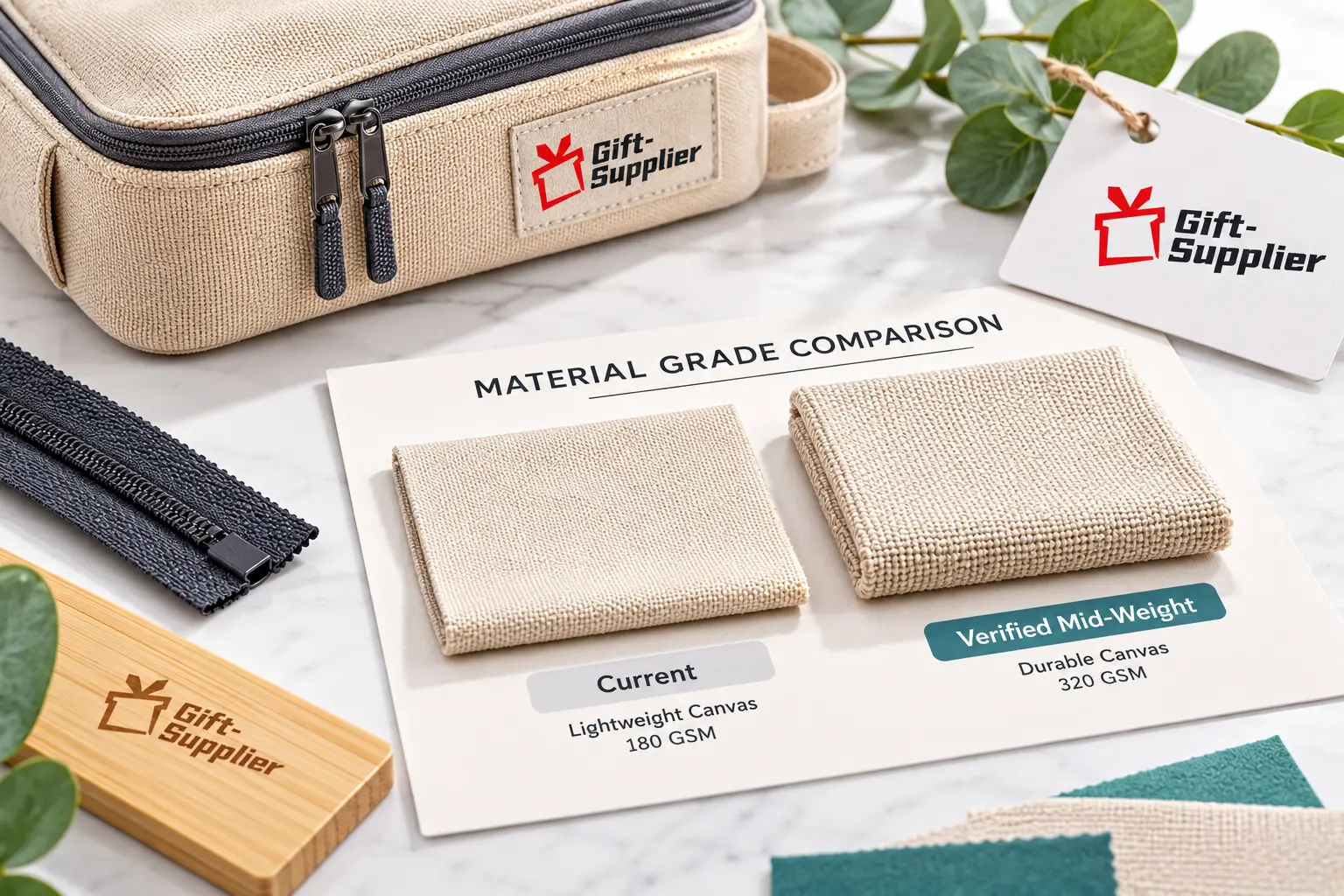
| Material grade | Changes the weight or grade of the base material | Varies by grade differential | Low to moderate — verify durability at the lighter grade | A side-by-side material sample at each grade |
Nine Ways to Reduce Promotional Product Costs Without Lowering Quality
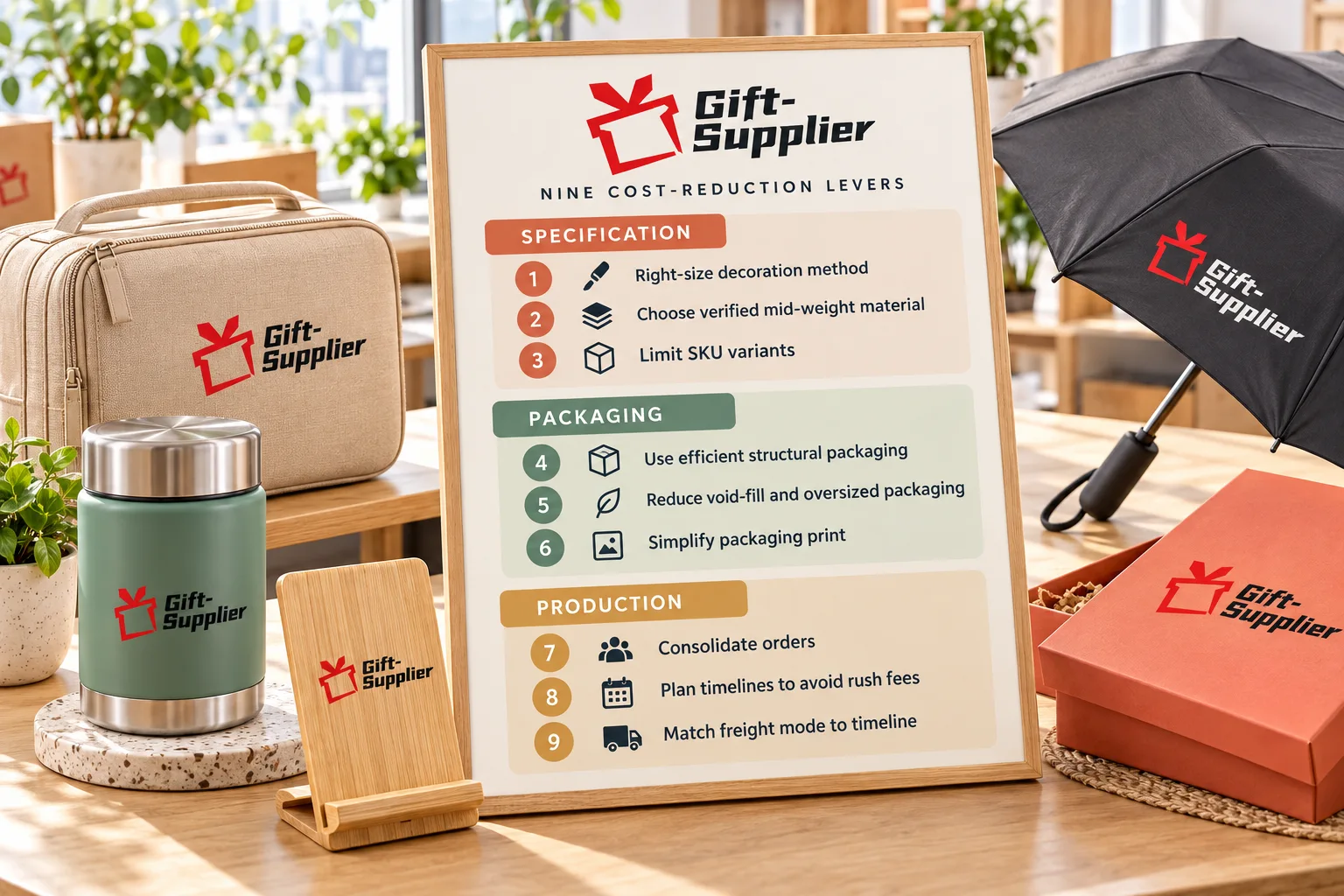
The nine levers below are grouped into the three areas named in this guide’s angle: specification, packaging, and production choices.
Specification Choices
- Right-size the decoration method to the design, rather than defaulting to the most expensive technique available. A single-color imprint with strong placement and contrast can read as premium as a multi-color print.
- Choose a verified mid-weight material grade that meets the item’s durability needs, instead of the heaviest grade by default. Confirm against a physical sample, not a spec sheet alone.
- Limit SKU variants — colors or sizes — to what recipients actually need. Each additional variant adds setup cost that gets spread across a smaller run.
Packaging Choices
- Use a structurally efficient packaging format, such as a well-designed sleeve or fold box, instead of a rigid gift box by default. Reserve rigid boxes for the hero tier.
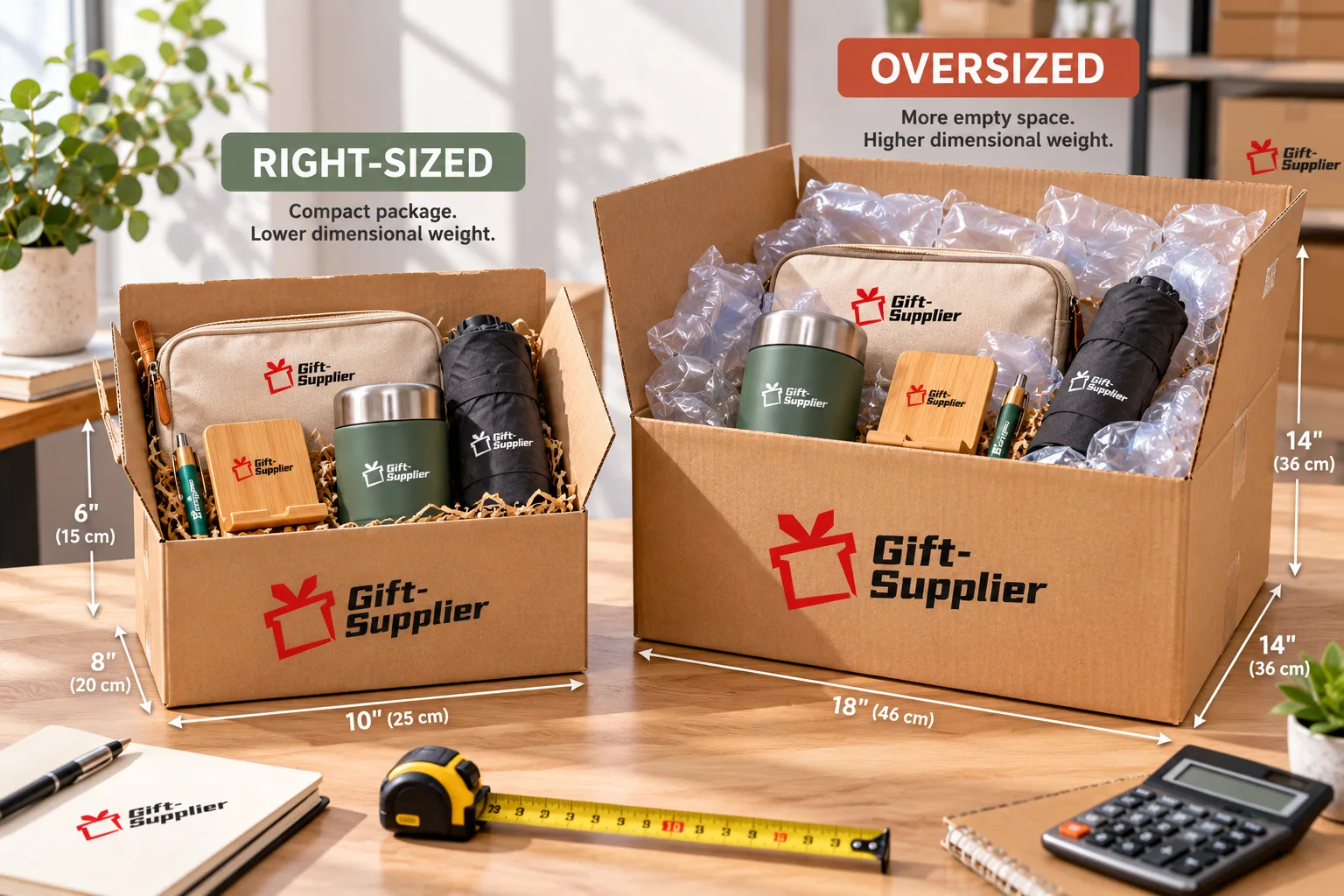
- Reduce void-fill and oversized packaging, which adds both material cost and freight cost through dimensional weight.
- Simplify packaging print — fewer ink colors or a simpler finish — while keeping the unboxing moment intentional, rather than cutting packaging altogether.
Production Choices
- Consolidate orders across departments or programs to reach a better pricing tier, rather than each team ordering small batches separately.
- Plan proofing and timelines to avoid rush production fees, one of the largest avoidable cost additions on a promotional order.
- Match freight mode to timeline — sea freight for larger, non-urgent orders instead of air freight by default, where the schedule allows it.
The Nine Levers at a Glance
| Category | Lever | One-line benefit |
| Specification | Right-size the decoration method | Keeps visual impact while reducing the most expensive technique |
| Specification | Choose a verified mid-weight material | Meets durability needs without paying for unused heft |
| Specification | Limit SKU variants to what’s needed | Cuts setup cost spread across unnecessary options |
| Packaging | Use an efficient structural format | Reduces both material and freight cost |
| Packaging | Reduce void-fill and oversized packaging | Lowers dimensional-weight freight charges |
| Packaging | Simplify packaging print, keep intent | Preserves the unboxing moment at lower cost |
| Production | Consolidate orders across teams | Unlocks better pricing tiers |
| Production | Plan timelines to avoid rush fees | Removes one of the largest avoidable cost additions |
| Production | Match freight mode to timeline | Cuts freight cost on non-urgent orders |
Buyer Framework: How to Apply These Levers in Order
The steps below apply the levers in an order that protects perceived quality first. The decision owner is typically the marketing procurement lead, with brand or design input on anything touching specification or packaging.
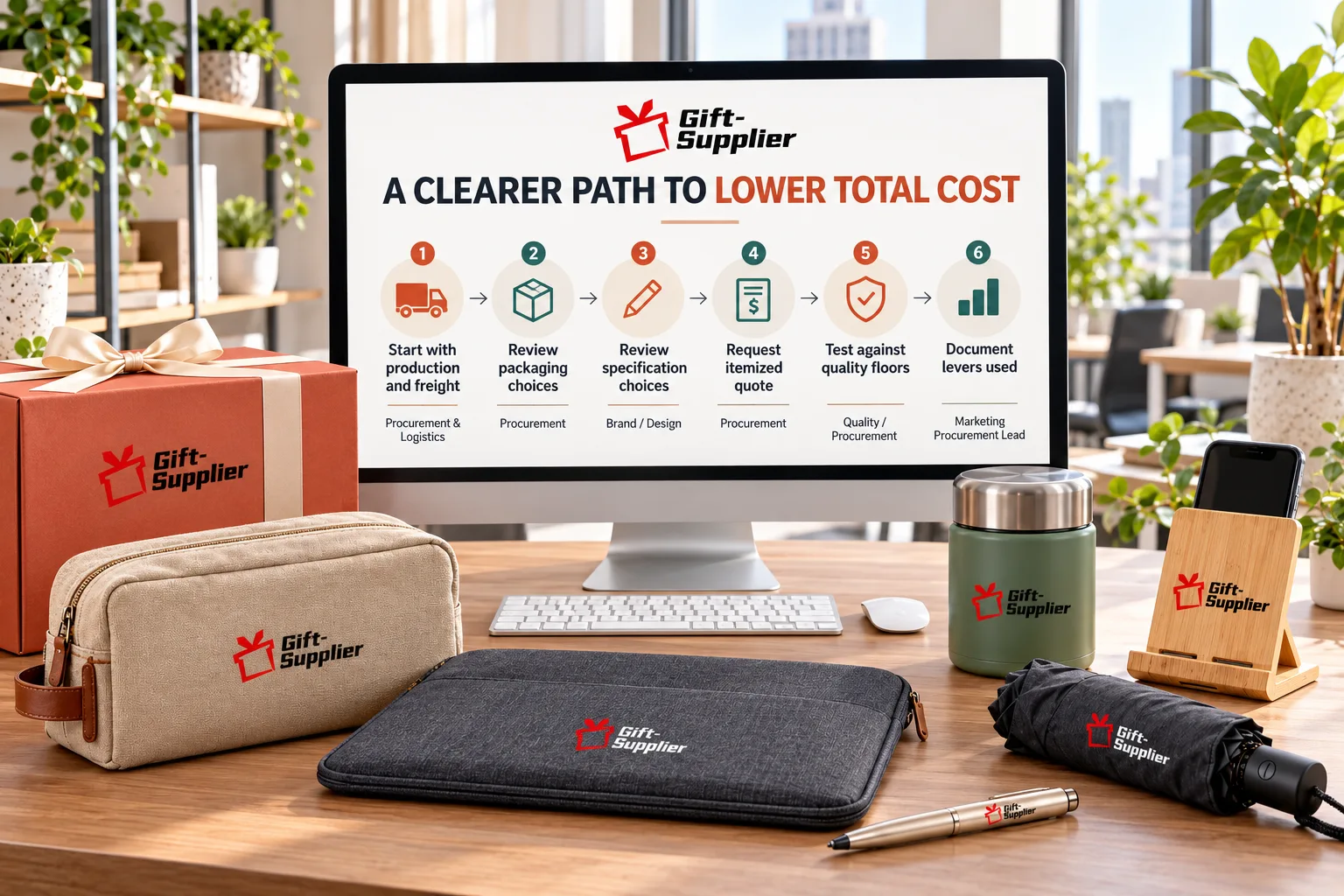
- Start with production and freight choices — consolidation, timeline, and freight mode — since the product itself doesn’t change.
- Review packaging choices next, reserving premium packaging for the hero tier and applying efficient packaging to the scalable tier.
- Only then review specification choices — decoration method, material grade, and variant count — verifying each change against a physical sample before committing.
- Request an itemized quote showing the cost impact of each individual change, not one bundled new price, so you can see which lever actually moved the number.
- Test the revised specification against the quality floors below before finalizing, so a change that crosses a floor gets flagged before production, not after delivery.
- Document which levers were used and the date, so the reasoning is available if the program is revisited next cycle.
Evidence From the Field: Illustrative Cost Stacking
A marketing procurement lead starts from a $8.50 unit price for a branded item and applies four levers in order, requesting a revised itemized quote after each change.
| Step | Lever applied | Running unit price (illustrative) |
| Starting specification | None — baseline quote | $8.50 |
| Step 1 | Orders consolidated across two departments | $8.10 |
| Step 2 | Packaging changed from rigid box to structural fold box | $7.40 |
| Step 3 | Decoration method simplified to a single-color imprint | $6.80 |
| Step 4 | Material grade adjusted to a verified mid-weight option | $6.20 |
In this illustrative example, the unit price dropped from $8.50 to $6.20, a reduction of $2.30 per unit, or roughly 27%. At 1,000 units, that is approximately $2,300 in illustrative savings, reached through four separate, verifiable changes rather than one indiscriminate cut to quantity or material.
Where to Get the Evidence for Each Lever
Each lever needs its own type of supporting evidence before it is applied to a real order.
| Lever category | Evidence to request | Who to involve |
| Specification | A physical sample comparing the current and reduced specification | Brand or design, with procurement |
| Packaging | A packaging sample and a dimensional-weight freight comparison | Procurement, with logistics |
| Production & freight | A standard-versus-rush quote, and an air-versus-sea freight quote | Procurement, with logistics |
Where Not to Cut: Quality Floors to Protect
Some elements should stay fixed regardless of budget pressure, because the cost of crossing them is larger than the savings involved.
| Element | Quality floor | Why protect it |
| Material durability | Must meet the functional need for the item’s expected use | A gift that breaks quickly damages the relationship more than a modest cost increase would have |
| Decoration durability | Imprint must not crack, fade, or peel under normal use | A degraded imprint looks worse over time than a simpler imprint done well |
| Compliance documentation | Never reduced to cut cost | A compliance gap is a safety and legal risk, not a quality trade-off |
| Hero-tier packaging distinction | Should stay visually distinct from the scalable tier’s packaging | Blending hero and scalable presentation undermines the purpose of the hero tier |
Risks and Limitations of This Cost Reduction Framework
- Savings from any single lever vary by product, vendor, and volume; the figures in this guide are illustrative, not a guarantee.
- Reducing material grade or decoration complexity without a verified sample risks crossing a quality floor the budget won’t reveal until the product is in hand.
- Freight mode and timeline changes only produce savings if the program’s actual deadline allows the longer lead time; applied to a date-critical order, they create risk instead.
- Order consolidation requires coordination across departments or programs, which is an organizational change, not only a procurement one.
- Compliance documentation should never be treated as a cost lever; see our promotional product compliance guidance for what must stay unchanged regardless of budget pressure.
- The stacking example in this guide is illustrative; actual cost reductions depend on your own vendor, specification, and order structure.
Request a Scoped Quote
If you are revising a specification to manage cost, share your current quote, quantity, and target budget. Our team can help identify which levers apply to your specific product before you change anything.
Prefer a lighter first step? Send us your current itemized quote for a quick review of which levers could apply.
Frequently Asked Questions
Which of these levers should we try first
Start with production and freight choices — order consolidation, timeline planning, and freight mode — since they carry the lowest perceived-quality risk because the product itself doesn’t change. Move to packaging, then specification, only after those lower-risk options are exhausted.
Does a lighter material always mean lower quality
Not necessarily. A verified mid-weight material that still meets the item’s durability needs is a cost reduction, not a quality reduction. The risk is in skipping the verification step, not in choosing a lighter grade itself. This can help reduce promotional product costs without lowering quality.
How much can packaging changes actually save
It depends on the format change and the order’s freight profile, so there is no universal figure. A dimensional-weight freight comparison between the current and a more efficient packaging format, as shown in the evidence table above, gives a real answer for your specific order and helps assess the landed cost.
Is it ever worth paying for rush production
Sometimes, when a fixed event date genuinely requires it. The point of planning timelines around this lever is to make rush fees a deliberate choice for a real deadline, rather than a default cost incurred because proofing started later than it needed to. This is one of the key price trade-offs to consider when managing the procurement budget.
How does this relate to total cost of ownership
These levers reduce specific cost inputs; total cost of ownership is the full calculation that shows whether those reductions actually lower what you pay per usable unit. Reviewing the landed cost, price trade-offs, and procurement budget together helps determine whether the changes truly reduce promotional product costs without lowering quality.
Sources and Further Guidance
International Chamber of Commerce — Incoterms® Rules
US International Trade Commission — Harmonized Tariff Schedule (HTS) search
UK Government — Trade Tariff: look up commodity codes, duty and VAT rates
US Consumer Product Safety Commission — Children’s Product Certificate
Author & Reviewer
Written by Claire Morgan, Senior Content Writer, with professional experience revising promotional product specifications to manage cost without reducing perceived quality.
Freshness & Update Log
- Published: October 1, 2026
- Last Reviewed: October 1, 2026
- Next scheduled review: within 12 months, or sooner if referenced freight or duty guidance changes materially
Related Resources
- /questions-to-ask-a-promotional-product-supplier/ — 18 evidence-based questions to ask once quotes are in hand.
- /promotional-product-supplier-audit-checklist/ — the 25-point checklist for auditing a supplier before you award the order.
- /promotional-merchandise-vendor-consolidation/ — how vendor consolidation interacts with ongoing performance scoring.