
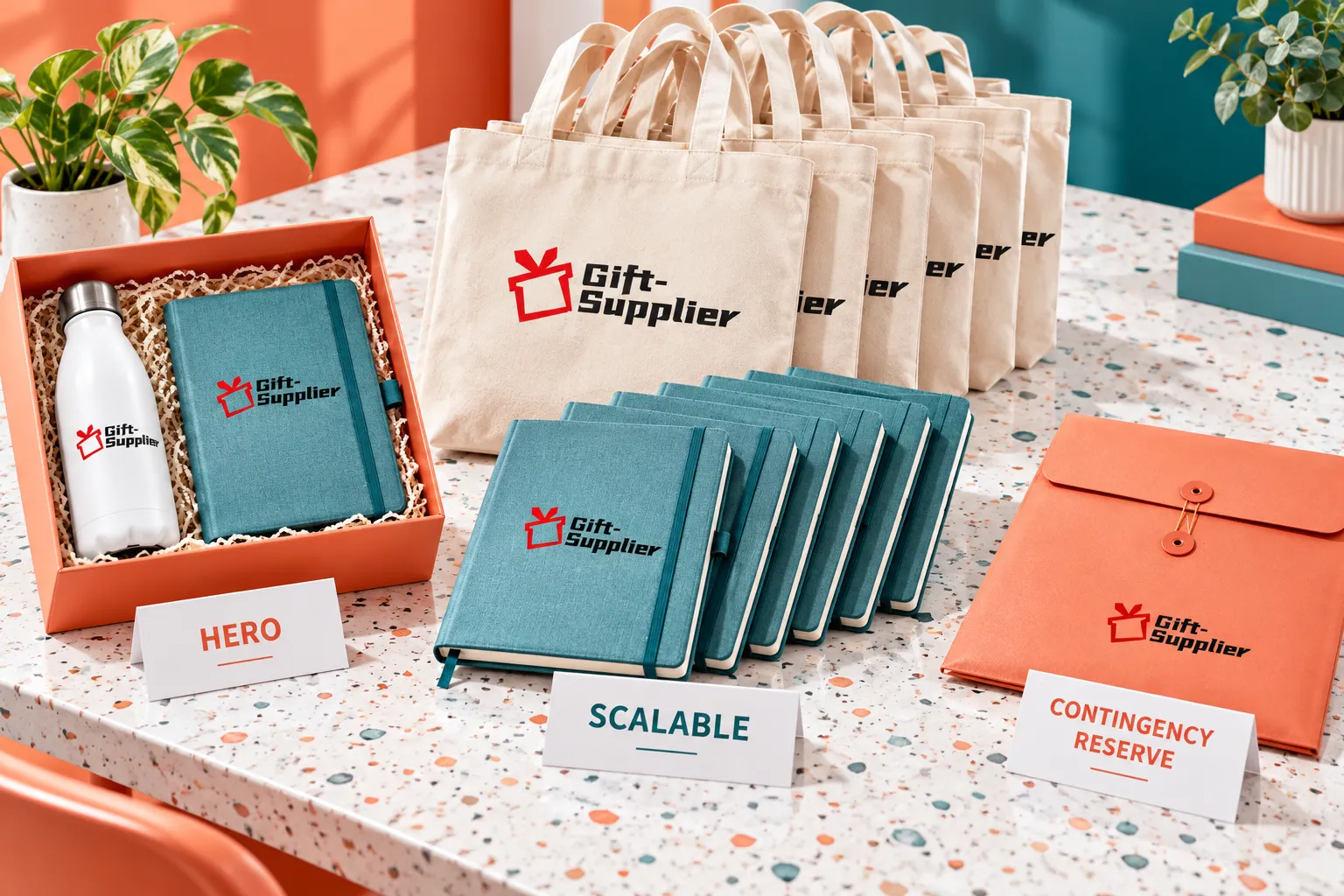
Allocating a promotional merchandise budget across reach, quality, and experience means splitting total spend into three tiers: hero items for your smallest, highest-value recipient group, scalable items for your largest audience, and a contingency reserve held back for rejects, rush freight, or late additions. This guide is written for marketing procurement leads planning a branded merchandise program for US and UK recipients, working from a fixed total budget and a defined recipient list. It assumes you can segment recipients into at least a broad group and, where relevant, a smaller VIP group. The framework below turns that segmentation into a dollar allocation and a per-recipient budget for each tier, rather than one average price applied to everyone.
Budget scrutiny makes this a current priority: a single blended per-unit price either overspends on the broad group or underspends on the recipients who matter most to the relationship. The sections below provide a decision table comparing the three tiers, a formula and step-by-step framework for splitting the budget, a worked example, and a way to size the contingency reserve instead of guessing at it.
Figures, percentages, and the worked example used in this article are illustrative only. Replace them with your own recipient counts, itemized quotes, and budget targets before finalizing an allocation.

Why a Single Per-Unit Budget Doesn’t Work for a Whole Program
A program with 1,000 recipients rarely has 1,000 recipients who matter equally to the relationship. A single average price applied across the whole list either overspends on the broad group, where the cost adds up fast, or underspends on the small group of clients, partners, or executives where a forgettable item does real damage to the relationship.
Promotional products budget allocation solves this by treating the program as a portfolio rather than one purchase. Reach comes from the largest, lowest-cost-per-unit tier. Quality and experience come from a smaller, higher-cost-per-unit tier reserved for the recipients who justify it. A contingency reserve sits alongside both, absorbing the rejects, rush freight, and late additions that a fixed budget otherwise has no room for.
Decision Table: The Three Portfolio Tiers
Use the table below to compare hero items, scalable items, and the contingency reserve against criteria you can verify in your own program.
| Criterion | Hero items | Scalable items | Contingency reserve |
| Cost per unit | Highest per-unit cost in the portfolio | Lowest per-unit cost, optimized for volume | Not a product line; held as reserve budget |
| Recipient reach | Smallest group — VIP clients, top partners, executives | Largest group — broad employee, trade show, or customer distribution | No fixed recipients; covers gaps or late additions |
| Quality standard | Premium material and presentation, often with a golden sample | Standard material verified against spec, priced for scale | Not applicable; spent against whichever tier the shortfall hits |
| Customization level | Often individually personalized or low-volume customization | Uniform branding applied at scale in one production run | Not applicable |
| Typical share of total budget | Smallest dollar share of the total program | Largest dollar share of the total program | A set percentage held back, not spent until needed |
| Risk if misallocated | Overspending here starves reach for the broader program | Underspending here risks a flimsy item at scale | Skipping this reserve leaves no buffer for rejects or rush costs |

The Budget Allocation Formula
The calculation converts a percentage split into a per-recipient dollar figure for each tier.
| Per-recipient budget (tier) = (Total program budget × Tier’s budget share) ÷ Number of recipients in that tier |
Recipients in the contingency tier are not counted, since the reserve is held back rather than divided across a recipient list.
Buyer Framework: How to Build the Allocation
The steps below turn the formula into a repeatable process. The decision owner is typically the marketing procurement lead, with finance confirming the total program budget and any spend caps.
- Define total program budget and the recipient count in each intended segment — hero, scalable, and any unassigned contingency.
- Set a target budget-share percentage for each tier based on program goals, using the sample allocations below as a starting point, not a fixed rule.
- Calculate per-recipient budget for the hero and scalable tiers using the formula above.
- Confirm each per-recipient figure against real, itemized quotes rather than a list price, since landed cost and price trade-offs change what a figure actually buys.
- Size the contingency reserve using the sizing table below, based on your own reject-rate and freight history where available.
- Document the allocation with the date and assumptions behind it, so it can be revisited if recipient counts or program scope change.
- Track actual spend against each tier separately during the program, so a hero-tier overspend doesn’t silently draw down the scalable or contingency budget.
For product options already organized by spend level, see our promotional gifts by budget page, then apply this framework to split your total budget across tiers before you shop.

Evidence From the Field: Illustrative Budget Split
The example below is an illustrative allocation created to show how the formula converts a total budget into a per-recipient figure for each tier. Replace the sample figures with your own recipient counts and quotes before using this as a real budget.
A marketing procurement lead at a mid-market brand is allocating a $50,000 program budget across 1,000 recipients: 20 VIP clients and 980 broader contacts.
| Tier | Budget share | Dollar allocation | Recipients | Per-recipient budget |
| Hero | 25% | $12,500 | 20 | $625.00 |
| Scalable | 65% | $32,500 | 980 | $33.16 |
| Contingency | 10% | $5,000 | held in reserve | not applicable |
| Total | 100% | $50,000 | 1,000 | — |
In this illustrative split, the hero tier’s $625 per-recipient figure and the scalable tier’s $33.16 per-recipient figure both need to be checked against itemized quotes, not a catalog list price, before either is treated as final. A quote that looks affordable at list price can still cost more once tooling, freight, and rejects are added, which is why this allocation should feed into a full landed-cost check before ordering.
Setting the Contingency Reserve
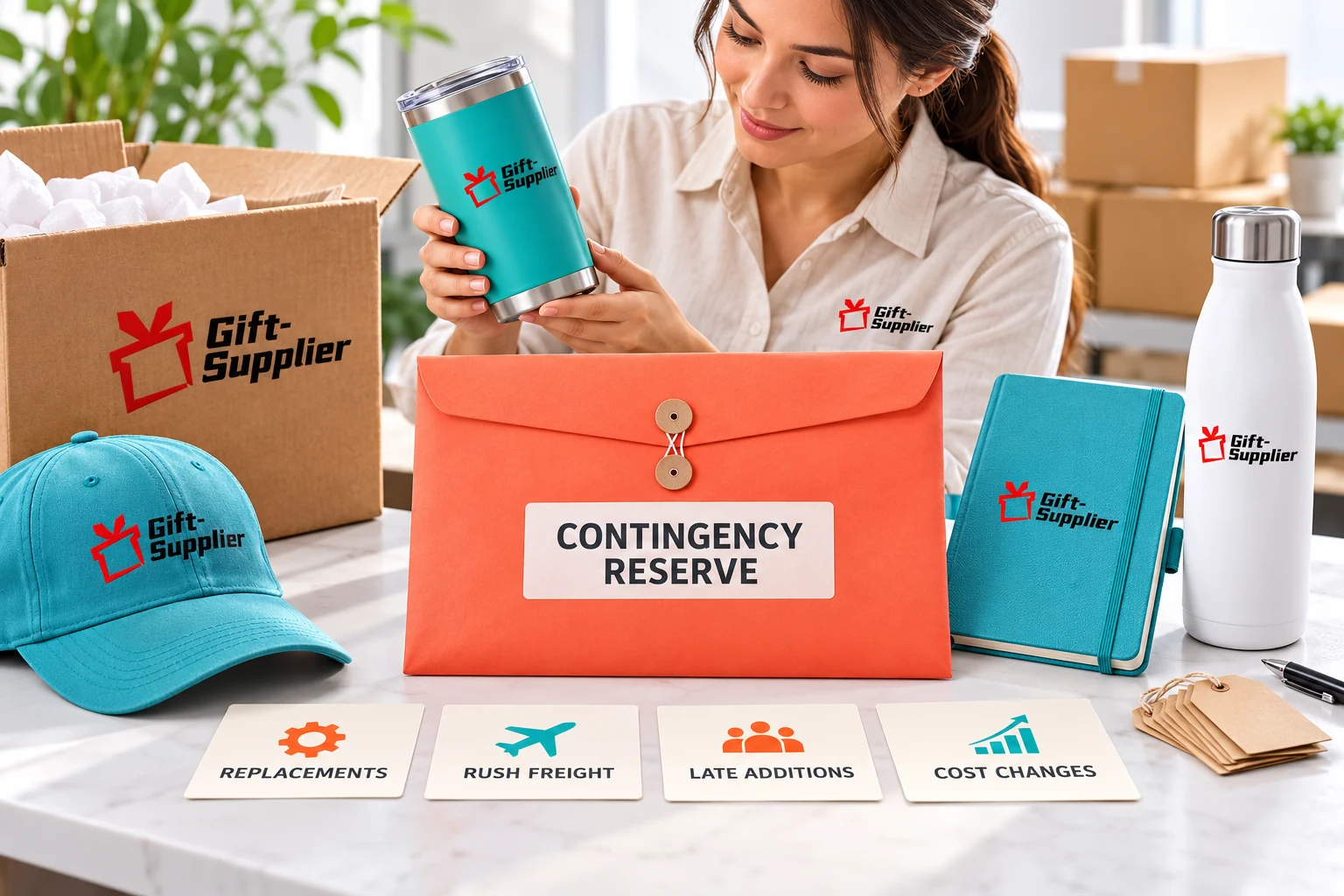
A contingency reserve sized on a guess is either wasted budget or an empty promise. The table below shows what it typically covers and how to size each piece.
| What it covers | Typical trigger | How to size it |
| Rejected or damaged units | Units failing inspection or damaged in transit | Base it on your historical reject rate, or the supplier’s stated tolerance if you have no history |
| Rush freight | A shortfall discovered close to an event date | Estimate the cost difference between standard and expedited shipping for a partial reorder |
| Late-added recipients | New hires, late RSVPs, or an expanded distribution list | Base it on how much recipient counts have shifted in past programs |
| Freight or duty cost variance | Landed cost changes between quoting and shipping | Base it on how much these costs have moved in recent programs |
Price Trade-Offs by Tier
A lower price at any tier is not automatically a saving. The table below shows what to check before cutting price at each level of the portfolio.
| Tier | What a lower unit price may cost you | What to verify before cutting price here |
| Hero | A less durable or less memorable item for your highest-value recipients | Material specification and packaging quality against a physical sample |
| Scalable | A flimsy item that damages brand perception at scale | MOQ, material specification, and reject rate at your actual order volume |
| Contingency | No reserve at all if this line is cut first when budgets tighten | Whether the reserve has ever been needed in a past program |
Sample Allocation by Program Type
The right split depends on the program. The table below gives illustrative starting points to adjust, not a fixed ratio.
| Program type | Suggested hero share | Suggested scalable share | Suggested contingency share |
| Executive or VIP-heavy program | Higher — fewer, higher-value recipients | Lower | Standard |
| Broad employee or customer giveaway | Lower, or no hero tier | Higher | Standard |
| Trade show or fixed event date | Moderate | Moderate | Higher — event-date risk |
| New or first-time program | Moderate | Moderate | Higher — less historical data |
Risks and Limitations of This Allocation Framework
- Budget shares are a starting framework, not a universal ratio; the right split depends on program goals and recipient mix.
- Per-recipient figures are only as reliable as the itemized quotes behind them; a list price will understate real cost once tooling, freight, and rejects are added.
- A contingency reserve sized too small leaves no buffer for rejects or rush freight; sized too large, it ties up budget that could improve the scalable tier.
- Recipient counts can shift after the budget is set; build in a review point before final ordering, not only at kickoff.
- This framework assumes recipients can be reasonably segmented into at least two groups; a program with a single flat audience may only need a scalable tier and a reserve.
- The worked example in this guide is illustrative; actual costs and splits will vary by program, product, and market.
Request a Scoped Quote
If you are planning a branded merchandise program, share your total budget, recipient segments, and target dates. Our team can help you turn a tier allocation into itemized, comparable quotes.
Prefer a lighter first step? Send us your recipient counts and target budget for a quick allocation sanity check before you shop for products.
Frequently Asked Questions
What if our program doesn’t have a hero tier at all?
Some programs are genuinely flat — a single conference giveaway with no distinct VIP group, for instance. In that case, split the procurement budget into a scalable tier and a contingency reserve only, and skip the hero allocation rather than forcing a tier the program doesn’t need.
How big should the contingency reserve be?
There is no universal figure. Size it against your own reject-rate and freight history using the sizing table above, and treat 10% as an illustrative starting point to adjust up or down based on program risk, not a fixed rule. This makes the promotional products budget allocation more responsive to actual program conditions.
Should contingency ever be spent on hero items instead of held back?
Generally no, since doing so removes the buffer the reserve exists for. If a program consistently needs to raid contingency for hero-tier shortfalls, that is a signal the hero tier’s original allocation was undersized, not that the reserve should be repurposed. Reviewing the price trade-offs between tiers can help identify where the allocation needs adjustment.
How does this relate to total cost of ownership?
This framework allocates dollars across tiers; it does not calculate what each tier actually costs once tooling, freight, duties, and rejects are included. Landed cost should therefore be considered when reviewing each tier’s allocation. The total cost of ownership calculation can then be run against each tier’s quotes.
Can this framework work under a fixed per-recipient spend cap?
Yes. A fixed per-recipient cap on the scalable tier still leaves room to allocate a separate hero budget for a smaller VIP group and a contingency reserve, as long as the caps are set at the tier level rather than applied as one number across the whole recipient list. This approach supports more controlled promotional products budget allocation while accounting for price trade-offs and landed cost.
Sources and Further Guidance
International Chamber of Commerce — Incoterms® Rules
US International Trade Commission — Harmonized Tariff Schedule (HTS) search
UK Government — Trade Tariff: look up commodity codes, duty and VAT rates
US Consumer Product Safety Commission — Children’s Product Certificate
Author & Reviewer
Written by Claire Morgan, Senior Content Writer, with professional experience planning branded merchandise budgets across recipient segments.
Freshness & Update Log
- Published: September 30, 2026
- Last Reviewed: September 30, 2026
- Next scheduled review: within 12 months, or sooner if referenced freight or duty guidance changes materially.
Related Resources
- /questions-to-ask-a-promotional-product-supplier/ — 18 evidence-based questions to ask once quotes are in hand.
- /promotional-product-supplier-audit-checklist/ — the 25-point checklist for auditing a supplier before you award the order.
- /promotional-merchandise-vendor-consolidation/ — how vendor consolidation interacts with ongoing performance scoring.