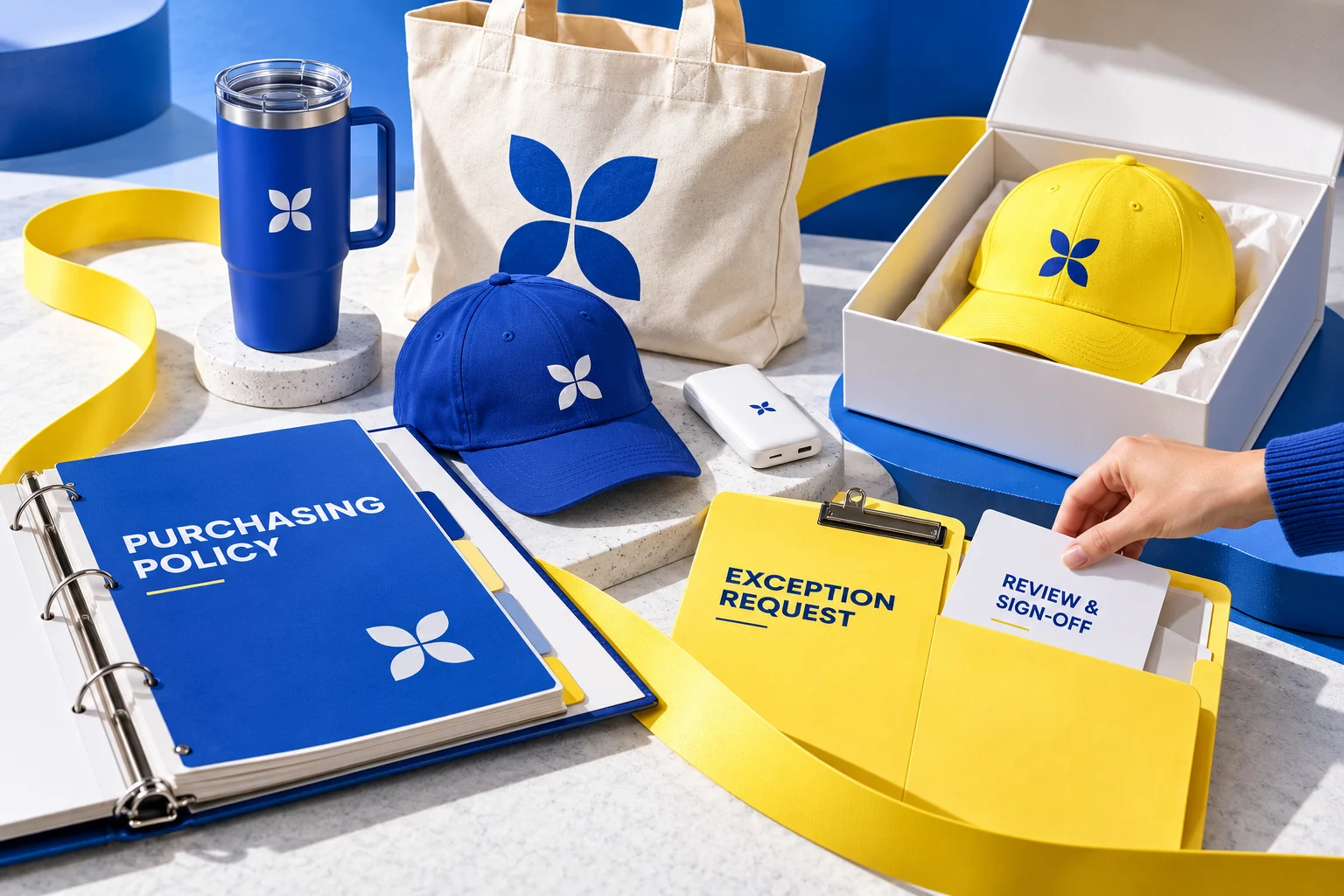
A promotional products procurement policy should connect four elements: brand control, an approved vendor list, budget authority, and compliance requirements. This guide is written for procurement managers building or updating a purchasing policy for branded merchandise across a mid-market or enterprise organization in US and UK markets. It assumes multiple departments currently purchase promotional products with limited central oversight, and that leadership has asked procurement to formalize the process. A working policy connects these four elements into one document that any department can follow, rather than leaving each one as a separate, unenforced expectation.
Formalizing promotional product purchasing is a current priority for organizations that have grown past ad hoc, department-by-department buying, since that pattern is exactly what produces off-brand merchandise, unvetted vendors, and spend nobody can fully account for. The sections below provide a decision table for what the policy should govern, a reusable policy template, a repeatable framework for building and rolling it out, and an illustrative rollout example.
Figures, thresholds, and the rollout example used in this article are illustrative only. Set actual budget thresholds and approval authority based on your own organization’s financial controls and governance structure.
Why Promotional Product Purchasing Needs a Written Policy
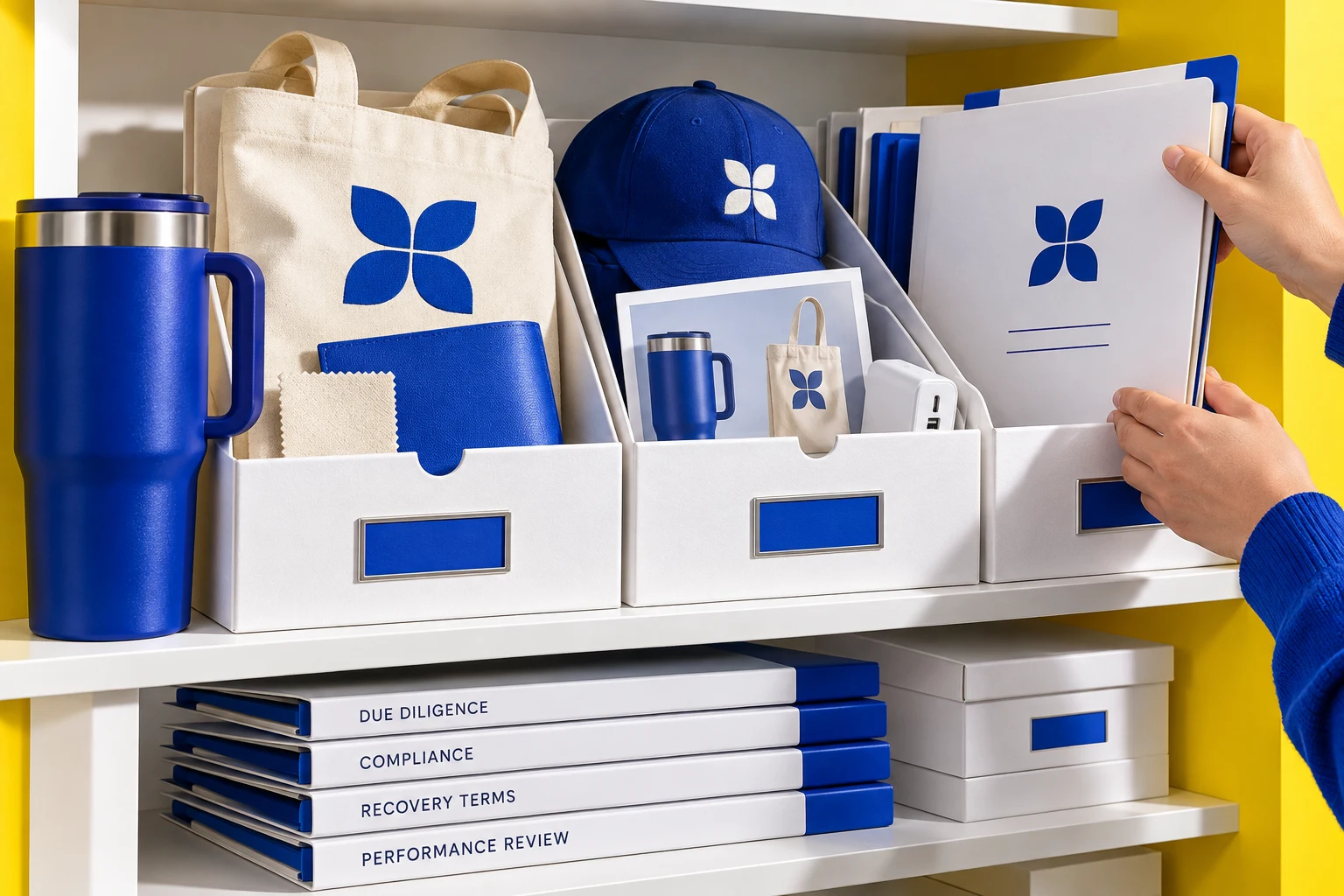
Without a written policy, promotional product purchasing tends to happen department by department, each with its own vendor relationships, its own interpretation of brand guidelines, and its own approval habits. That pattern is rarely a problem until an off-brand item reaches a customer, a compliance gap surfaces in a product nobody centrally reviewed, or finance cannot account for how much the organization actually spent on branded merchandise last year.
A promotional products procurement policy fixes that by connecting brand control, vendor approval, budget authority, and compliance into one referenced document, rather than leaving each as a separate and unenforced expectation scattered across departments.
Decision Table: What a Procurement Policy Should Govern
Use the table below to check a draft policy against the areas that most often separate a policy that gets followed from one that gets quietly worked around.
| Policy area | What it governs | Why it matters | Evidence or mechanism |
| Brand control | Approved logos, colors, and brand guidelines for any branded merchandise | Prevents off-brand or inconsistent merchandise reaching customers or employees | A linked brand guideline document referenced in every purchase request |
| Approved vendor list | Which vendors are pre-qualified to receive a purchase order | Prevents ad hoc purchasing from unvetted vendors | A maintained list tied to the supplier due diligence process |
| Budget & approval authority | Spend thresholds and who can approve at each level | Prevents purchases exceeding an individual’s actual authority | A documented approval matrix by spend level |
| Compliance requirements | Required documentation for regulated product categories | Prevents a compliance gap from an otherwise-approved vendor | A compliance checklist referenced for regulated categories |
| Purchase approval process | The steps a request must go through before an order is placed | Creates a consistent, auditable purchase record | A defined workflow with named approval steps |
| Exceptions & review | How and when a deviation from policy can be requested | Prevents policy erosion through undocumented one-off exceptions | A written exception request and approval record |
The Policy Template: Core Sections
The fields below make up a reusable policy template, grouped into six sections. Draft each section with input from the relevant stakeholder — brand or marketing for design control, finance for budget authority, and compliance for regulated categories.
Purpose & Scope
- Statement of why the policy exists and what problem it solves
- Departments, business units, or regions the policy applies to
- Product categories covered, including any explicitly out of scope
- Policy owner and the date it takes effect
Brand & Design Control
- Link to the current brand guidelines document
- Who must approve a new design before it is sent to a vendor
- Approved logo files and color specifications
- Process for requesting an exception to standard brand guidelines
Approved Vendor Requirements
- Criteria a vendor must meet to be added to the approved list
- Who maintains and updates the approved vendor list
- Process for requesting a new vendor be evaluated
- Review frequency for vendors already on the list
Budget & Approval Authority
- Spend thresholds and who can approve at each level
- Required documentation at each approval level
- Budget code or cost center requirements for every purchase
- Process for a purchase that spans multiple departments or budgets
Compliance & Risk
- Product categories requiring additional compliance documentation
- Who reviews compliance documentation before an order is approved
- Record-keeping requirements for compliance documents
- Escalation path if a compliance gap is discovered after ordering
Exceptions & Policy Review
- How to request an exception, and who approves it
- Documentation required to support an exception request
- Scheduled review interval for the policy itself
- Who is responsible for updating the policy after each review

Buyer Framework: How to Build and Roll Out the Policy
The steps below turn the template into a working policy, with a clear decision owner — typically the procurement director or head of procurement, working with named stakeholders from brand, finance, and compliance.
- Draft the policy using the six core sections above, with input from brand or marketing, finance, procurement, and compliance stakeholders.
- Define the approved vendor list criteria and populate it using your existing supplier due diligence records.
- Set the budget authority matrix based on your organization’s actual approval structure, not a generic template.
- Circulate the draft policy to department stakeholders for review before finalizing — a policy nobody was consulted on tends to get worked around.
- Publish the policy alongside the approved vendor list and budget matrix, and require every purchase request to reference both.
- Establish an exception request process so legitimate one-off needs have a documented path, rather than an undocumented workaround.
- Review the policy at a set interval, such as annually, updating the vendor list and budget thresholds as the organization changes.
Our team can help populate your approved vendor list as part of a scoped sourcing engagement — see promotional product sourcing for how we support procurement teams building out vendor due diligence.
Budget Authority Matrix
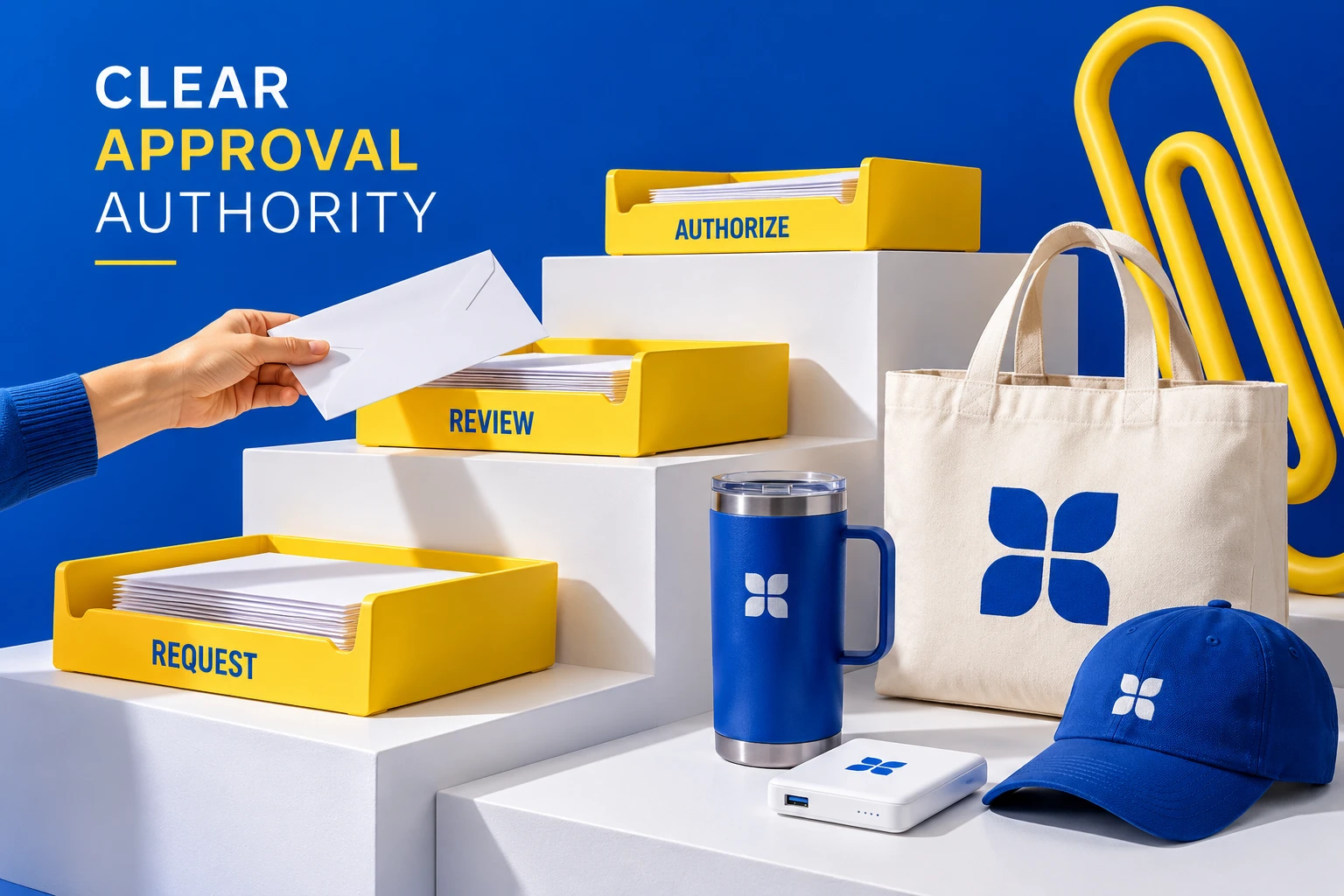
The table below is an illustrative starting structure for spend thresholds and approval authority. Set actual thresholds against your organization’s real financial controls.
| Spend level | Who can approve | Required documentation |
| Below a low departmental threshold | Department manager | Purchase request referencing the approved vendor list |
| Mid-range spend | Procurement manager | Scoped quote and budget code confirmation |
| High spend, or a new vendor | Procurement director or budget owner | Supplier due diligence record and scoped quote |
| Above a defined high threshold | Finance or executive sign-off | Full business case, including total cost and contract terms |
Evidence From the Field: Illustrative Policy Rollout Example
The example below is an illustrative policy rollout scenario created to show how a policy changes purchasing behavior over time. Replace the sample details with your own verified rollout records before presenting this as a real case.
An organization with several departments independently purchasing branded merchandise rolls out a new procurement policy over a defined period.
| Stage | Illustrative finding | Resulting action |
| Before the policy | Multiple departments purchased branded merchandise independently, from different vendors, with inconsistent logo usage | Policy drafted to centralize brand control and vendor approval |
| Policy rollout | Departments required to route purchases through the approved vendor list and budget matrix | Initial pushback from teams used to purchasing directly |
| Following review period | Purchases from unapproved vendors declined; brand guideline exceptions required documented sign-off | Fewer off-brand items reported, and approval turnaround improved |
In this illustrative scenario, the initial resistance to routing purchases through a central policy gave way to a more consistent, auditable purchasing pattern once the approved vendor list and budget matrix were actually usable, not just theoretical documents.

Approved Vendor List Criteria
The policy’s approved vendor list is only as reliable as the criteria used to build it. The table below connects that list back to the organization’s existing due diligence and performance processes.
| Criterion | What qualifies a vendor for the list | Related process |
| Due diligence completed | Vendor has passed the organization’s supplier due diligence review | See our 25-point supplier audit checklist |
| Compliance documentation on file | Current compliance documents held for relevant product categories | See our promotional product compliance resource |
| Recovery terms documented | A written remedy for late delivery or failed QC is on file | Captured during vendor onboarding |
| Performance review scheduled | Vendor has an initial or ongoing performance scorecard review scheduled | See our vendor scorecard framework |
Policy Exception Requests
Even a well-designed policy needs a legitimate path for a genuine exception. The table below covers common exception scenarios and what should be documented before approval.
| Exception scenario | Documentation required before approval |
| A one-time event needs a vendor not on the approved list | Business justification, timeline reason, and a completed due diligence review before the order is placed |
| A department requests an off-brand design for a specific internal use | Written sign-off from the brand or marketing stakeholder |
| A purchase exceeds budget authority for a genuine urgent need | Written approval from the next authority level up, documented promptly if used in an emergency |
Risks and Limitations of This Policy Framework
- A policy is only effective if departments actually know it exists and where to find it; publishing it is not the same as adoption.
- Budget thresholds and approval authority should reflect your organization’s actual financial controls; a generic threshold copied from elsewhere may not match your authority structure.
- An approved vendor list needs periodic maintenance; a stale list recreates the same ad hoc purchasing risk the policy was meant to prevent.
- An overly restrictive exception process can push departments toward informal workarounds; the exception path needs to be genuinely usable, not just theoretical.
- This policy structure is a general framework; regulated industries or public sector organizations may need additional approval or disclosure requirements.
- The rollout example in this guide is illustrative; actual adoption timelines and outcomes vary by organization size and culture.
Request a Scoped Quote
If you are building or updating a promotional products procurement policy, share your current vendor relationships, department structure, and approval process. Our team can help populate an approved vendor list as part of a scoped quote.
Prefer a lighter first step? Send us your draft policy for a quick gap review before you circulate it internally.
Frequently Asked Questions
Who should own the promotional products procurement policy once it’s published?
Typically the procurement director or head of procurement, since the promotional products procurement policy spans vendor approval and budget authority that fall within that role. Brand, finance, and compliance stakeholders should stay involved in their respective sections, but a single named owner keeps the policy from becoming everyone’s responsibility and no one’s.
How often should the approved vendor list be updated?
A quarterly or semi-annual review is a reasonable starting cadence for most organizations, with updates triggered sooner if a vendor’s due diligence status or performance materially changes. Regular vendor evaluation helps keep the approved list aligned with current supplier performance and business requirements.
Should every department be required to use the same approved vendors?
Not necessarily. Different departments may need different product categories or specialist vendors. The policy can support multiple approved vendors across categories, as long as every vendor on the list has passed the same supplier due diligence bar.
What is a reasonable exception approval timeline?
This depends on the exception type and your organization’s approval structure, but setting an explicit target turnaround for a routine exception request helps prevent the procurement process from becoming a bottleneck that encourages departments to bypass it entirely.
How does this policy relate to a supplier due diligence process?
The promotional products procurement policy’s approved vendor list depends directly on a supplier due diligence process to populate and maintain it — see our 25-point supplier audit checklist for the underlying process this policy references.
Sources and Further Guidance
US Consumer Product Safety Commission — Children’s Product Certificate
California OEHHA — Proposition 65 Frequently Asked Questions for Businesses
UK Government — Placing Manufactured Products on the Market in Great Britain
Google Search Central — Creating Helpful, Reliable, People-First Content
Author & Reviewer
Written by Claire Morgan, Senior Content Writer, with professional experience building corporate purchasing policies for branded merchandise programs.
Freshness & Update Log
- Published: September 26, 2026
- Last Reviewed: September 26, 2026
- Next scheduled review: within 12 months, or sooner if referenced regulatory guidance changes.
Related Resources
- /questions-to-ask-a-promotional-product-supplier/ — 18 evidence-based questions to ask once quotes are in hand.
- /promotional-product-supplier-audit-checklist/ — the 25-point checklist for auditing a supplier before you award the order.
- /promotional-merchandise-vendor-consolidation/ — how vendor consolidation interacts with ongoing performance scoring.