

A promotional product request for proposal for a multi-market branded merchandise program should cover five areas beyond product specifications: pricing basis, service level requirements, data and reporting expectations, compliance scope by market, and governance and escalation terms. This guide is written for procurement managers running an RFP for a branded merchandise program spanning multiple markets, typically US and UK, rather than a single one-time order. It assumes the buyer has already defined program scope and is preparing to issue the RFP to a shortlist of vendors. Covering these five areas up front is what makes vendor responses genuinely comparable and prevents a program-wide gap from surfacing only after a vendor has already been selected.
A multi-market RFP is a current priority for procurement teams consolidating or formalizing branded merchandise spend across regions, since the stakes of an incomplete RFP scale with the number of markets it covers. The sections below provide a decision table for what each RFP section should require, a reusable core template, a repeatable framework for running the process, and an illustrative comparison of two vendor responses to the same RFP.
Figures, timelines, and vendor responses used as examples in this article are illustrative only. Confirm actual pricing, service levels, and compliance requirements directly with your own vendors and internal stakeholders.

Why a Multi-Market RFP Needs More Than a Product Spec
A single-order sourcing brief can focus almost entirely on product specification, because it covers one product, one supplier, and one delivery. A promotional product request for proposal for a multi-market program is a different document: it is evaluating a vendor relationship that will span multiple markets, multiple reporting cycles, and an ongoing service commitment, not just one production run.
Leaving out pricing basis, service levels, data and reporting, compliance scope, or governance terms does not just risk an unusable quote — it risks selecting a vendor whose capabilities genuinely do not match the program once it is running in three or four markets at once.
Decision Table: RFP Sections and What They Should Require
Use the table below to check a draft RFP against the sections that most often separate a comparable, usable response from a vague one.
| RFP section | What to require | Why it matters | Evidence to request |
| Pricing basis | A clear pricing basis — FOB factory, landed cost, or delivered price — and how it changes by volume tier and market | Prevents comparing quotes that are actually priced on different bases | Written pricing basis definition and a tiered pricing table per market |
| Service levels | Defined response times, proof turnaround, and issue resolution commitments | Creates measurable accountability instead of a general service promise | Named SLA metrics with target times, not just “responsive service” |
| Data & reporting | Defined reporting format, frequency, and fields across markets | Ensures visibility across multiple markets without a custom request each time | A sample report template or reporting dashboard example |
| Compliance | Compliance documentation requirements per destination market and product category | Prevents a program-wide compliance gap emerging market by market | Sample compliance documentation matched to a comparable prior product |
| Governance & escalation | Named contacts, escalation path, and review cadence across markets | Keeps a multi-market program from fragmenting into disconnected regional relationships | An org chart or named escalation contacts per market |

The RFP Template: Core Sections for a Multi-Market Program
The fields below make up a reusable RFP template, grouped into six sections. Draft every section with input from the relevant internal stakeholder — finance for pricing, compliance for market scope, and IT or analytics for data and reporting.
Program Overview
- Program name, scope, and number of markets covered
- Total estimated annual spend or volume across markets
- Program duration and any renewal terms sought
- Named program owner and internal stakeholders
Pricing Basis
- Requested pricing basis — FOB, landed, or delivered — per market
- Volume tiers and how pricing changes at each tier
- Currency and any exchange-rate handling terms
- What is included versus billed separately, such as tooling, freight, or duties
Service Level Requirements
- Required response time for standard inquiries
- Required proof or sample turnaround time
- Required issue resolution timeline for a failed shipment or QC issue
- Any penalties or credits tied to missed service levels
Data & Reporting
- Required reporting frequency, such as monthly or quarterly
- Required data fields — spend by market, delivery performance, order status
- Preferred reporting format or system integration
- Data ownership and access terms after the program ends
Compliance & Market Scope
- Destination markets and applicable regulatory categories
- Required compliance documentation per market and product category
- Labeling and packaging requirements by market
- Process for handling a compliance requirement that changes mid-program
Governance & Escalation
- Named account team and escalation contacts
- Review cadence, such as a quarterly business review
- Change-control process for adding a new market or product
- Contract term, renewal, and exit terms

Scoring Rubric for RFP Responses
Score each RFP section on a consistent scale so responses stay comparable across vendors and reviewers.
| Score | Definition |
| 1 | Not addressed, or answered with no specific detail |
| 2 | Addressed vaguely, without a checkable commitment |
| 3 | Addressed with a specific commitment, but missing supporting evidence |
| 4 | Addressed with a specific commitment and supporting evidence or documentation |
| 5 | Fully addressed with evidence, plus a clear remedy if the commitment is not met |
Buyer Framework: How to Run a Multi-Market RFP Process
The steps below turn the template into a repeatable process, with a clear decision owner — typically the procurement manager overseeing the multi-market program, working with named stakeholders per section.
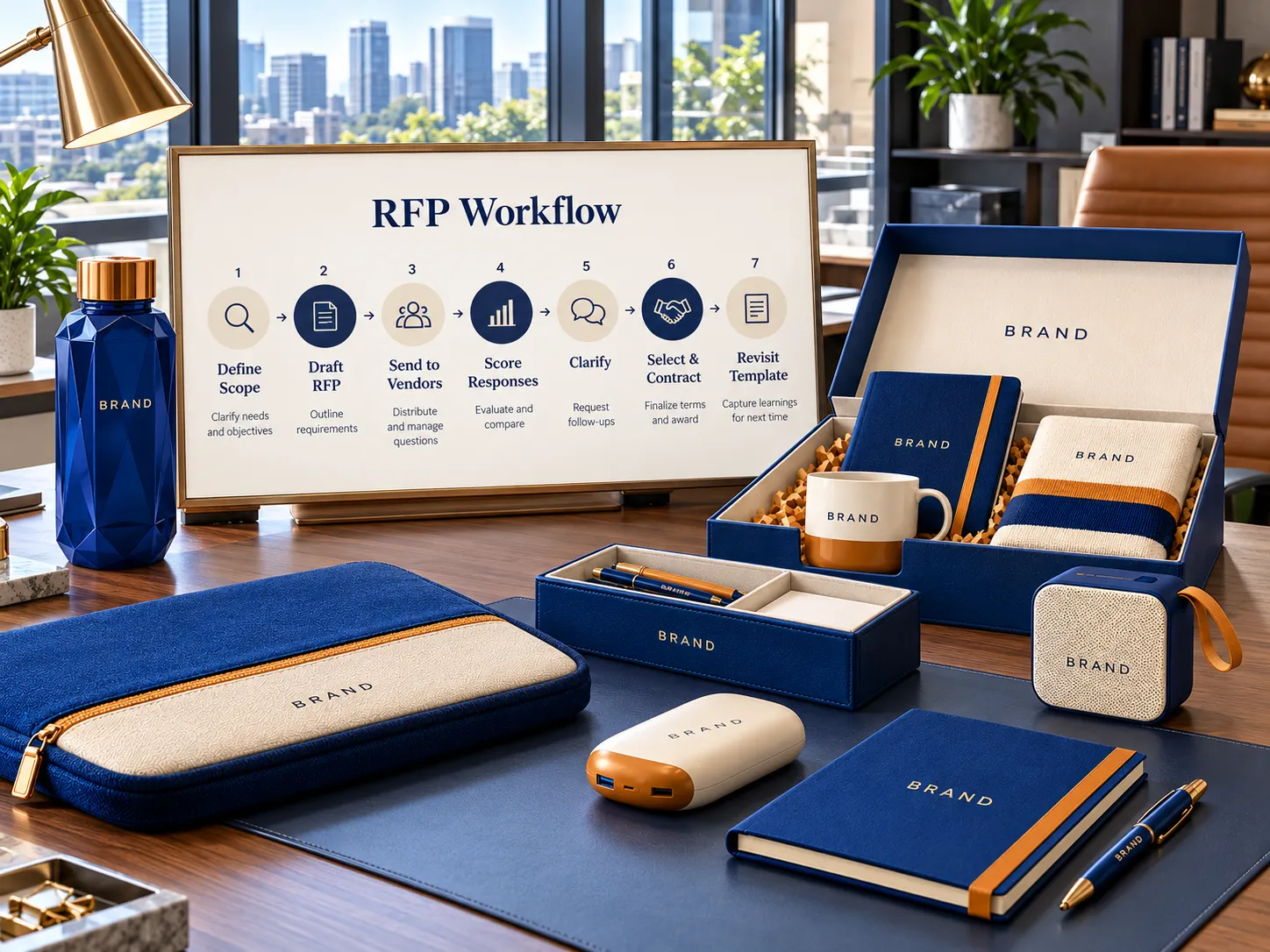
- Define program scope across all markets before drafting the RFP — total spend, product categories, and the market list.
- Draft the RFP using the six core sections above, with input from finance, compliance, and IT or reporting stakeholders.
- Send the identical RFP to every shortlisted vendor, with a stated response deadline and a required response format.
- Score responses against the decision table and rubric above, flagging vague or unquantified answers for follow-up.
- Request a clarifying call or written follow-up for any section scored ambiguous, before moving to final evaluation.
- Select a vendor and translate the RFP requirements directly into the contract or service agreement — informal RFP promises that don’t make it into the contract are not enforceable.
- Revisit the RFP template itself after the program’s first review cycle, incorporating any gap discovered.
Our team can help draft and run a multi-market RFP process — see promotional product sourcing for how we support procurement teams through this process.
Evidence From the Field: Illustrative RFP Response Comparison
The example below is an illustrative comparison of two vendor RFP responses created to show how the decision table applies in practice. Replace the sample responses with your own verified RFP evaluation before presenting this as a real comparison.
A procurement team issues an identical RFP to two shortlisted vendors for a branded merchandise program covering three markets.
| RFP section | Vendor A response (illustrative) | Vendor B response (illustrative) |
| Pricing basis | General price range provided; pricing basis not specified | Landed cost basis stated per market, with tiered volume pricing |
| Service levels | General assurance of responsive service | Stated response time and proof turnaround targets, with named metrics |
| Data & reporting | Reporting described as “available upon request” | Monthly report template provided, with sample fields shown |
| Compliance | General compliance assurance with no market-specific detail | Compliance documentation matrix provided per market |
In this illustrative comparison, both vendors quoted similar unit pricing, but Vendor B’s responses scored higher across every RFP section under the rubric above, since each answer included a checkable commitment rather than a general assurance. The pricing basis gap alone would have made a true cost comparison unreliable if it had gone unaddressed.

Setting Service Level Requirements That Are Actually Measurable
A service level commitment only has value if it can be checked. The table below shows how to turn a general service promise into a measurable requirement.
| Metric | What to specify | Why it’s measurable |
| Response time | Maximum hours to a substantive reply for a standard inquiry | Creates a checkable number instead of “responsive” |
| Proof turnaround | Maximum business days from request to a delivered proof | Ties directly to program launch timelines |
| Issue resolution time | Maximum time to a documented remedy for a failed shipment or QC issue | Prevents an open-ended “we’ll look into it” response |
| Reporting timeliness | Maximum days after period-end for report delivery | Keeps visibility current across markets |
| Escalation response | Maximum time for a named escalation contact to respond to an urgent issue | Distinguishes routine support from urgent issue handling |
Market-Specific RFP Additions
A multi-market program often needs a few additional, market-specific requirements layered onto the core template above.
| Market or program factor | Additional RFP requirement | Why |
| US market | Confirm the CPSIA or Proposition 65 documentation process where applicable | US-specific consumer product requirements apply to certain categories |
| UK / EU market | Confirm the UKCA or CE marking process where applicable | GB and EU market placement requirements differ from US requirements |
| Multi-currency programs | Confirm currency and exchange-rate handling terms explicitly | Prevents pricing ambiguity across markets billed in different currencies |
| Data residency-sensitive programs | Confirm where reporting data is stored and who can access it | Some organizations have internal data residency requirements |
Risks and Limitations of This RFP Framework
- An RFP response is not a binding commitment until its terms are incorporated into the actual contract or service agreement.
- Multi-market programs can surface compliance and data requirements the buyer’s team did not anticipate; involve compliance and IT or reporting stakeholders in drafting, not only after responses arrive.
- A stated service level with no penalty or remedy attached is a preference, not a guarantee, and should be reviewed accordingly.
- Reporting and data terms vary by a vendor’s internal systems; confirm format compatibility before assuming a vendor’s standard report will meet your needs.
- This RFP structure is a general framework; highly regulated categories may require additional market-specific sections beyond what’s covered here.
- The vendor comparison in this guide is illustrative; actual RFP responses vary by vendor and program.
Request a Scoped Quote
If you are preparing an RFP for a multi-market branded merchandise program, share your program scope, markets, estimated spend, and current vendor relationships. Our team can help structure the RFP and evaluate responses.
Prefer a lighter first step? Send us your draft RFP for a quick gap review before you send it to vendors.
Frequently Asked Questions
How long should vendors be given to respond to a multi-market RFP?
A multi-market promotional product request for proposal typically needs more preparation time than a single-order request, since pricing, compliance, and reporting sections may require input from a vendor’s internal teams across markets. Building in more response time than you would for a simple quote request tends to produce more complete answers.
Should pricing be requested in a single currency or per market?
Requesting pricing per market, in that market’s local currency alongside a stated exchange-rate handling term, tends to produce more accurate and comparable figures and supports consistent vendor evaluation across markets.
What’s the difference between this RFP and a single-order sourcing brief?
An RFP evaluates an ongoing, multi-market vendor relationship across pricing, service, data, and governance. A single-order sourcing brief defines one product’s specification for one quote, making it a narrower part of the procurement process. See our sourcing brief template for that per-order process.
Should data and reporting requirements be the same across all markets?
The core fields, such as spend and delivery performance, should stay consistent so reports are comparable across markets. Market-specific fields, such as additional compliance documentation status, can be added on top of that consistent core. This also supports supplier due diligence without making every market report identical.
What happens if a vendor’s RFP response doesn’t match what’s delivered later?
This is why RFP commitments need to be carried into the actual contract or service agreement, not left in the RFP response alone. As part of supplier due diligence, buyers should ensure important commitments are clearly documented. A discrepancy against a contractual term has a clear remedy path; a discrepancy against only a proposal document is harder to enforce.
Sources and Further Guidance
US Consumer Product Safety Commission — Children’s Product Certificate
California OEHHA — Proposition 65 Frequently Asked Questions for Businesses
UK Government — Placing Manufactured Products on the Market in Great Britain
Google Search Central — Creating Helpful, Reliable, People-First Content
Author & Reviewer
Written by Claire Morgan, Senior Content Writer, with professional experience running multi-market RFP processes for branded merchandise programs.
Freshness & Update Log
- Published: September 24, 2026
- Last Reviewed: September 24, 2026
- Next scheduled review: within 12 months, or sooner if referenced regulatory guidance changes.
Related Resources
- /questions-to-ask-a-promotional-product-supplier/ — 18 evidence-based questions to ask once quotes are in hand.
- /promotional-product-supplier-audit-checklist/ — the 25-point checklist for auditing a supplier before you award the order.
- /promotional-merchandise-vendor-consolidation/ — how vendor consolidation interacts with ongoing performance scoring.