
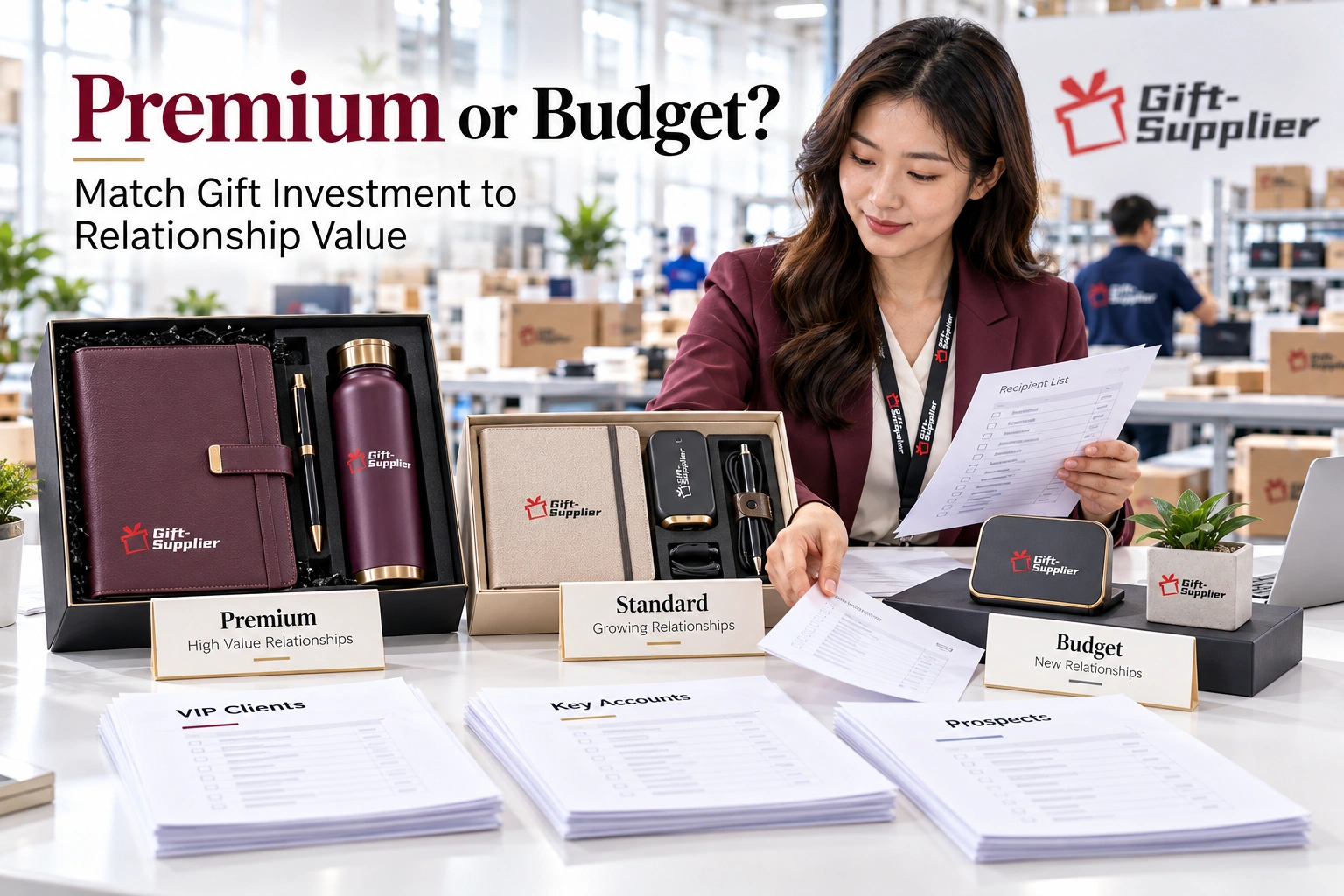
Premium vs budget corporate gifts should be decided by relationship value, not by a flat per-recipient price: score each recipient on a few verifiable factors, group them into two or three tiers, and spend more only where the relationship justifies it. This guide is written for marketing procurement leads running corporate gifting programs for US and UK recipients, with a defined recipient list and a fixed total budget. It assumes you can score recipients using CRM or account data and apply the tiers consistently. Differences between tiers should show up in presentation and personalization as much as in price, so no recipient sees a gift that signals they matter less.
Budget scrutiny makes this a current priority: a single gift for everyone overspends on low-engagement contacts and underspends on the accounts that matter most, while careless tiering creates visible inequity that can damage the very relationships the program is meant to build. The sections below provide a decision table, a relationship value scoring model, a buyer framework with a named decision owner, an illustrative segmentation example, and a check for both inequity and waste.
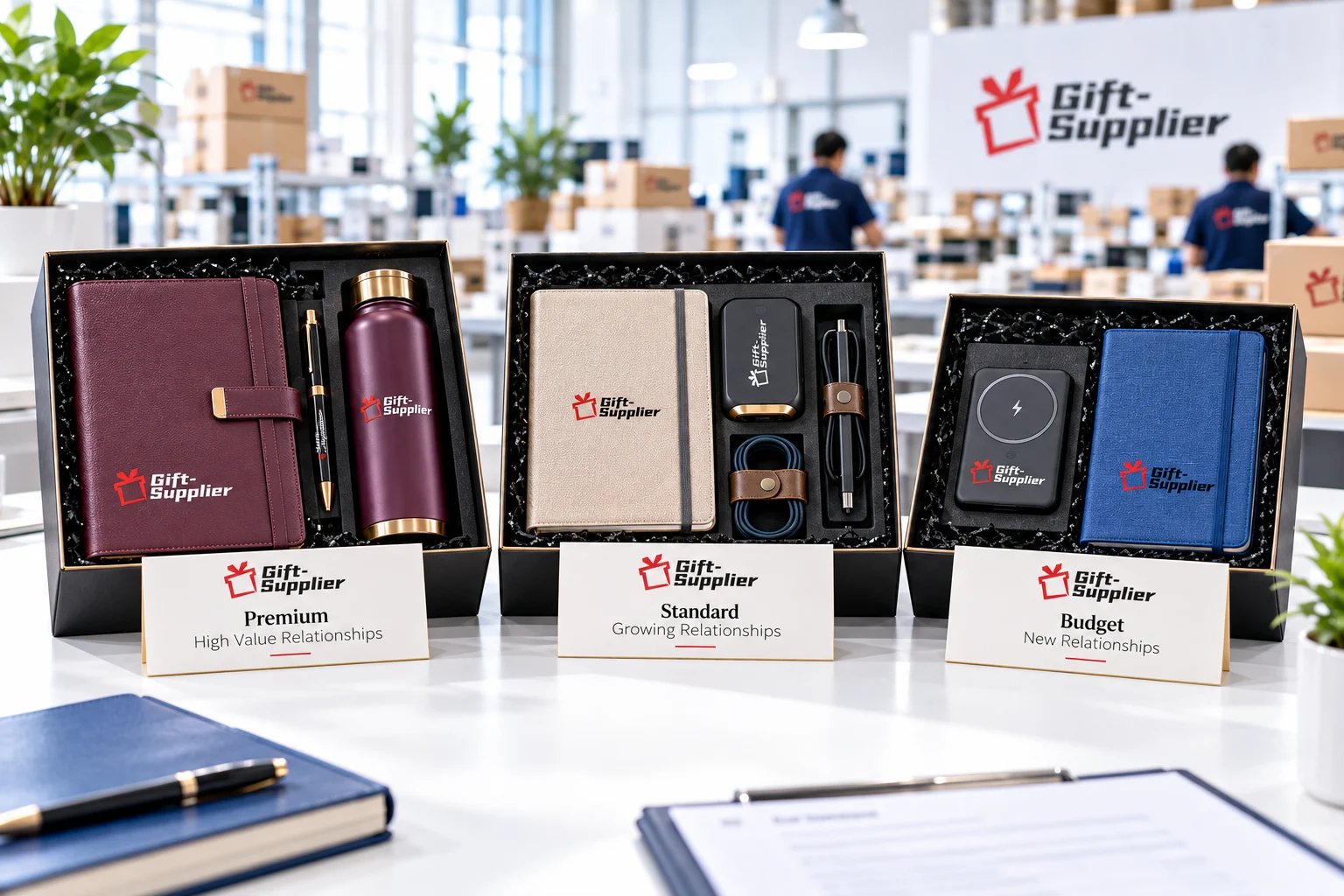
Why One Gift for Everyone Fails, and Why Unchecked Tiering Does Too
A single gift at a single price is easy to buy and easy to defend, but it treats a long-standing strategic account and a cold prospect as equals. The result is usually one of two outcomes: the gift is good enough for the prospect and underwhelming for the account, or it is good enough for the account and wasteful across the rest of the list.
Tiering fixes the spend problem but introduces a people problem. When recipients can compare gifts, because they work at the same company, attend the same event, or talk to each other, a visible gap in quality can read as a ranking. Choosing between premium vs budget corporate gifts therefore has two jobs: put money where relationship value is highest, and design the tiers so the difference does not look like a judgment of the recipient.
Decision Table: Premium vs. Budget Corporate Gifts
Use the table below to compare the two approaches against criteria you can verify with your own data and quotes.
| Criterion | Premium gifts | Budget gifts | What to verify |
| Relationship fit | Strategic accounts, long tenure, high influence over decisions | Broad customer base, prospects, early-stage relationships | Recipient scores built from your own CRM or account data |
| Landed cost per recipient | Higher; freight, duties, and insurance weigh more per unit | Lower per unit; freight and handling often dominate | An itemized landed-cost quote for each tier, not a blended average |
| MOQ | Small tier quantities may fall below a supplier’s usual MOQ, which can raise unit price | Larger runs usually sit closer to MOQ and better price breaks | MOQ in writing at the quantity of each tier |
| Lead time | Personalization and premium materials can add production and proofing time | Standard items are usually simpler to schedule | Lead time at your actual quantity, including proofing rounds |
| Material and finish | Higher-grade materials and presentation packaging | Standard-grade materials with functional packaging | A physical sample of each tier before approval |
| Visible inequity risk | Highest where recipients compare gifts, such as colleagues at one client or guests at one event | Lower, provided the gift looks intentional and consistent | Where and when recipients are likely to see each other’s gifts |
| Waste risk | Premium sent to disengaged recipients is the costliest waste | Bulk budget items can still go unclaimed or unused | Engagement recency and unclaimed-stock history for each recipient group |

Relationship Value Scoring: A Verifiable Way to Assign Tiers
Instead of assigning tiers by instinct or seniority, score each recipient on four factors from 1 to 3, then add the scores. Each factor should map to a field your team already holds.
| Factor | Score 1 | Score 2 | Score 3 |
| Strategic value | Small or unproven account | Mid-sized or growing account | Core account or strategic partner |
| Relationship tenure | New or first contact | Established for a moderate period | Long-standing relationship |
| Decision influence | Limited influence on buying decisions | Contributes to decisions | Makes or approves decisions |
| Recent engagement | No recent activity in your defined window | Occasional activity | Active and recent engagement |
Buyer Framework: How to Segment Recipients and Set Tier Budgets
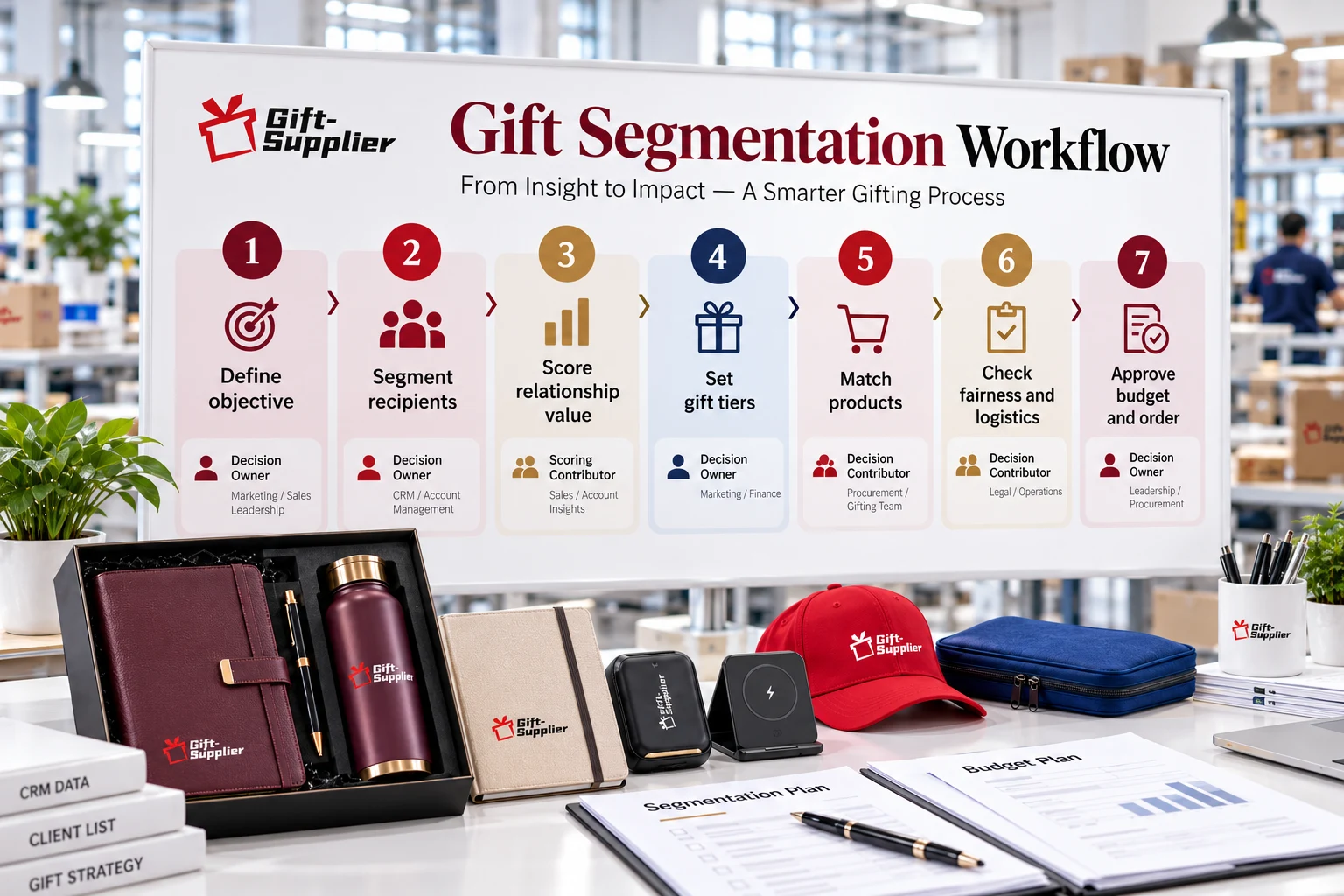
The steps below turn the scoring model into a repeatable process. The decision owner is typically the marketing procurement lead, with account management or sales supplying the recipient scores.
- Compile the full recipient list with the CRM or account fields needed for each scoring factor.
- Have account management or sales score each recipient using the rubric, and record the date and scorer.
- Map total scores to two or three tiers, and confirm the recipient count in each tier.
- Set a per-recipient budget for each tier from the total program budget, then request itemized landed-cost quotes at those quantities.
- Check each tier’s items against a physical sample, and design shared presentation, such as the same box and card, so tiers read as a family.
- Run the inequity and waste checks below before ordering, adjusting tiers where recipients will compare gifts or where policies limit what can be accepted.
- Document the scores, tier thresholds, and assumptions with dates, so the segmentation can be reviewed at the next program.
Avoiding Visible Inequity
Tiering only works if recipients do not experience it as ranking. The table below covers the situations where gifts are most likely to be compared, and what to do about each.
| Situation | Inequity risk | Mitigation |
| Several recipients at one client company | Colleagues compare gifts and one sees a clearly lesser item | Give recipients at the same organization the same tier unless roles differ sharply, and explain differences by role, not rank |
| Gifts opened together at an event | A visible quality gap in front of peers | Use the same box, card, and wrapping across tiers, and hand over gifts individually |
| Recipients who talk to each other or post publicly | Differences surface online or in conversation | Keep tiers close enough in look and feel that a comparison feels reasonable |
| Internal teams who see the gift list | Internal debate about who is “worth” more | Share the scoring rubric and its basis, not the names behind each tier |
| Recipients bound by gift policies | A premium gift may be refused or create a compliance issue | Check recipient policies first, and move such recipients to a tier they can accept |

Evidence From the Field: Illustrative Segmentation
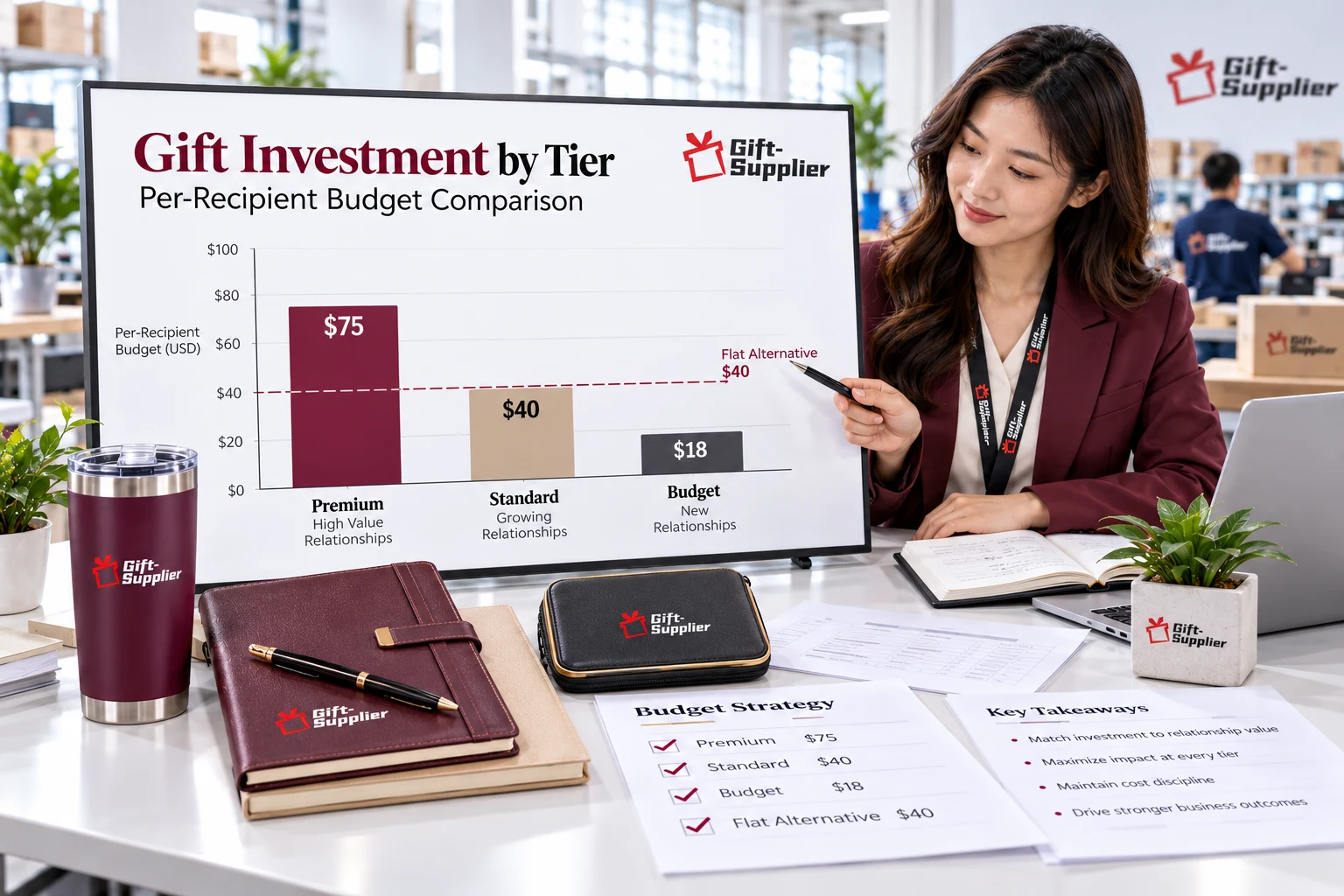
A marketing procurement lead has a $20,000 gifting budget for 500 recipients, scored and grouped into three tiers. Per-recipient budgets are set for the premium and standard tiers, and the budget tier receives the remainder.
| Tier | Recipients | Per-recipient budget | Tier total | Share of budget |
| Premium | 30 | $200.00 | $6,000 | 30% |
| Standard | 120 | $60.00 | $7,200 | 36% |
| Budget | 350 | $19.43 (rounded) | $6,800 | 34% |
| Total | 500 | — | $20,000 | 100% |
A flat approach would give every recipient $40 (500 × $40 = $20,000). Against that, the tiered plan gives each of the 30 premium recipients five times as much and each of the 350 budget-tier recipients roughly half as much. The ratios between adjacent tiers are about 3.3 to 1 (premium to standard) and 3.1 to 1 (standard to budget). A team might set its own guardrail on how wide the gap between adjacent tiers can be, and rely on shared presentation to keep the difference from feeling like a ranking.
Spotting Waste Before You Order
Premium spend is only worth making where it can land. The table below lists common signs that a premium or standard gift would be wasted, and what to do instead.
| Signal | Why spend is wasted | What to do instead |
| No engagement in your defined window | A premium gift to a dormant contact rarely changes the relationship | Move the contact to the budget tier, or hold the gift until engagement resumes |
| The same person appears on more than one list | Duplicate gifts double the cost with no added value | De-duplicate the recipient list before quoting |
| Recipient cannot accept gifts under their policy | The gift may be refused or returned, adding repacking and storage cost | Confirm acceptance rules first, or offer a non-gift alternative |
| Address or contact details unconfirmed | Failed deliveries add cost and delay | Verify addresses before shipping, and see the delivery-failure costs in our cost-per-recipient guide |
| Recipient count still shifting | Over-ordering premium items leaves surplus that is hard to reuse | Order the premium tier last, or in a smaller first batch |
Risks and Limitations of This Approach
- Scoring involves judgment; two scorers can rate the same account differently, so keep the rubric specific and record who scored and when.
- Scores go stale as relationships change; rescore before each program rather than reusing an old list.
- Tiers can still become visible through conversation or social media, even with consistent presentation, so treat the mitigations above as risk reduction, not elimination.
- Gift acceptance rules vary by recipient, employer, sector, and market, and the thresholds that apply are set by the recipient’s own policy and local law, not by this guide.
- Premium items can carry different landed-cost, duty, and compliance treatment than budget items, so quote each tier separately rather than scaling one quote.
- The segmentation example in this guide is illustrative; actual tier sizes, budgets, and outcomes will vary by program.
Request a Scoped Quote
If you are tiering a corporate gifting program, share your recipient counts by tier, target budget, destination markets, and timeline. Our team can help you request itemized quotes for each tier so the comparison is fair.
Prefer a lighter first step? Send us your tier counts and per-recipient budgets for a quick review before you request quotes.
Frequently Asked Questions
How many tiers should we use for premium vs budget corporate gifts?
Two or three tiers are usually enough. Each additional tier adds sourcing, packaging, and communication work, increasing the landed cost and creating more visible differences between recipients. Keeping tiers limited helps manage the procurement budget while balancing price trade-offs.
Can we give everyone the same gift and personalize only the note?
Yes. A single gift with personalized messaging is a valid option when recipients are likely to compare gifts or when relationship values are close. However, the price trade-offs may mean spending more on low-value contacts and less on top accounts than a tiered approach to premium vs budget corporate gifts.
What if a lower-tier recipient learns about the premium tier?
Tie differences to role or relationship stage in a way you can explain clearly, keep presentation consistent, and avoid language that sounds like ranking. When comparing premium vs budget corporate gifts, matching packaging and thoughtful presentation can help recipients appreciate their gifts without feeling overlooked.
Should recipients’ gift policies affect the tier they are placed in?
Yes. Check acceptance rules before ordering, since some recipients cannot accept gifts above a set value or cannot accept gifts at all. Considering these restrictions during procurement budget planning helps avoid refused gifts, unnecessary repacking, storage costs, and an increase in landed cost.
How does tiering relate to splitting a total budget across tiers?
Tiering decides who receives each level of gift, while budget allocation determines how the procurement budget is divided across those tiers, including a contingency reserve. Evaluate landed cost and price trade-offs before finalizing the allocation. See our budget allocation framework for guidance on dividing the total spend.
Sources and Further Guidance
UK Government — Bribery Act 2010 guidance
US Department of Justice — FCPA Resource Guide
International Chamber of Commerce — Incoterms® Rules
US International Trade Commission — Harmonized Tariff Schedule (HTS) search
UK Government — Trade Tariff: look up commodity codes, duty and VAT rates
Author & Reviewer
Written by Claire Morgan, Senior Content Writer, with professional experience comparing supplier quotes and pricing in downstream risk for branded merchandise programs.
Freshness & Update Log
- Published: October 11, 2026
- Last Reviewed: October 11, 2026
- Next scheduled review: within 12 months, or sooner if referenced anti-bribery, duty, or freight guidance changes materially.
Related Resources
- /promotional-products-budget-allocation/ — how to decide which portfolio tier a price-break decision should apply to.
- /questions-to-ask-a-promotional-product-supplier/ — 18 evidence-based questions to ask once quotes are in hand.
- /promotional-product-supplier-audit-checklist/ — the 25-point checklist for auditing a supplier before you award the order.
- /promotional-merchandise-vendor-consolidation/ — how vendor consolidation interacts with ongoing performance scoring.