
A promotional products procurement scorecard that procurement teams will actually use should weight five KPI categories — quality, delivery, cost, service, and compliance — and combine them into a single weighted score using a defined formula, rather than tracking five unweighted numbers side by side. This guide is written for procurement managers overseeing ongoing vendor performance for branded merchandise programs in US and UK markets, who already have at least one active supplier relationship generating order history to score. It assumes the buyer wants a repeatable scoring method for existing vendors, not a one-time pre-award evaluation. The scorecard below is built to be recalculated on a regular cycle, not filled out once and filed away.
Most vendor scorecards fail for the same reason: they track everything and weight nothing, so a strong delivery record and a weak compliance record produce the same flat number as the reverse. A working promotional products procurement scorecard should let one program weight compliance heavily because the category is regulated, while another weights cost and delivery because it is a high-volume, low-risk giveaway program. The sections below provide the five KPI categories, a weighting framework, a worked scoring calculation, and an illustrative two-vendor comparison.
Figures, weight ranges, and scores used as examples in this article are illustrative only. Set actual weights and scoring scales based on your own program’s risk profile and available data.
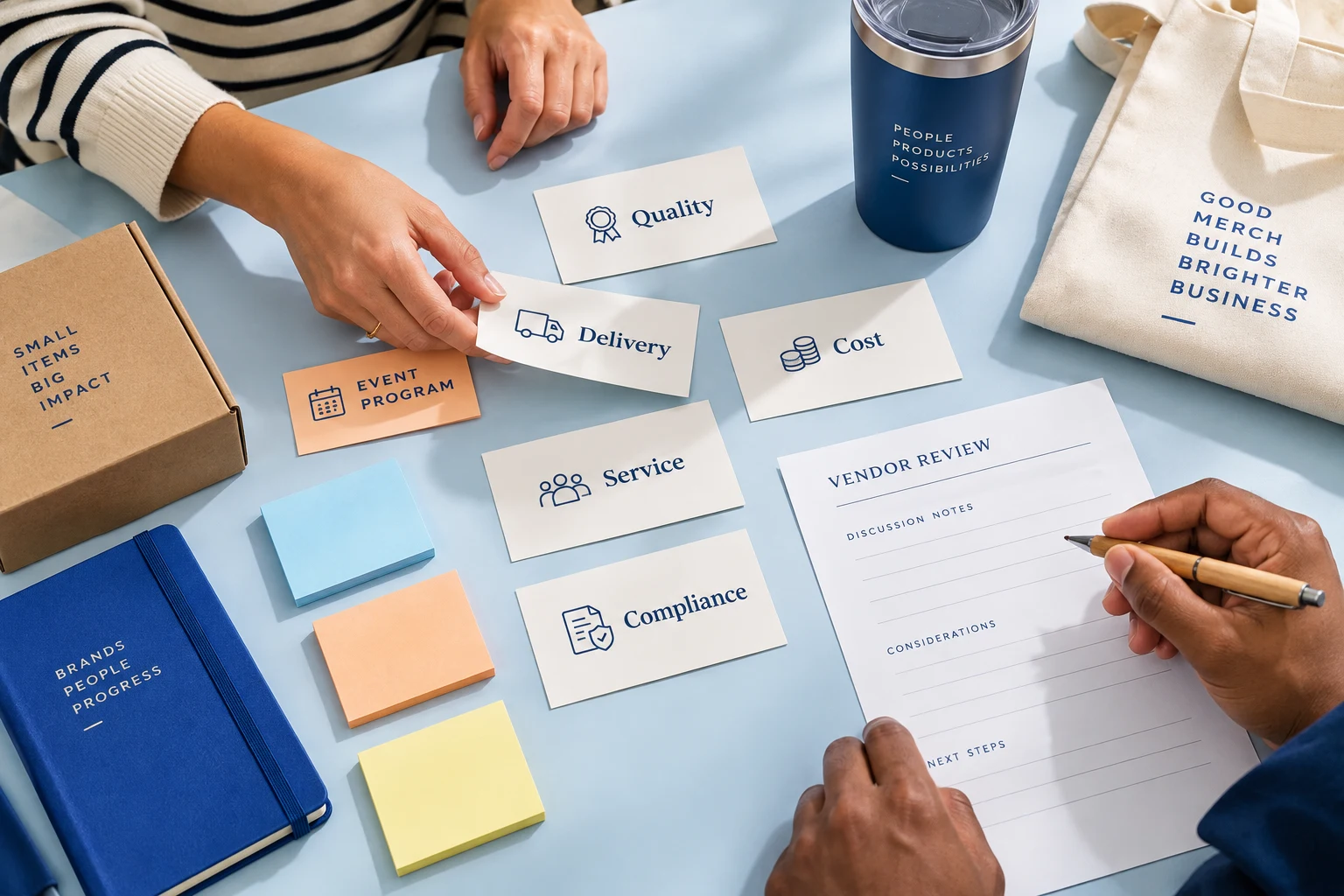
Why Procurement Needs a Scorecard It Will Actually Use
A scorecard that lists five separate numbers without combining them into one weighted result tends to get filled in once and then ignored, because it does not produce a clear answer to “is this vendor performing well overall.” A weighted promotional products procurement scorecard solves that by forcing an explicit choice about what matters most for a given program, then producing one number that reflects that choice.
The same structure also makes vendor comparisons and reorder decisions defensible. Instead of a general impression that “Vendor A feels more reliable,” a weighted score shows exactly which categories drove the difference, and by how much.
The Five KPI Categories and What They Measure
Use the table below as the foundation for the scorecard. Each category should map to data your team can actually capture, not just a general impression.
| KPI category | What it measures | Example metric | Typical weight range |
| Quality | Conformance to the approved specification and golden sample | Defect rate on inspected units | 25%–35% |
| Delivery | On-time and complete delivery against the confirmed schedule | On-time-in-full (OTIF) rate | 20%–30% |
| Cost | Total cost performance relative to the agreed quote, not unit price alone | Quoted vs. actual landed cost variance | 15%–25% |
| Service | Responsiveness and proactive communication | Average response time to a request | 10%–20% |
| Compliance | Documentation accuracy and currency for the product category | Compliance document exceptions found | 10%–20% |

Setting the Scoring Scale
Score each category on a consistent 1–5 scale, with a plain-language definition for each level so different reviewers score the same way.
| Score | Definition |
| 1 | Unacceptable — recurring, unresolved failures in this category |
| 2 | Below expectations — noticeable gaps that require follow-up |
| 3 | Meets expectations — performs to the agreed standard with minor exceptions |
| 4 | Strong — consistently exceeds the agreed standard |
| 5 | Exceptional — verified, sustained performance with no exceptions in the review period |
Buyer Framework: How to Build and Weight the Scorecard
The steps below turn the five categories into a working scorecard, with a clear decision owner — typically the category procurement manager, with input from quality, logistics, and compliance leads on their respective categories.
- Select the five KPI categories — quality, delivery, cost, service, and compliance — as the scorecard’s foundation.
- Assign a weight to each category that reflects your program’s risk profile; a compliance-sensitive program should weight compliance higher than a low-risk giveaway program.
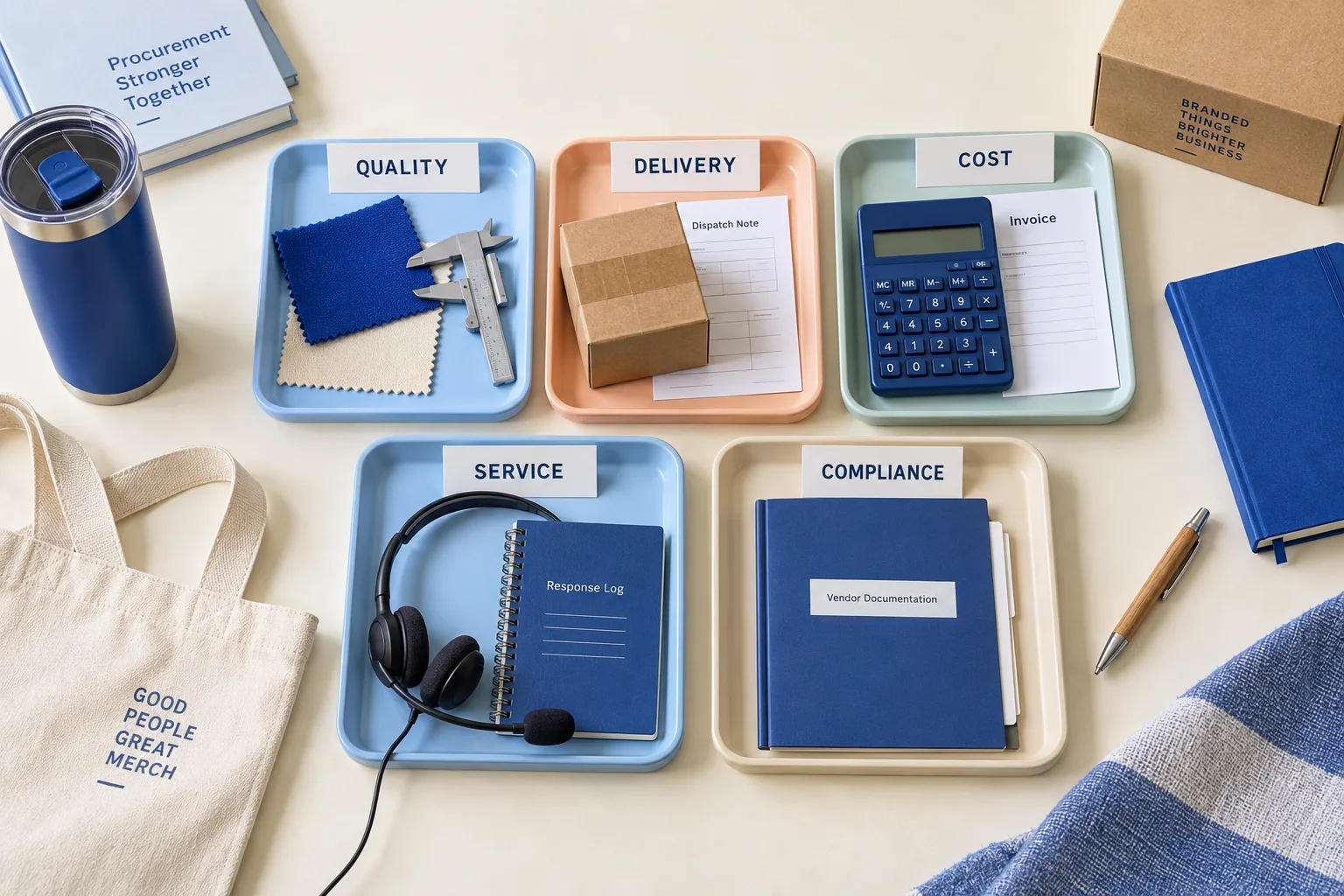
- Define one or two measurable metrics per category, tied to data you can actually capture, such as inspection reports, delivery records, invoices, or response logs.
- Set the 1–5 scoring scale for each metric, using the plain-language definitions above so scoring stays consistent across reviewers.
- Calculate each vendor’s weighted total score using the formula below, on a consistent review cycle such as quarterly.
- Review scores with the vendor directly, not only internally — a scorecard that isn’t shared rarely changes vendor behavior.
- Revisit category weights annually, or whenever program risk changes, since a static scorecard becomes stale.
Our team can help set up a vendor scorecard process as part of an ongoing sourcing relationship — see promotional product sourcing for how we support procurement teams with vendor performance tracking.
The Scoring Formula: How to Calculate a Weighted Vendor Score
Once each category has a weight and a 1–5 score, calculate the weighted total using the formula below.
Weighted Vendor Score = Σ (Category Score × Category Weight), summed across all five categories, producing a single score out of 5.
Worked example, using illustrative weights of Quality 30%, Delivery 25%, Cost 20%, Service 15%, and Compliance 10%, and a vendor scoring 4 on quality, 5 on delivery, 3 on cost, 4 on service, and 5 on compliance:
- Quality: 4 × 0.30 = 1.20
- Delivery: 5 × 0.25 = 1.25
- Cost: 3 × 0.20 = 0.60
- Service: 4 × 0.15 = 0.60
- Compliance: 5 × 0.10 = 0.50
- Weighted total: 1.20 + 1.25 + 0.60 + 0.60 + 0.50 = 4.15 out of 5
Evidence From the Field: Illustrative Two-Vendor Scorecard
The example below is an illustrative scorecard comparison created to show how weighting changes the outcome. Replace the sample scores with your own verified vendor data before presenting this as a real comparison.
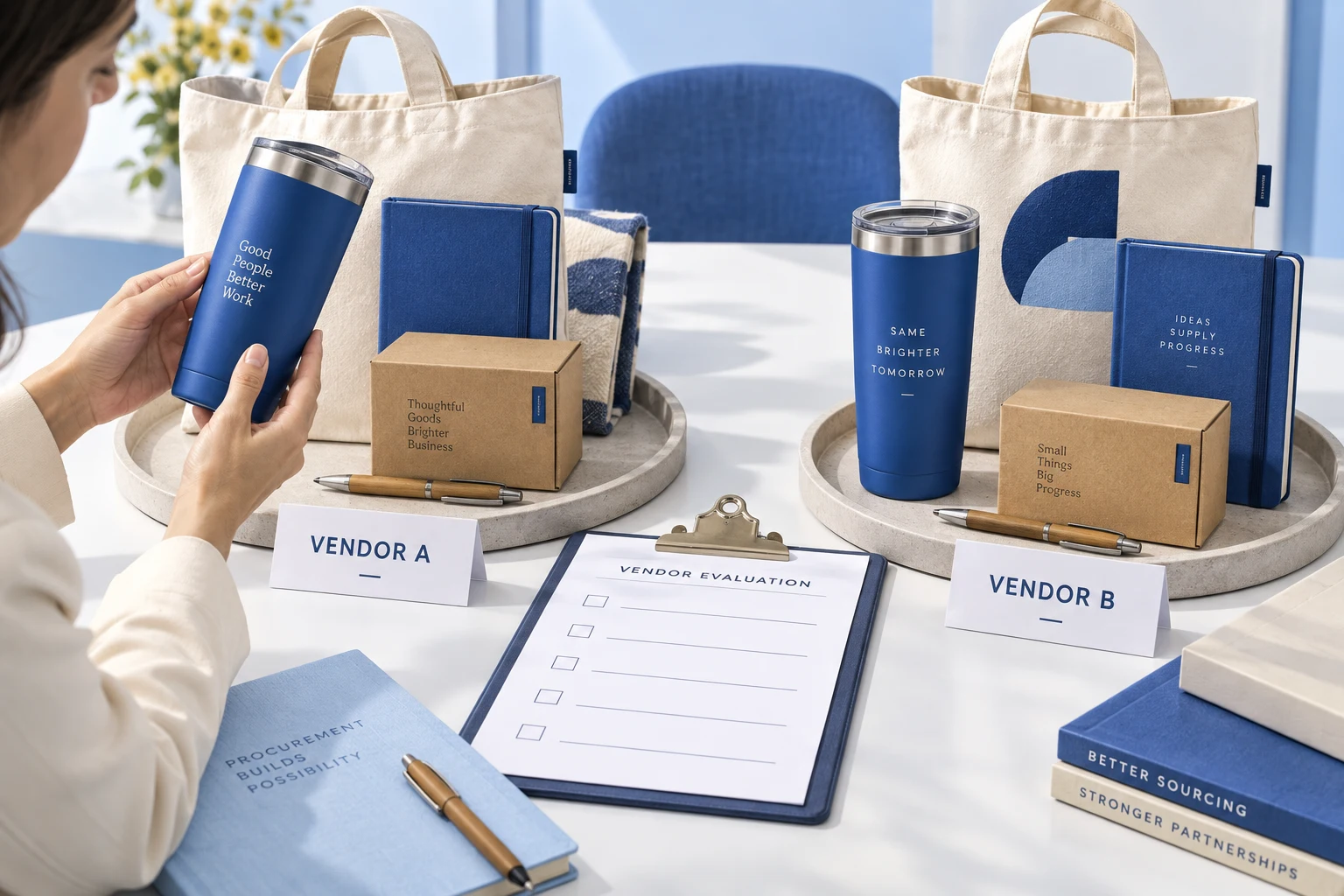
A procurement team scores two vendors supplying the same branded merchandise category, using identical weights across both.
| KPI category | Weight | Vendor A score (illustrative) | Vendor B score (illustrative) |
| Quality | 30% | 4 | 5 |
| Delivery | 25% | 5 | 3 |
| Cost | 20% | 3 | 4 |
| Service | 15% | 4 | 3 |
| Compliance | 10% | 5 | 4 |
| Weighted total | 100% | 4.15 | 3.90 |
In this illustrative comparison, Vendor B scored higher on quality alone, but Vendor A’s stronger delivery and service performance produced a higher weighted total once the program’s actual category weights were applied. Without weighting, a simple average would have understated how much delivery reliability mattered to this particular program.
Setting KPI Weights by Program Type
The right weighting depends on the program, not a fixed industry standard. Use the table below as a starting point for adjusting weights to your specific program.
| Program type | Suggested emphasis | Category to weight higher |
| High-volume, low compliance risk | Emphasize cost and delivery efficiency | Cost, Delivery |
| Compliance-sensitive category (children’s products, food-contact) | Emphasize compliance and quality | Compliance, Quality |
| Event-driven or date-critical program | Emphasize delivery reliability above other factors | Delivery |
| New or unproven vendor relationship | Emphasize service and responsiveness during onboarding | Service, Quality |
| Strategic, high-spend consolidated vendor | Balanced weighting across all five categories, reviewed most frequently | Balanced across all five |
Data Sources for Each KPI Category
A scorecard is only as reliable as the data behind it. The table below shows where each category’s data typically comes from and who is best placed to collect it.
| KPI category | Data source | Who collects it |
| Quality | Inspection reports and return or defect logs | Quality / QC owner |
| Delivery | Purchase order records and shipment tracking | Procurement or logistics |
| Cost | Invoices compared against the original quote and landed cost worksheet | Procurement or finance |
| Service | Response time logs and escalation records | Procurement manager |
| Compliance | Compliance document log and exception reports | Compliance or quality |

Risks and Limitations of This Scorecard
- A scorecard is only as reliable as the underlying data; inconsistent record-keeping across categories will distort the weighted score.
- Static weights can misrepresent a program that has changed since the scorecard was last set; revisit weights when program risk changes.
- A single low score in one review cycle does not necessarily indicate an ongoing pattern; review trend data across multiple cycles before acting on a score.
- Compliance scoring reflects documentation review, not a guarantee of product safety; treat it as one input, not a certification.
- This scorecard structure is a starting framework; regulated or safety-critical categories may need additional category-specific KPIs.
- The two-vendor example in this guide is illustrative; actual scores depend on your own data, weighting choices, and review period.
Request a Scoped Quote
If you are setting up ongoing vendor performance tracking for a branded merchandise program, share your current vendor relationships, program categories, and review cadence. Our team can help structure a scorecard for your specific programs.
Prefer a lighter first step? Send us your current vendor performance data for a quick scorecard structure review.
Frequently Asked Questions
How often should the scorecard be recalculated?
A quarterly cycle is a reasonable default for most branded merchandise programs, though a high-volume or compliance-sensitive program may warrant monthly review. The right frequency depends on how quickly enough order history accumulates to produce a meaningful score. A promotional products procurement scorecard should be reviewed whenever there is enough new performance data to support an accurate assessment.
Should every vendor be scored on the same weights?
Not necessarily. Weights should reflect the specific program’s risk profile, as shown in the weighting-by-program-type table above. Two vendors supplying very different categories may reasonably use different weight distributions. This makes vendor evaluation more relevant to each program’s requirements.
What should trigger a vendor review meeting versus routine tracking?
A significant drop in the weighted total, a failing score in any single high-weight category, or a compliance exception are reasonable triggers for a direct review meeting, rather than waiting for the next scheduled cycle. These triggers can be incorporated into the procurement process for consistent vendor monitoring.
Can a scorecard replace a supplier audit?
No. A scorecard tracks ongoing performance using existing order data, while an audit verifies documentation and capability before or independent of order history. Supplier due diligence should therefore include both ongoing scorecard tracking and appropriate supplier audits. See our 25-point supplier audit checklist for the pre-order and periodic audit process this scorecard complements.
What if a vendor disputes their score?
Share the underlying data behind each category score, not just the final number, since a dispute usually points to a data or definition gap rather than disagreement with the scoring method itself. Reviewing the raw records together supports transparent vendor evaluation and tends to resolve most disputes faster than defending the score alone.
Sources and Further Guidance
US Consumer Product Safety Commission — Children’s Product Certificate
California OEHHA — Proposition 65 Frequently Asked Questions for Businesses
UK Government — Placing Manufactured Products on the Market in Great Britain
Google Search Central — Creating Helpful, Reliable, People-First Content
Author & Reviewer
Written by Claire Morgan, Senior Content Writer, with professional experience building vendor performance scorecards for branded merchandise programs.
Freshness & Update Log
- Published: September 22, 2026
- Last Reviewed: September 22, 2026
- Next scheduled review: within 12 months, or sooner if referenced regulatory guidance changes.
Related Resources
- /questions-to-ask-a-promotional-product-supplier/ — 18 evidence-based questions to ask once quotes are in hand.
- /promotional-product-supplier-audit-checklist/ — the 25-point checklist for auditing a supplier before you award the order.
- /promotional-merchandise-vendor-consolidation/ — how vendor consolidation interacts with ongoing performance scoring.