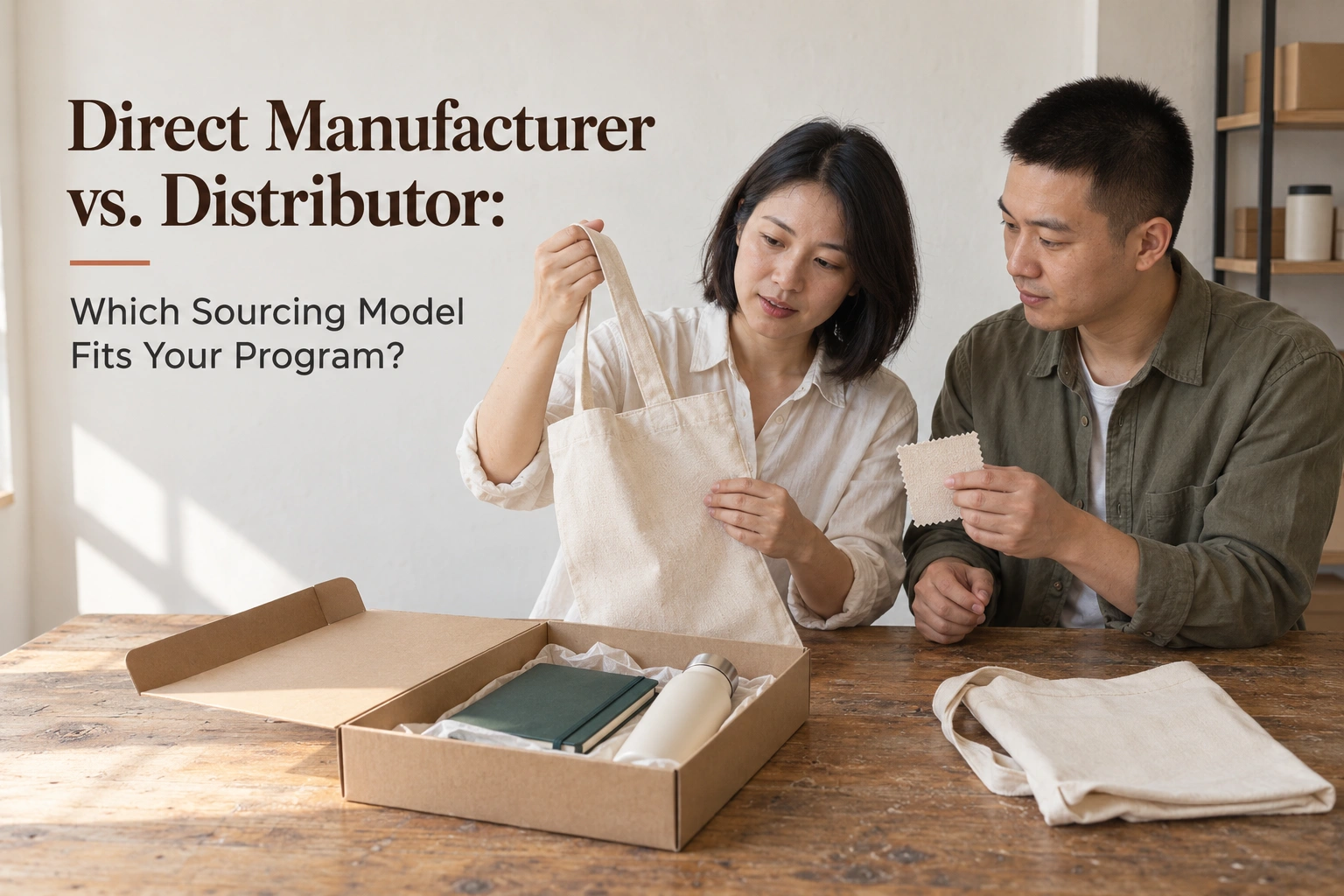
A direct manufacturer typically gives a buyer more control over production, materials, and cost at higher volume, while a promotional products distributor typically offers broader assortment, lower minimum order quantities, and a single point of accountability across multiple factories. Understanding direct manufacturer vs promotional products distributor is an important part of the procurement process for businesses comparing sourcing models.
This guide is written for procurement managers sourcing branded merchandise for mid-market and enterprise programs in US and UK markets, comparing one viable manufacturer option against one viable distributor option for the same specification. It assumes the buyer already has a product brief, target quantity, and delivery date, and is deciding which sourcing model to run the order through, not which specific vendor to select.
Neither model is categorically cheaper or faster. The right choice depends on order volume, SKU complexity, internal quality-control capacity, and how much accountability risk the buyer is willing to hold directly. The sections below compare both models on six verifiable criteria, walk through a repeatable decision framework, and show an illustrative side-by-side quote comparison.
Figures, quantities, and cost components used as examples in this article are illustrative only. Confirm actual MOQ, lead time, and landed cost directly with each vendor for your specific product and market.
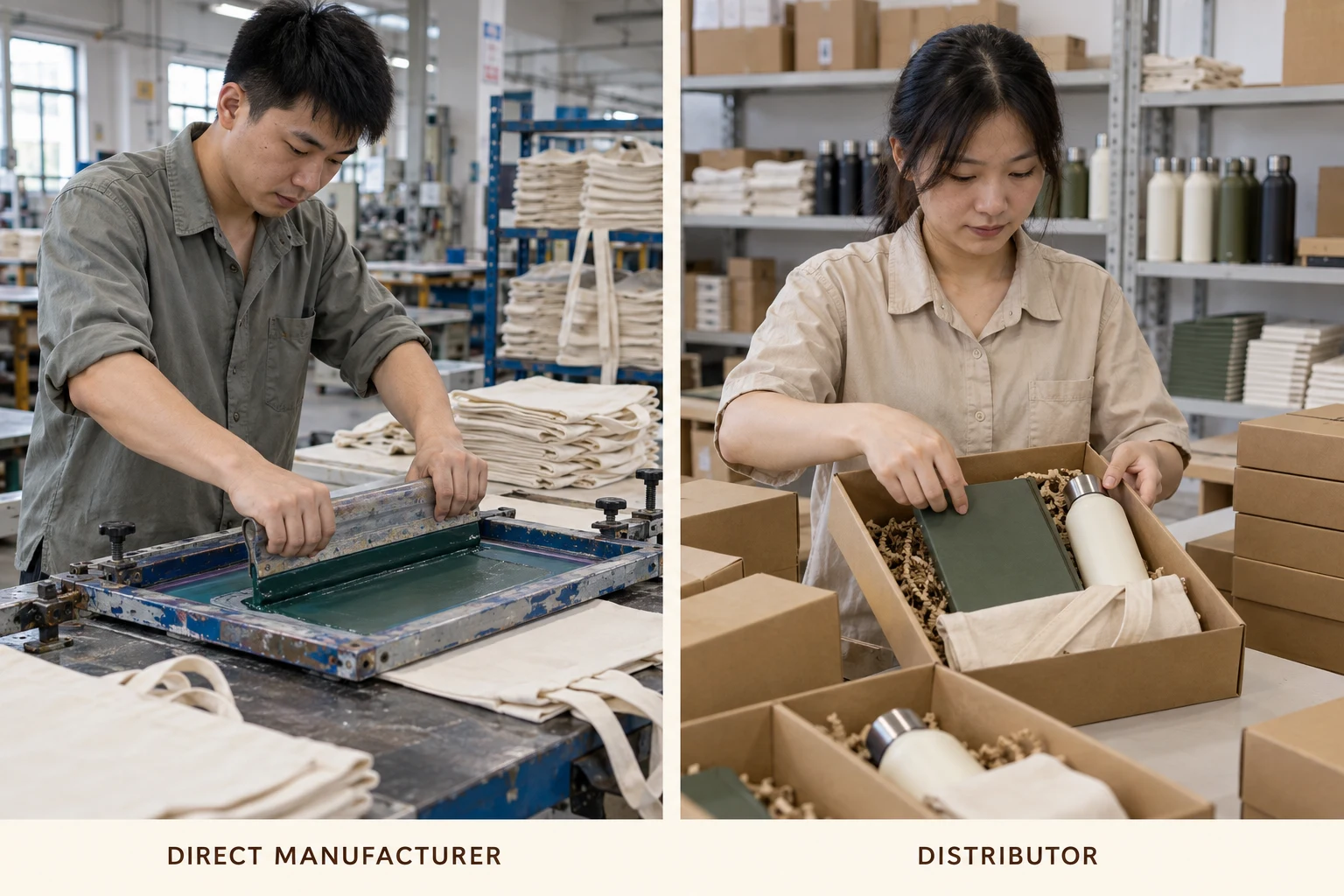
Why the Sourcing Model Decision Matters
The choice between a direct manufacturer and a promotional products distributor is often made by default, based on whichever vendor responded first, rather than by comparing the two models against the program’s actual requirements. That default approach can leave cost, speed, or accountability on the table.
A direct manufacturer vs. promotional products distributor comparison becomes especially important once a program grows past a single order: the model that fit a 500-unit pilot may not fit a 20,000-unit annual program with multiple SKUs and a compliance-sensitive category.
Decision Table: Direct Manufacturer vs. Distributor
Compare both models against the six criteria below using evidence you can verify — a quote, a written policy, or a contract term — rather than a general sales claim.
| Criterion | Direct manufacturer | Promotional products distributor | What to verify |
| Control over production | Direct line of sight into materials, decoration method, and factory floor | Limited visibility; production is managed through the distributor’s supplier network | Ask who has direct factory contact and how change requests are handled |
| Assortment breadth | Typically narrower, centered on the factory’s own product range | Typically broader, sourced across multiple factories and categories | Request a catalog scope relevant to your program’s SKU mix |
| MOQ flexibility | Often higher MOQ tied to a single factory’s production runs | Often lower MOQ, since the distributor can combine demand across clients | Get MOQ in writing for your specific product and quantity |
| Speed to first order | Can be slower to onboard as a new account; faster once established | Often faster to a first order, drawing on existing supplier relationships | Compare stated onboarding and first-order timelines in writing |
| Accountability for problems | Single party responsible, but may have limited service infrastructure | Single point of contact even when multiple factories are involved | Confirm in writing who owns resolution if a shipment or QC issue occurs |
| Landed cost transparency | Cost structure closer to factory price, but buyer absorbs more coordination | Cost may include distributor margin and service fees, often bundled | Request an itemized quote showing product, freight, duties, and service fees separately |
Best-Fit Scenarios by Program Characteristic
Use the table below as a starting guide for which model tends to fit a given program characteristic. Confirm against your own volume, timeline, and internal resources before deciding.
| Program characteristic | Direct manufacturer likely fits when… | Distributor likely fits when… |
| Order volume | Volume is high and consistent enough to justify a dedicated factory relationship | Volume is smaller, seasonal, or spread across many low-quantity SKUs |
| SKU variety | The program centers on one or two product types at scale | The program spans many product categories from different factories |
| Internal QC resources | The buyer’s team can manage proofing, QC, and factory communication directly | The buyer prefers a single vendor to manage QC and factory coordination |
| Timeline | There is enough lead time to onboard and manage a new factory relationship | The order needs a faster first-order turnaround through an established network |
| Compliance category | The buyer’s team can verify compliance documentation factory-by-factory | The buyer wants one vendor accountable for compliance documentation across SKUs |
Buyer Framework: How to Choose the Right Sourcing Model
The steps below give procurement teams a repeatable way to compare a manufacturer and a distributor for the same program, with a clear decision owner — typically the category procurement manager running the sourcing decision.
- Define program characteristics first: order volume, SKU variety, timeline, internal QC capacity, and compliance category.
- Request comparable, itemized quotes from at least one manufacturer and one distributor for the identical specification and quantity.
- Compare both quotes against the decision table criteria above, not unit price alone.
- Confirm accountability terms in writing for both options — specifically who owns resolution for a late shipment or failed QC.
- Calculate total landed cost for each option, including freight, duties, and any service fees, not just the quoted unit price.
- Run a smaller pilot order with the preferred option when timeline and order structure allow it.
- Document the model decision and the criteria behind it, so the comparison can be revisited if volume, SKU mix, or compliance requirements change.
Our team can help run this comparison against your own program specifications — see promotional product sourcing for how we support procurement teams through this decision.
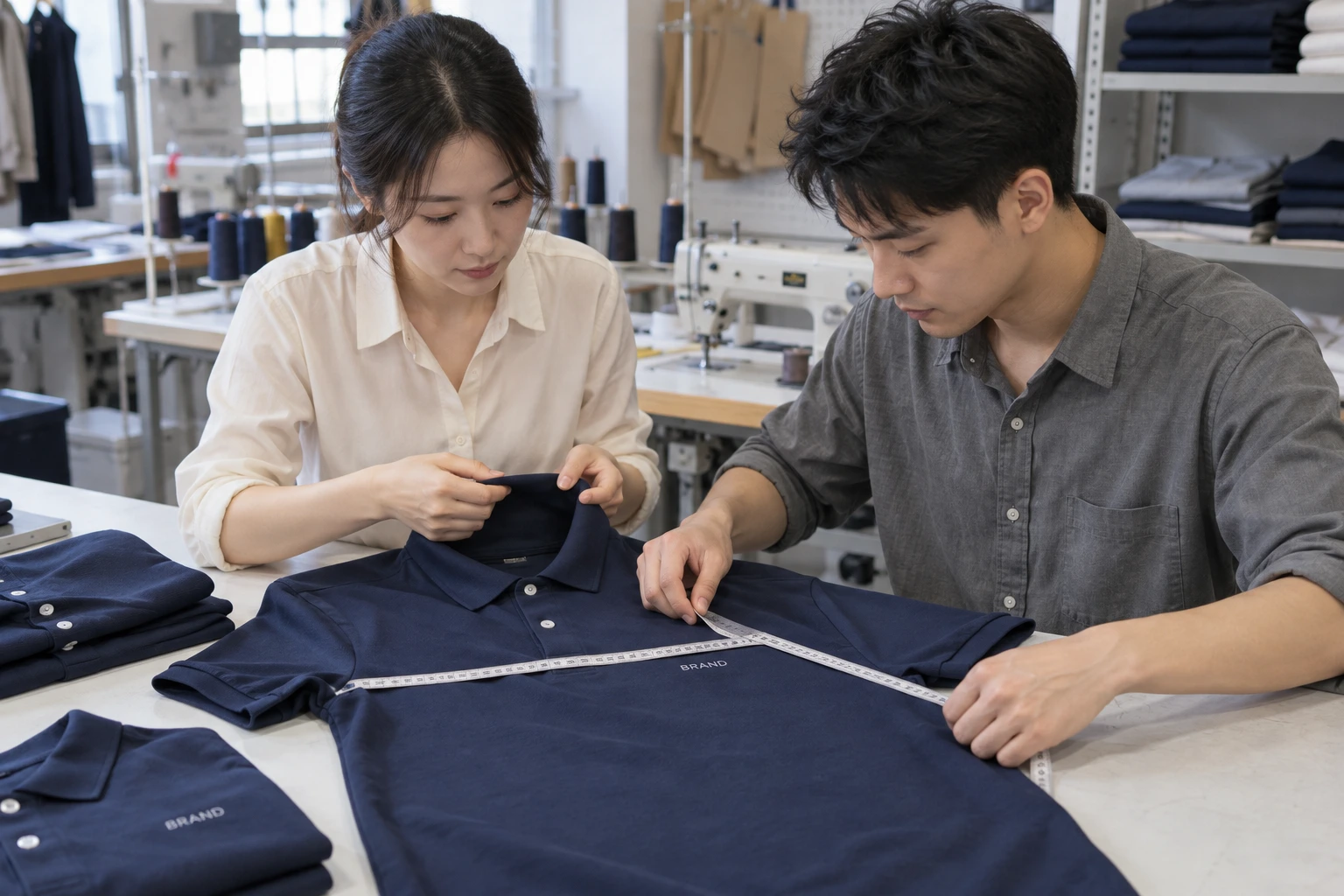
Evidence From the Field: Illustrative Quote Comparison
The example below is an illustrative sourcing-model comparison created to show how the decision table applies in practice. Replace the sample figures with verified quotes before presenting this as a real case study.
A mid-market retail brand requests quotes for the same branded apparel program from one direct manufacturer and one promotional products distributor, using an identical specification and target quantity.
| Factor | Manufacturer quote (illustrative) | Distributor quote (illustrative) |
| Unit price | Lower quoted unit price, factory-direct | Higher quoted unit price, includes distributor margin |
| Minimum order quantity | Higher MOQ tied to the factory’s standard production run | Lower MOQ, combined with other client demand |
| Lead time to first order | Longer, due to new-account onboarding at the factory | Shorter, drawing on an existing supplier relationship |
| Included services | Buyer manages proofing and QC directly with the factory | Distributor manages proofing, QC, and kitting as part of the quote |
| Accountability | Buyer is the direct point of contact with the factory | Distributor is the single point of contact across its supplier network |
In this illustrative scenario, the manufacturer’s lower unit price was partly offset by the buyer’s added coordination time and a higher MOQ than the program needed in its first year. The distributor’s bundled proofing and QC services became a relevant factor once total landed cost and internal labor were included, not just the quoted unit price.
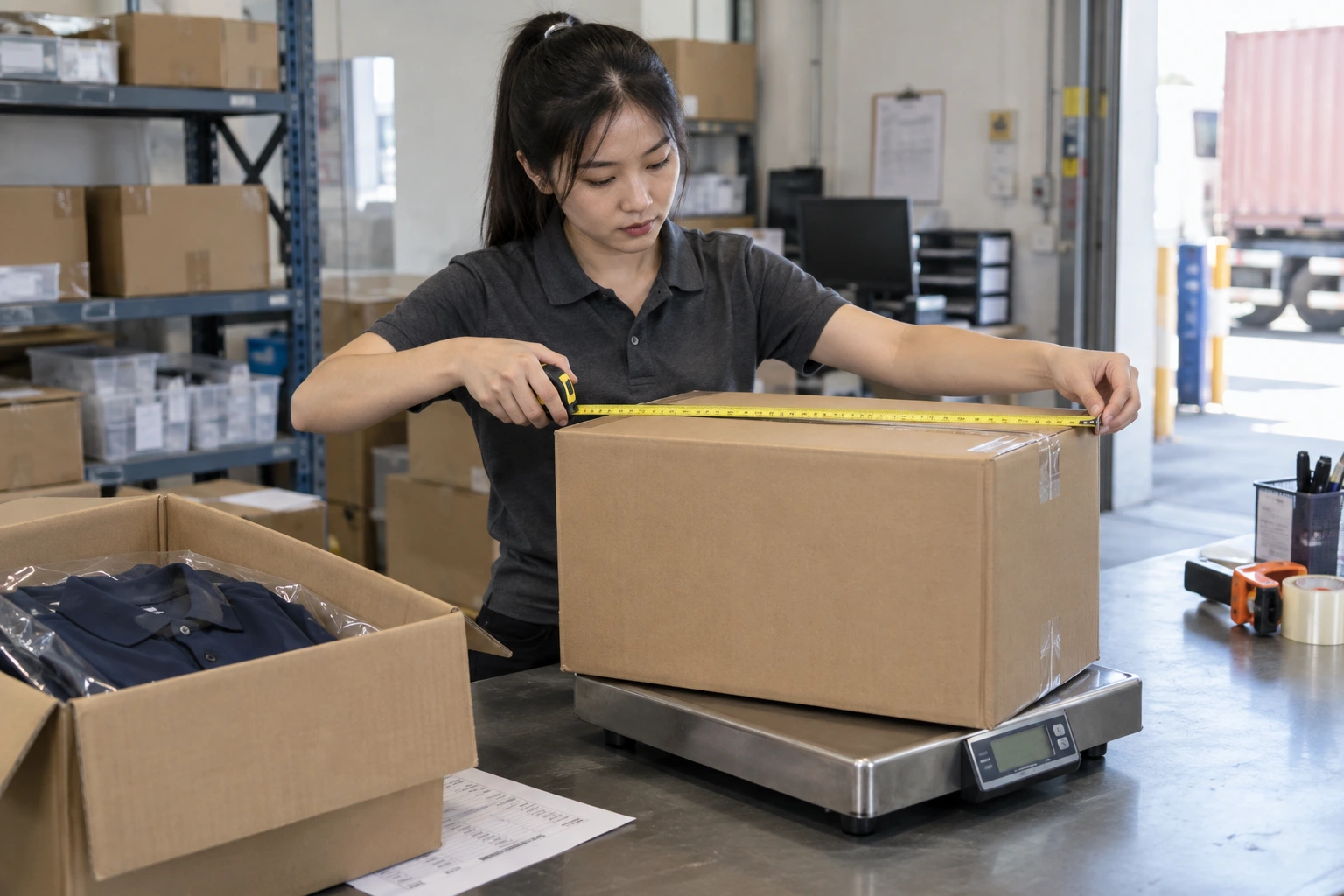
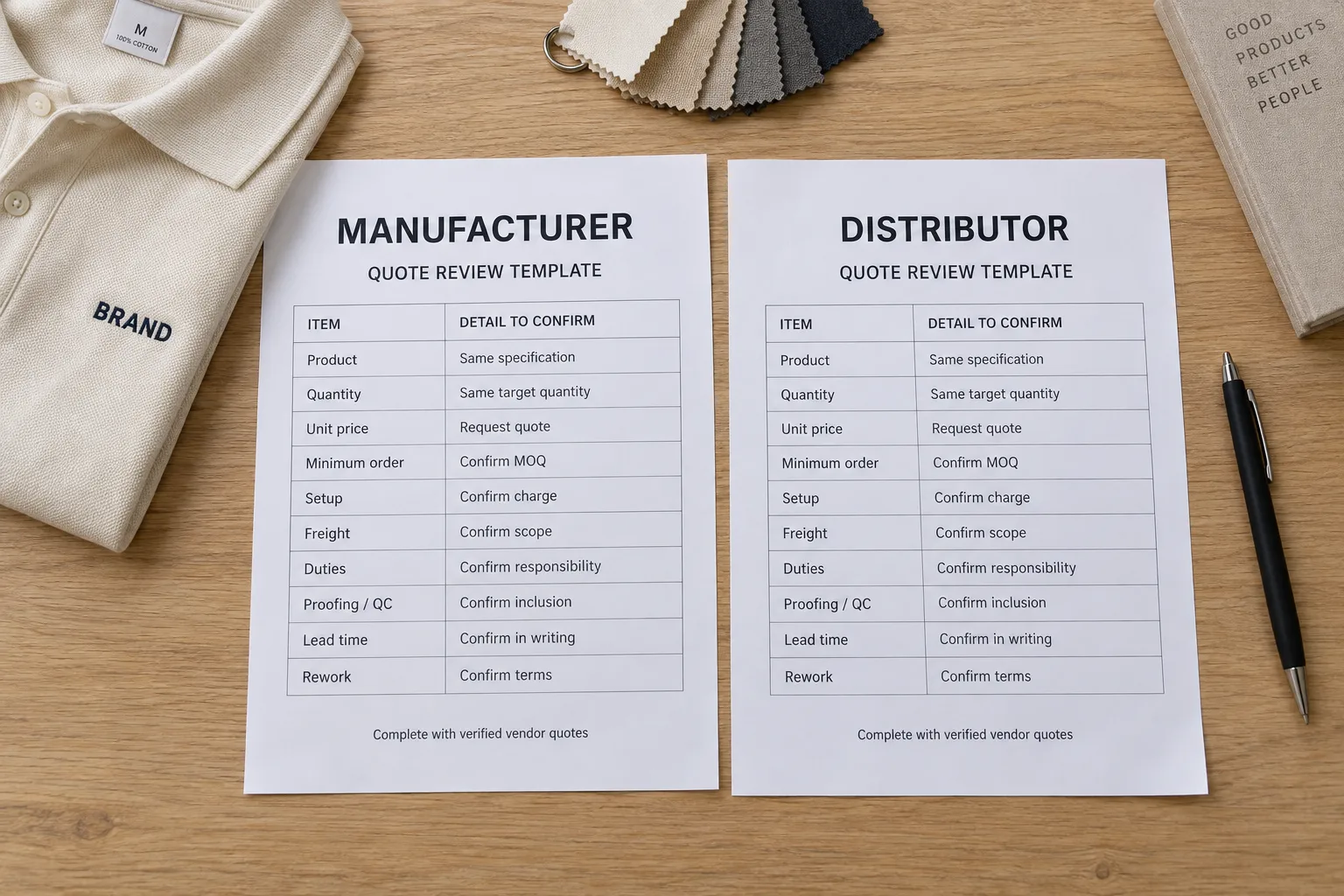
Total Landed Cost Checklist
Unit price alone does not show the full cost of either sourcing model. Use the checklist below to request a complete, itemized cost breakdown from both a manufacturer and a distributor before comparing quotes.
| Cost component | Ask the manufacturer | Ask the distributor |
| Tooling or setup | Confirm tooling cost and whether it is a one-time or per-run charge | Confirm whether tooling is included, passed through, or waived |
| Freight and logistics | Confirm who arranges freight and which Incoterms rule applies | Confirm whether freight is bundled into the quoted unit price |
| Duties and customs | Confirm who is responsible for duties at the destination market | Confirm whether customs handling is included in the service fee |
| Proofing and QC | Confirm whether proofing and QC are billed separately | Confirm what proofing and QC services are included in the quote |
| Rework or reproduction | Confirm the cost and timeline if a reproduction is required | Confirm whether reproduction cost is covered under the distributor’s terms |
Risks and Limitations of This Comparison
- Neither model is categorically cheaper, faster, or lower-risk; outcomes depend on the specific vendor, product, and market.
- A distributor’s supply chain visibility is only as strong as its own supplier due diligence process, which buyers should confirm rather than assume.
- A direct manufacturer relationship shifts more coordination and QC workload onto the buyer’s own team, which requires internal capacity.
- Compliance documentation requirements vary by product, market, and category and should be confirmed for the exact SKU under either model.
- Switching sourcing models mid-program can carry its own transition cost and should be planned for, not assumed to be seamless.
- The quote comparison in this guide is illustrative; actual pricing, MOQ, and lead time will vary by vendor and season.
Request a Scoped Quote
If you are comparing a manufacturer and a distributor for an upcoming program, share your product specifications, target quantity, timeline, and destination market. Our team can help run this comparison against your program’s actual requirements.
Prefer a lighter first step? Send us your manufacturer and distributor quotes for a landed-cost comparison review before you commit to either model.
Frequently Asked Questions
Can a Procurement Team Use Both Sourcing Models When Comparing Direct Manufacturer vs Promotional Products Distributor?
Yes. Many programs use a direct manufacturer for a high-volume core SKU and a distributor for lower-volume or seasonal items. The direct manufacturer vs promotional products distributor comparison can be applied separately to each SKU category rather than to the program as a whole.
Does Going Direct to a Manufacturer Always Reduce Landed Cost in the Procurement Process?
Not always. A lower unit price from a manufacturer can be offset by a higher MOQ, added freight and customs coordination, and internal labor spent managing proofing and QC directly. Total landed cost, not unit price, is the more reliable comparison during the procurement process.
Who Is Accountable If a Distributor-Sourced Product Fails Compliance During Vendor Evaluation?
This should be confirmed in writing before ordering, since accountability terms vary by distributor contract. As part of vendor evaluation, buyers should review compliance documentation directly rather than relying solely on a distributor’s assurance. See our promotional product compliance resource for what documentation to request.
When Does a Low MOQ Make a Distributor the Better Fit in the Procurement Process?
When order volume is small, seasonal, or spread across many SKUs, a distributor’s ability to combine demand across clients can make a lower MOQ available than a single factory would offer a new direct account. This can be an important consideration during the procurement process.
How Should We Evaluate a Distributor’s Own Supplier Due Diligence?
Ask the distributor to share how it audits its own factory network, including compliance documentation practices and recovery terms. During supplier due diligence, applying the same evaluation criteria used for a direct manufacturer to the distributor’s underlying suppliers is a reasonable starting point.
Sources and Further Guidance
International Chamber of Commerce — Incoterms® Rules
US Consumer Product Safety Commission — Children’s Product Certificate
California OEHHA — Proposition 65 Frequently Asked Questions for Businesses
UK Government — Placing Manufactured Products on the Market in Great Britain
Author & Reviewer
Written by Claire Morgan, Senior Content Writer, with professional experience comparing manufacturer and distributor sourcing models for branded merchandise programs.
Freshness & Update Log
- Published: September 17, 2026
- Last Reviewed: September 17, 2026
- Next scheduled review: within 12 months, or sooner if referenced trade or compliance guidance changes.
Related Resources
- /promotional-product-sourcing/ — primary commercial page: request a scoped quote and sourcing review.
- /promotional-product-supplier-audit-checklist/ — the 25-point checklist for auditing either a manufacturer or a distributor before you order.
- /promotional-product-compliance/ — category-specific compliance requirements and documentation.
- /supplier-onboarding-guide/ — how new suppliers are onboarded and audited after selection.