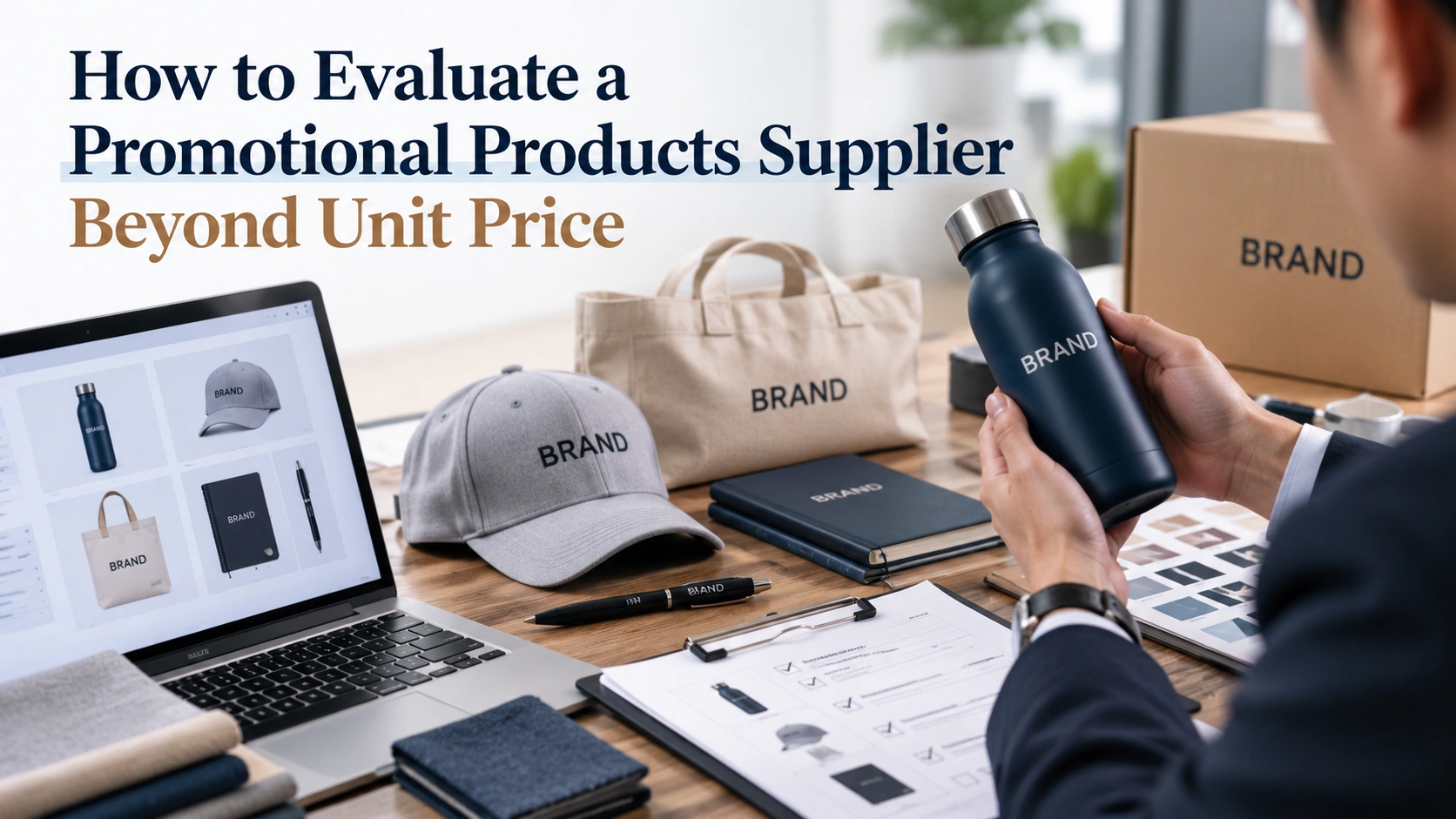
Evaluating a promotional products supplier requires more than comparing unit prices. Buyers should also review communication, proofing accuracy, product-specific testing and compliance, production capacity, traceability, and the supplier’s written recovery process. This guide provides a practical scorecard and due diligence checklist for procurement teams comparing shortlisted suppliers.
Unit price is one part of the decision. It does not show total landed cost, quality risk, delivery risk, or compliance responsibilities. The framework below helps buyers compare suppliers using documented evidence rather than sales claims.
This guide is written for procurement managers sourcing branded merchandise, apparel, and giveaways in US and UK markets. It assumes buyers already have a shortlist of two to four suppliers and need a repeatable way to compare them. Figures and thresholds used as examples in this article are illustrative only and should be adjusted to your product, project risk, and company purchasing policy.

Why Total Cost and Risk Matter More Than Price Alone
A quoted unit price reflects one moment: the cost of goods at one quantity, under stated conditions. It does not show what happens if artwork is misread, a material substitution occurs, or a shipment is delayed. Buyers who compare suppliers on price alone risk discovering the full cost later, through rework, expedited freight, or a missed delivery date.
A structured supplier evaluation treats price as one factor inside a wider comparison, alongside total landed cost and risk. The criteria that matter most in practice are the ones a buyer can verify before signing a purchase order: how the supplier communicates, how they proof, how they test and document compliance, how much capacity they can support, how they trace materials, and what they do when something goes wrong.
The Supplier Evaluation Scorecard: 6 Criteria Beyond Price
Score each shortlisted supplier against the six criteria below. Use the scoring guide first, then apply the weighting rule so that critical requirements are not averaged away by strong scores elsewhere.
Scoring Guide
| Score | Meaning |
| 1 | Unacceptable or unsupported |
| 2 | Significant gaps or high risk |
| 3 | Acceptable with conditions |
| 4 | Strong and well documented |
| 5 | Fully verified and exceeds the project requirement |
Weighting rule: Weight the criteria according to project risk. Compliance, safety, intellectual-property, and mandatory delivery requirements should be treated as pass-or-fail conditions rather than averaged into the total score.
| Criterion | What to verify | Evidence to request | Example red flag |
| Responsiveness | Time to a substantive reply that answers the buyer’s specific question | Correspondence timestamps across at least two real inquiries | Repeatedly misses the agreed response time or does not answer the question asked |
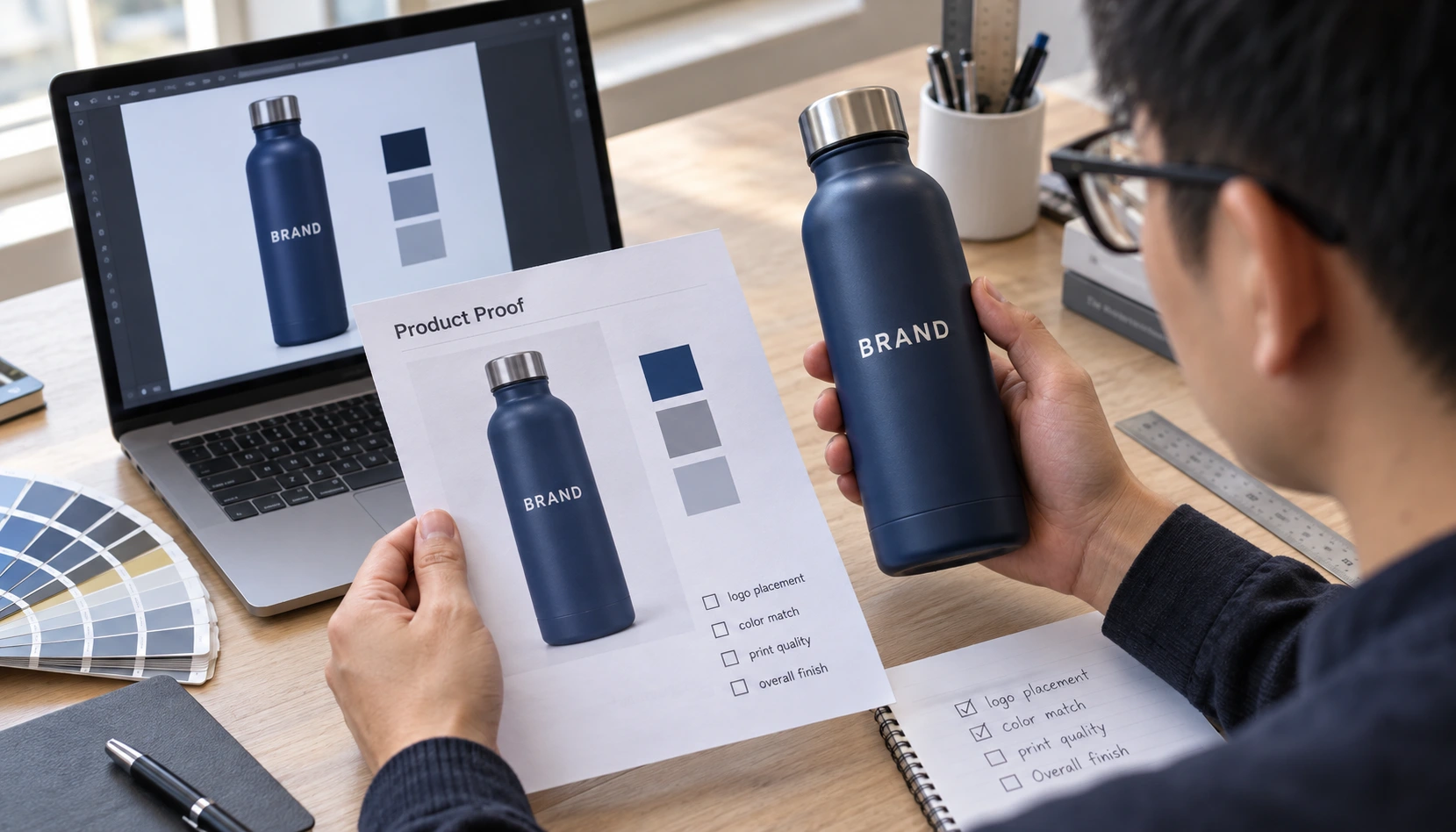
| Proofing accuracy | Match to approved artwork, dimensions, colors, and placement | Digital mockup, physical sample, or pre-production proof compared to the approved file | Repeatedly submits proofs that do not match the approved artwork, dimensions, colors, or placement |
| Testing & compliance | Requirements applicable to the selected product, intended users, destination market, and sales channel | Current test reports, declarations, certificates, labels, or warnings matching the exact product and configuration | Documents for a different product, SKU, material, color, age grade, factory, or destination market; expired or incomplete reports; or an unverifiable laboratory |
| Production capacity | Stated capacity and production schedule against your project volume | Written capacity statement, facility audit note, or production schedule, including any subcontracted processes | Capacity claim with no facility, schedule, or shift detail |
| Traceability | Ability to trace a finished unit back to material lot and production run | Lot or batch coding sample, or a QC log excerpt | No lot or batch system in place for the product category |
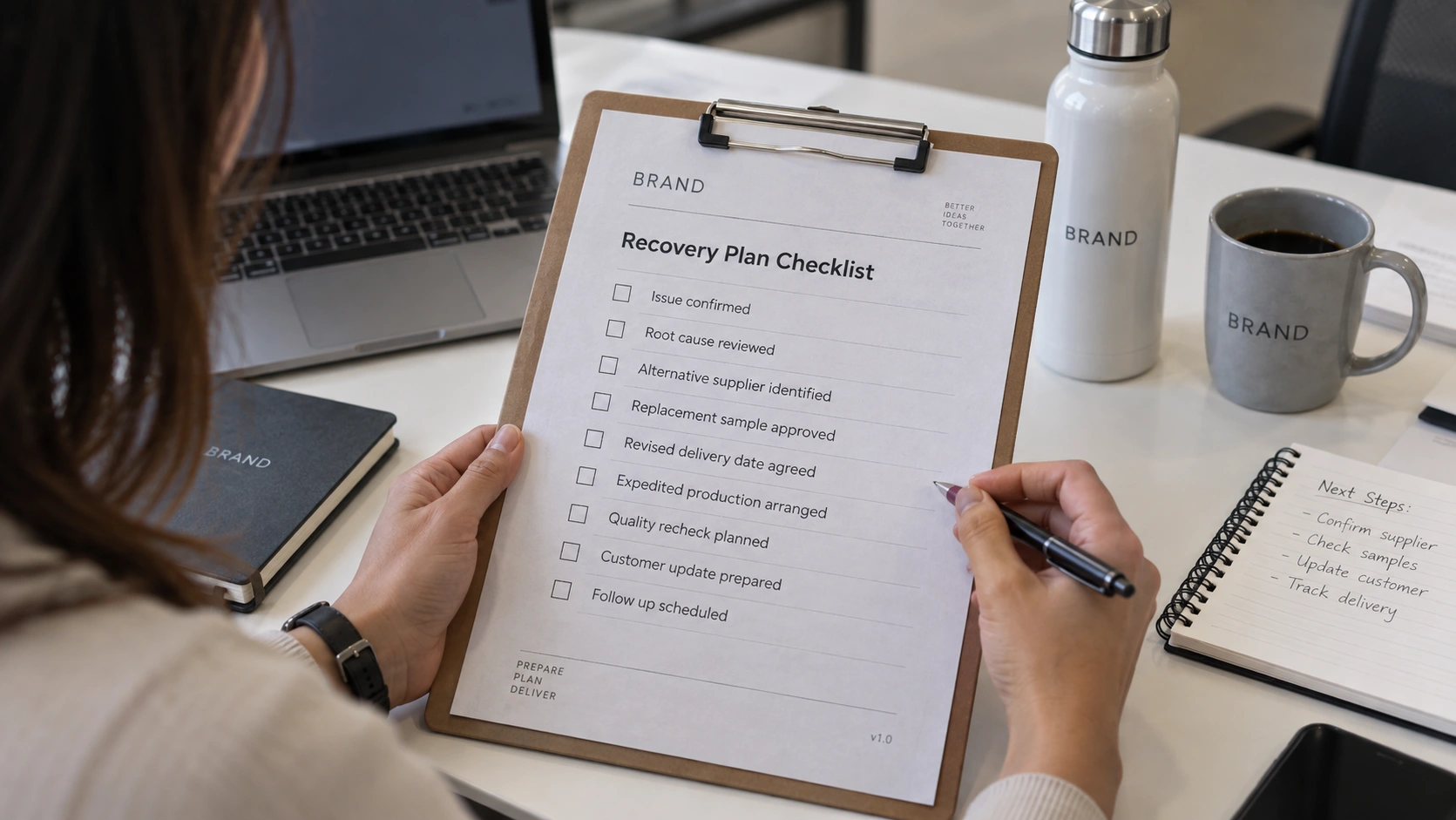
| Recovery plan | Written process for late shipment, misprint, or failed QC | Contract clause, quality agreement, or documented escalation path | No written remedy; verbal reassurance only |
Examples of relevant compliance evidence may include a Children’s Product Certificate (CPC) or General Certificate of Conformity (GCC) where applicable, relevant laboratory test reports, conformity documentation, labeling information, or a Proposition 65 exposure assessment or warning review. Required documents vary by product, intended use, age grade, and destination market — they are not universal certificates that apply to every promotional item.
What a Compliance Document Review Should Confirm
- Product identity and exact model or SKU
- Materials and colors covered by the document
- Applicable standard or regulation cited
- Test date and report number
- Testing laboratory details
- Destination market the document supports
- Responsible certificate holder
Add Total Landed Cost to the Comparison
Looking beyond unit price does not mean ignoring price. Review total landed cost separately from the six risk criteria above. Compare unit price together with tooling, sampling, packaging, inspection, freight, duties, possible rework, and other confirmed project costs before making a final decision.
Market Scope and Compliance Disclaimer
This guide focuses on procurement practices for US and UK markets. Requirements referenced in this article, including CPSIA, a CPC, a GCC, Proposition 65, UKCA, and CE, are not requirements for every promotional product. They depend on the product category, intended use, age grade, destination market, and sales channel.
Product testing, certification, labeling, and warning requirements must be confirmed for the selected product, intended use, users, destination market, and sales channel. This guide provides general procurement information and is not legal or compliance advice.
A Step-by-Step Supplier Due Diligence Process
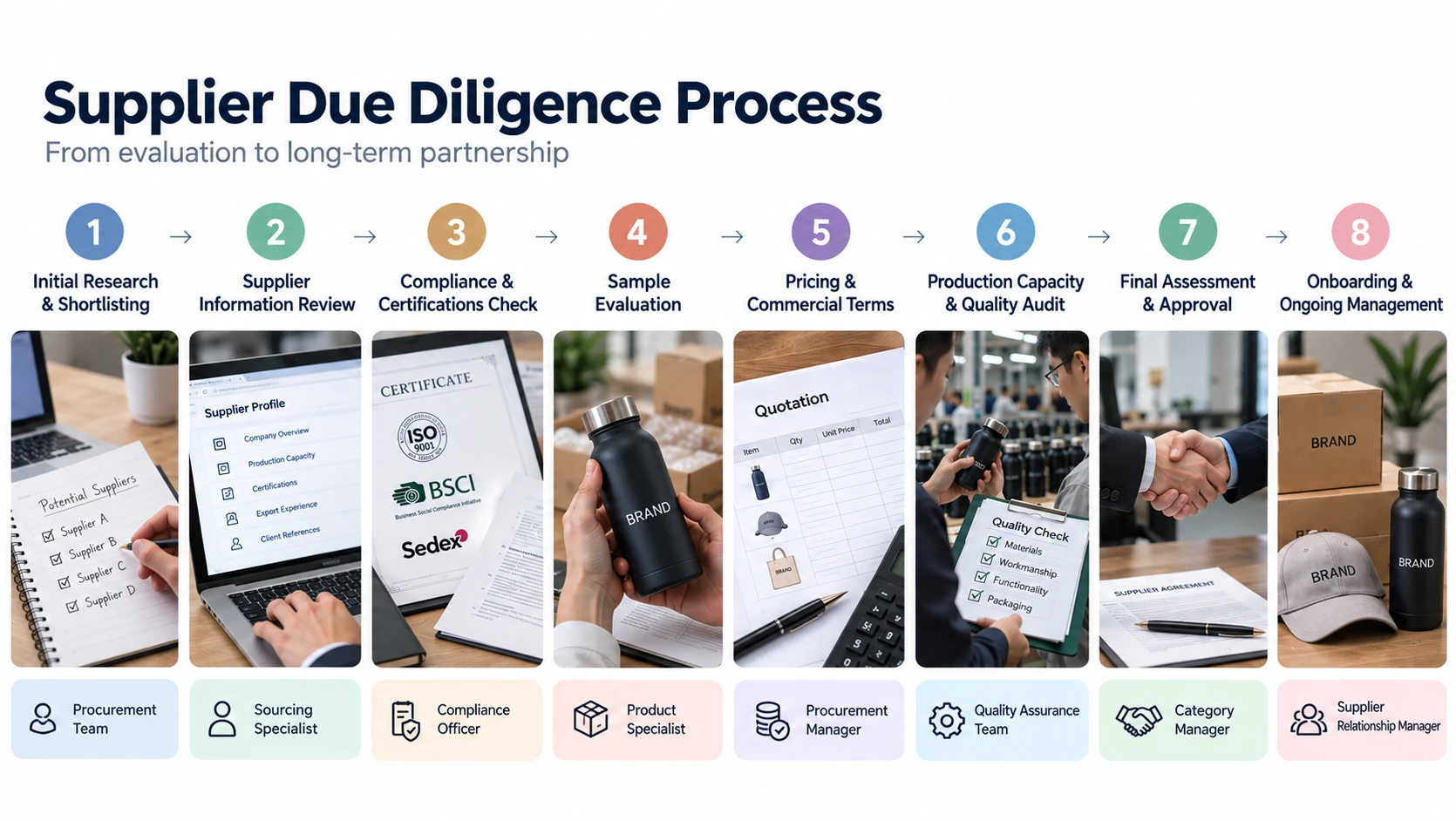
The process below gives procurement teams a repeatable sequence for comparing shortlisted suppliers. Assign a clear process owner — typically the procurement manager running the sourcing decision — before starting.
- Define the mandatory product specifications, branding requirements, quality tolerances, compliance needs, budget, destination market, and required delivery date before contacting suppliers.
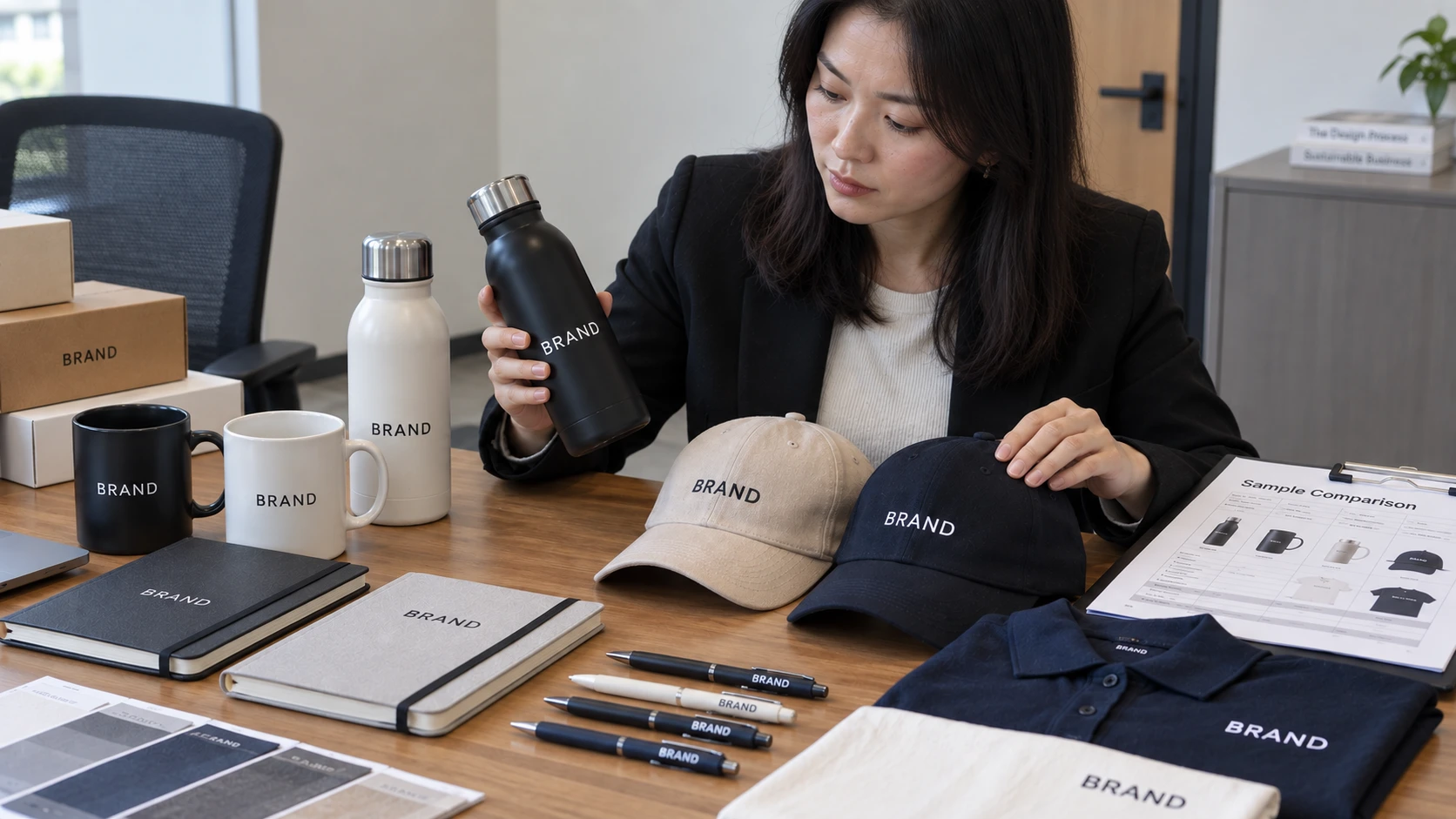
- Request appropriate evidence from each shortlisted supplier. Clearly distinguish between a digital mockup, stock sample, custom physical sample, and pre-production proof (see terminology below).
- Score each supplier against the same criteria and retain the supporting emails, proofs, reports, and written statements as your evidence record.
- Review every applicable compliance document against the exact product, SKU, material, color, age grade, intended use, destination market, standard, test date, laboratory, and certificate holder.
- Confirm production capacity and the proposed production schedule in writing, including any subcontracted processes where relevant.
- Agree on change-control and recovery procedures before order confirmation. Contract remedies should be reviewed by the buyer’s procurement or legal team.
- Use a smaller pilot run when it is commercially and technically suitable for the project. There is no universal percentage that fits every order.
- Record the supplier decision and review performance again at reorder, when specifications change, when the factory changes, or according to company policy.
Proof and Sample Terminology
These terms are used throughout this guide and are often used loosely by suppliers. Confirm which one you are actually receiving before scoring proofing accuracy.
| Term | Meaning |
| Digital mockup | A visual layout showing approximate branding position, scale, and appearance. It does not prove material, color, function, or production quality. |
| Stock sample | An existing standard sample used to review general material, size, construction, or function. It may not include the buyer’s branding. |
| Custom sample | A physical sample made with the buyer’s selected design or specifications for evaluation before bulk production. |
| Pre-production proof | The approved reference made before bulk production. The approval scope and any permitted production tolerances should be recorded. |
Illustrative Supplier Comparison
The example below is an illustrative supplier-evaluation scenario created to show how the scorecard can be used in practice. Replace the sample figures with verified project records before presenting this as a real case study.
A procurement team compares three shortlisted suppliers for a branded merchandise order. Supplier A quotes the lowest unit price, Supplier B quotes a mid-range price, and Supplier C quotes the highest price. The team requests proofs and applies the scorecard before making a decision.
| Supplier | Evidence type received | Proofing outcome | Written recovery clause |
| Supplier A (lowest quoted price) | Digital mockup, followed by a custom physical sample | Sample did not match the approved artwork on the first submission; a corrected sample was approved after revision | Not included in the standard contract terms |
| Supplier B (mid-range price) | Custom physical sample | Sample matched the approved artwork on first submission | Included, with a defined reproduction timeline |
| Supplier C (highest quoted price) | Pre-production proof | Proof matched the approved artwork on first submission | Included, with a defined reproduction timeline |
In this illustrative scenario, Supplier B and Supplier C both scored higher than Supplier A on proofing accuracy once the evidence was reviewed against the scorecard. A written recovery plan reduced delivery risk and became an important factor in the final supplier decision, alongside total landed cost.
Risks and Limitations of This Evaluation Process
- A scorecard supports a purchasing decision but does not guarantee future supplier performance.
- Self-reported capacity, testing, traceability, and recovery information should be independently checked where the project risk justifies it.
- Applicable requirements can change when the product, material, age grade, use, destination market, factory, or sales channel changes.
- Contract clauses and remedies should be reviewed by qualified procurement or legal personnel.
- The example comparison in this guide is illustrative; individual supplier results will vary by category, season, and project.
- This process assumes a shortlist of two to four suppliers is already available; it does not cover supplier sourcing or discovery.
Recovery Plan Checklist: What to Discuss in Writing
Use this checklist to identify points that may need to be documented in the quotation, purchase order, quality agreement, or contract. Final terms should be reviewed according to the buyer’s purchasing policy and applicable law.
| Recovery item | Ask for in writing | Why it matters |
| Late shipment remedy | Defined credit or freight-upgrade trigger point | Removes ambiguity on when a delay becomes a breach |
| Failed QC or misprint | Reproduction timeline and process | Sets a measurable recovery expectation |
| Material substitution | Written notice requirement before any substitution | Prevents undisclosed changes to fabric, plastic grade, or finish |
| Escalation contact | Named account owner, not a shared inbox | Cuts response time during an active problem |
| Force majeure and exceptional events | Covered events, notice duties, mitigation steps, revised schedule, and commercial consequences | Clarifies how both parties will respond when an exceptional event affects production or delivery |
Frequently Asked Questions
How many suppliers should we compare?
Two to four suppliers can be a practical starting range for many projects, but the appropriate number depends on the product, project value, purchasing policy, available suppliers, and evaluation resources. The same requirements and evidence standards should be applied to every shortlisted supplier.
Should we request a digital mockup or a physical sample?
A digital mockup can help confirm layout and approximate branding position, but it does not verify material, color, construction, function, or production quality. A physical custom sample or pre-production proof provides stronger evidence when these factors are important to the purchasing decision.
What should we do if two suppliers receive the same score?
Review the mandatory pass-or-fail requirements first, then apply project-specific weighting. A time-sensitive order may give more weight to production planning and recovery procedures, while a regulated or safety-sensitive product may require stronger testing, traceability, and documentation.
How often should an approved supplier be reviewed?
Review frequency should follow the buyer’s purchasing policy and project risk. Re-evaluation may be appropriate when the product category, material, factory, production process, destination market, order value, or compliance requirements change, or when previous performance raises concerns.
Does a lower proofing score automatically disqualify a supplier?
Not always. The decision depends on the type of error, project risk, corrective action, and whether mandatory requirements have been met. Unresolved compliance, safety, intellectual-property, or specification failures should not be averaged out by stronger scores in less critical areas.
Sources and Further Guidance
US Consumer Product Safety Commission — Children’s Product Certificate
California OEHHA — Proposition 65 Frequently Asked Questions for Businesses
UK Government — Placing Manufactured Products on the Market in Great Britain
Google Search Central — Creating Helpful, Reliable, People-First Content
Author & Reviewer
Written by Claire Morgan, Senior Content Writer, with professional experience sourcing branded merchandise and apparel for mid-market and enterprise programs.
Freshness & Update Log
- Published: September 12, 2026
- Last reviewed / Date Modified: September 12, 2026
- Next scheduled compliance check: within 12 months, or sooner if referenced regulatory guidance changes.
Ready to Apply This Scorecard?
If you are comparing suppliers for an upcoming project, share your product specifications, quantity, branding, packaging, destination, and required delivery date. Our team can help review product options, samples, quality requirements, production risks, and quotation details.
Related Resources
- /promotional-product-sourcing/ — overview of our promotional product sourcing service.
- /supplier-onboarding-guide/ — how new suppliers are onboarded and audited after selection.
- /promotional-product-compliance/ — category-specific compliance requirements and documentation.
- /quality-control-process/ — how proofing and QC are run once a supplier is approved.